A comma separates parts of a sentence, while a semicolon links closely related ideas.
Many people search “semicolon or comma” because both marks look similar but work in different ways.
This confusion often happens in essays, emails, and exams. Users search “semicolon vs comma rules,” “when to use semicolon,” and “comma or semicolon examples.”
Choosing the wrong one can change meaning or make writing unclear. This guide explains both punctuation marks in simple words.
It shows rules, examples, common mistakes, and usage trends. It helps you write clear sentences and use punctuation with confidence.
⚡ Semicolon or Comma: Quick Answer
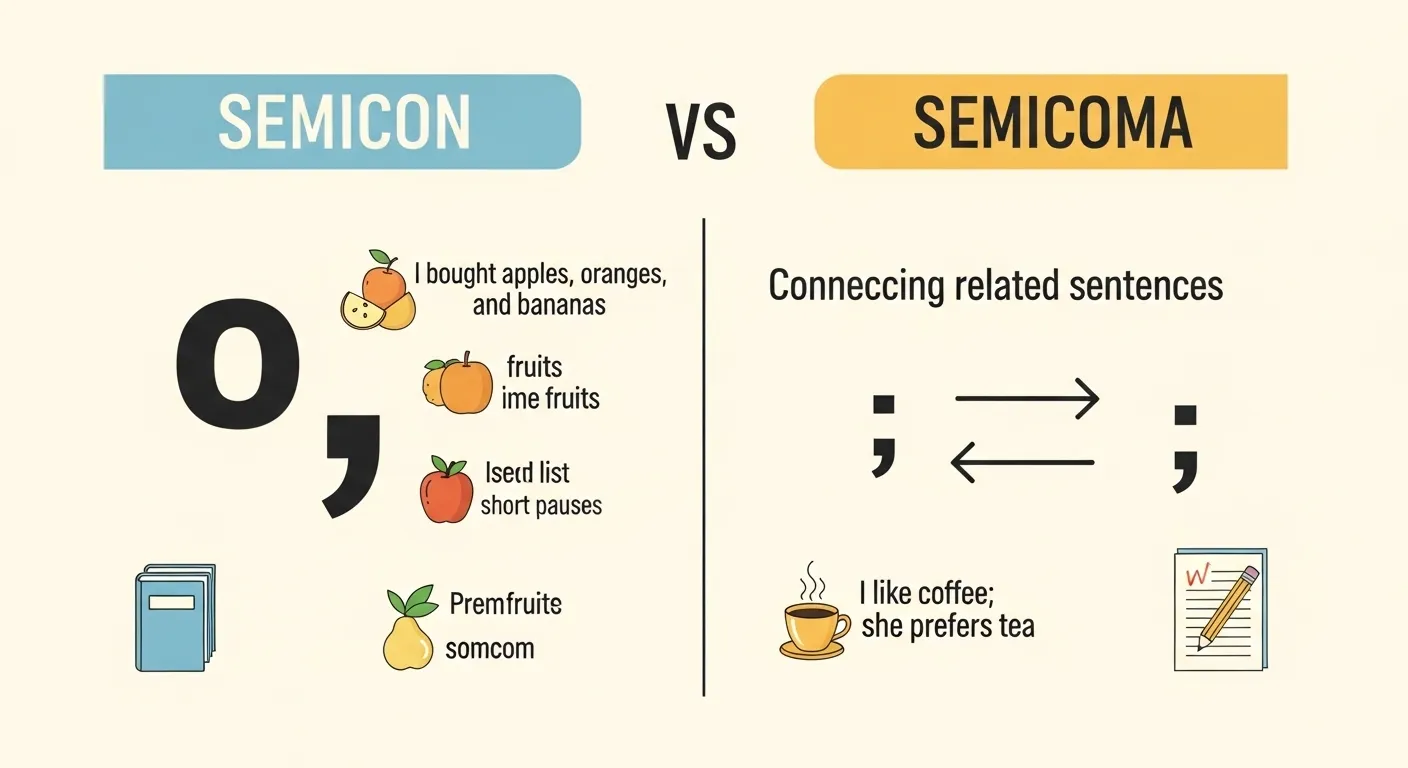
Comma = small pause. Semicolon = stronger link between sentences.
- Comma (,) → separates words or clauses
- Semicolon (;) → connects two related sentences
Simple Examples
- “I bought apples, oranges, and bananas.” → Comma
- “I like coffee; she prefers tea.” → Semicolon
Quick Comparison Table
| Feature | Comma | Semicolon |
| Symbol | , | ; |
| Use | Short pause | Strong link |
| Joins sentences | No | Yes |
| Lists | Yes | Complex lists |
Simple idea:
- Comma = break
- Semicolon = connection
📘 Definition of Semicolon or Comma
What Is a Comma? ➕
A comma is a punctuation mark. It creates a short pause.
It is used to:
- Separate items in a list
- Separate clauses
- Add clarity
Example:
“She bought apples, mangoes, and grapes.”
What Is a Semicolon? ➖
A semicolon connects two related sentences. It shows a stronger link than a comma.
Example:
“He was tired; he still finished his work.”
A semicolon can replace:
- A full stop
- A conjunction like “and” or “but”
🌍 The Origin of Semicolon or Comma
Origin of Comma
The comma comes from Greek writing.
It meant a short cut or pause.
Writers used it to help reading flow.
Origin of Semicolon
The semicolon was introduced in the 15th century.
It helped connect ideas more clearly.
Writers needed a mark stronger than a comma.
🇺🇸🇬🇧 British English vs 🇺🇸 American English Spelling
There is no spelling difference.
Rules are mostly the same.
Table
| Mark | American | British |
| Comma | Same | Same |
| Semicolon | Same | Same |
Usage style may vary slightly, but rules are similar.
🎯 Which Version Should You Use?
Choose based on sentence structure.
Use Comma When
- Writing lists
- Adding small pauses
- Joining clauses with conjunctions
Example:
“I was tired, but I kept working.”
Use Semicolon When
- Joining two full sentences
- Showing strong connection
- Writing complex lists
Example:
“I was tired; I kept working.”
Quick Guide
| Situation | Correct Choice |
| List of items | Comma |
| Two sentences | Semicolon |
| Short pause | Comma |
| Strong link | Semicolon |
⚠️ Common Mistakes with Semicolon or Comma
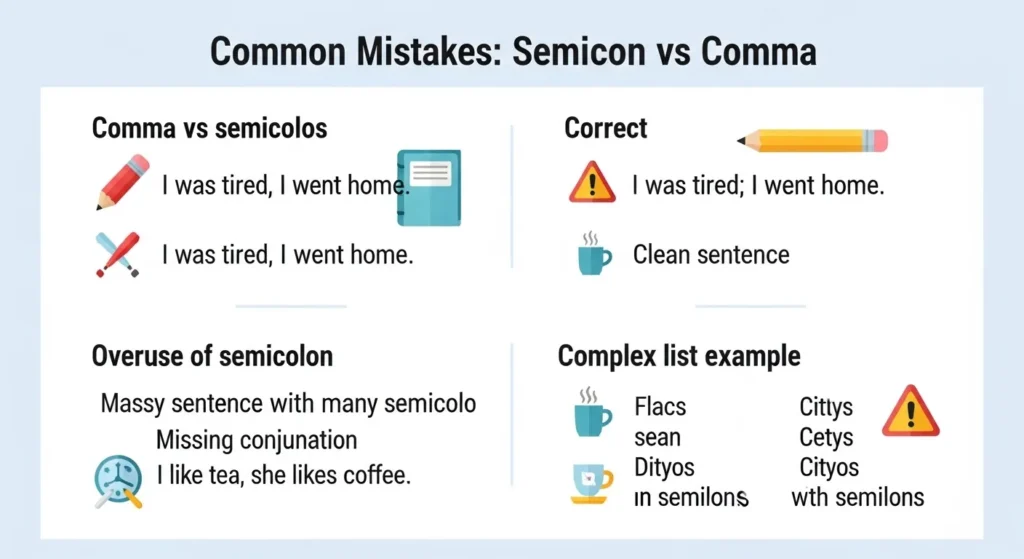
Mistake 1 : Using Comma Instead of Semicolon
❌ “I was tired, I went home.”
✔ “I was tired; I went home.”
Mistake 2 : Overusing Semicolons
❌ Using semicolon everywhere
✔ Use only for related sentences
Mistake 3 : Missing Conjunction
❌ “I like tea, she likes coffee.”
✔ “I like tea; she likes coffee.”
✔ “I like tea, and she likes coffee.”
Mistake 4 : Wrong Use in Lists
Use semicolons in complex lists:
✔ “I visited Paris, France; Rome, Italy; and Berlin, Germany.”
💬 Semicolon or Comma in Everyday Examples
“I completed the report, and I sent it.”
News
“The event ended early; many people left.”
Social Media
“Busy day, but feeling good.”
Formal Writing
“The study was long; the results were important.”
📊 Semicolon or Comma: Google Trends & Usage Data
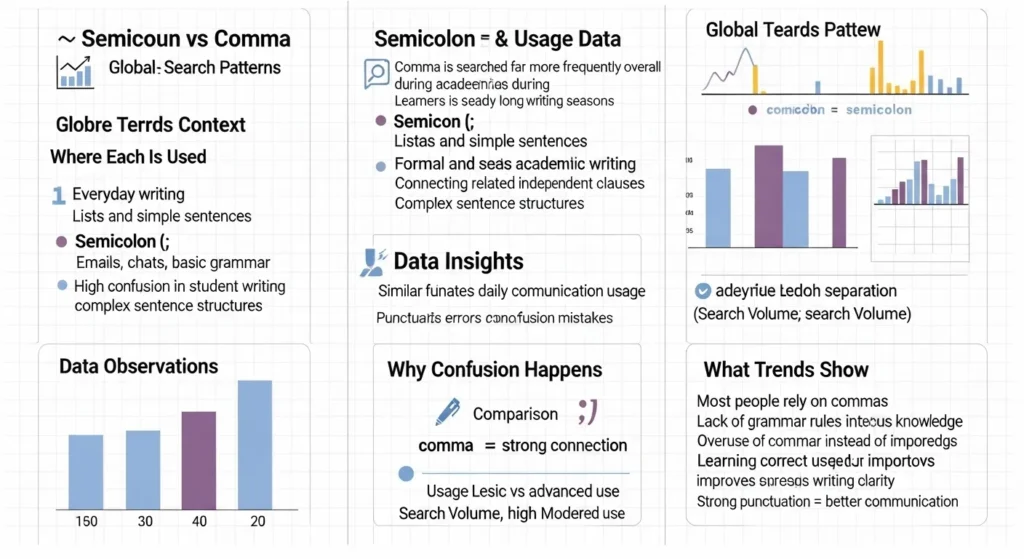
Many students search this topic.
Trending Search Queries
- semicolon vs comma
- when to use semicolon
- comma rules
- semicolon examples
- comma vs semicolon worksheet
- punctuation rules semicolon
Countries
| Country | Interest |
| USA | Very High |
| UK | High |
| Canada | High |
| Australia | High |
Students and writers search this often.
📊 Keyword Variation Table
| Search Query | Meaning |
| semicolon vs comma | Comparison |
| comma rules | Usage |
| semicolon examples | Learning |
| punctuation guide | General rules |
| semicolon in lists | Advanced use |
❓ FAQs
1. What is the main difference?
Comma creates a pause. Semicolon connects sentences.
2. Can a semicolon replace a comma?
Yes, but only between two full sentences.
3. When should I use a comma?
Use it in lists and short pauses.
4. Can I use semicolon in lists?
Yes, for complex lists.
5. Is semicolon formal?
Yes. It is common in formal writing.
6. Can I avoid semicolons?
Yes. You can use full stops instead.
7. Why do people confuse them?
Both are small marks, but their use is different.
🏁 Conclusion
The topic semicolon or comma is important for clear writing. Many people confuse these punctuation marks because they look similar and both create pauses in sentences. However, their functions are different.
A comma is used for short pauses, lists, and joining clauses with conjunctions. It is simple and very common in everyday writing.
A semicolon is stronger. It connects two complete sentences that are closely related. It is often used in formal writing and complex sentence structures.
Understanding this difference helps improve writing skills. It also helps avoid common grammar mistakes. If you remember one simple rule, it becomes easy. Use a comma for small breaks.
Use a semicolon for strong connections between ideas. With practice, choosing the right punctuation becomes natural.
Clear punctuation leads to clear communication, which is important in school, work, and daily life.
Discover More Articals!
Which Is Better: Zyrtec or Benadryl?
Liason vs Liaison: What Is the Difference?
Claritin or Allegra: Which One Is Best for Your Allergy Relief?

thinkaora.com is my English grammar comparison website where I simplify confusing words, spelling differences, and usage rules through clear explanations and examples. My goal is to help learners, writers, and students understand English easily and use correct grammar with confidence.