
“Who” is used for people, while “whose” shows possession or ownership.
Many learners mix these two words because they sound alike and appear in similar sentences. Writers often pause and ask which one fits better.
This confusion happens in emails, social media posts, school work, and professional writing. Clear understanding helps avoid grammar mistakes and makes writing sound natural and correct.
People search this topic to improve accuracy and confidence when writing English. This guide explains the difference in simple terms.
You will learn meanings and usage patterns around the world so you can choose the right word every time without hesitation.
Who or Whose: Quick Answer
The difference is simple:
- Who refers to a person or asks about identity.
- Whose shows ownership or possession.
Basic Examples
| Word | Meaning | Example |
| Who | Refers to a person | Who is calling? |
| Who | Subject of a sentence | The teacher who helped me is kind. |
| Whose | Shows ownership | Whose book is this? |
| Whose | Possessive form | The girl whose car broke down called for help. |
Simple Rule
- Use who when you talk about a person or ask about someone.
- Use whose when something belongs to someone.
More Examples
- Who wrote this message?
- Who is at the door?
- Whose phone is ringing?
- I met a writer whose stories inspire many readers.
Keep sentences short. Think about ownership. If you can replace it with “his,” “her,” or “their,” choose whose.
Difference Between Who and Whose Explained Clearly 🔍
Many English learners search for the difference between who and whose because the words sound similar but perform different grammar functions.
The easiest way to understand who vs whose is to focus on meaning.
👉 Use who when talking about a person.
👉 Use whose when showing ownership or possession.
Examples:
✔ “Who called you last night?”
✔ “Whose jacket is on the chair?”
In grammar, who works as a subject pronoun, while whose acts as a possessive determiner or possessive pronoun.
Another common confusion appears in relative clauses:
✔ “The teacher who explained the lesson was helpful.”
✔ “The student whose laptop stopped working missed the class.”
A simple memory trick is helpful:
👉 who = person
👉 whose = ownership
Once you connect whose with possession, choosing the correct word becomes much easier in everyday writing and conversation.
The Origin of Who or Whose
The words “who” and “whose” come from Old English. The older form of “who” was “hwa.” It referred to people and asked questions about identity. Over time, the spelling changed to “who,” but the meaning stayed the same.
“Whose” developed as the possessive form. English needed a way to show ownership linked to a person.
Instead of adding an apostrophe, the language created a separate possessive word. This structure is similar to pronoun pairs like:
- he → his
- she → her
- who → whose
The spelling difference exists because English pronouns evolved differently from nouns. Nouns often add apostrophes to show possession, but pronouns usually change form instead.
Historical changes in pronunciation also influenced spelling. Silent letters and vowel shifts shaped the modern forms we use today.
Understanding this history helps learners remember that “whose” is not a contraction. It is simply the possessive version of “who.”
British English vs American English Spelling
Unlike many English word pairs, “who” and “whose” do not change spelling between regions. Both British and American English use the same forms and meanings.
However, usage style can vary slightly. British writing sometimes uses more formal sentence structures, while American writing may prefer shorter and more direct phrasing.
Comparison Table
| Feature | British English | American English |
| Who spelling | who | who |
| Whose spelling | whose | whose |
| Meaning | Same meaning | Same meaning |
| Formal usage | Often slightly formal | Often concise |
| Everyday use | Very common | Very common |
Examples
British style example:
- The man whose house stands near the river is famous.
American style example:
- Who is coming to the meeting today?
The core rule remains identical across English varieties.
Which Spelling Should You Use?
Choosing between “who” and “whose” depends on meaning, not location.
If your audience is in the United States
Use:
- Who for subjects or questions about people.
- Whose for possession.
American readers expect clear, simple sentences. Avoid long or complex structures when possible.
If your audience is in the UK or Commonwealth countries
The same rule applies. British readers also follow traditional grammar patterns. Formal writing may include more relative clauses.
Example:
- The author whose work gained recognition spoke at the event.
Global Audience Advice
When writing for international readers:
- Keep sentences short.
- Avoid complex grammar.
- Use clear ownership signals.
Always ask:
- Am I referring to a person? → Use who.
- Am I showing ownership? → Use whose.
Common Mistakes with Who or Whose
Many writers confuse these words due to pronunciation similarity.
Mistake 1: Using “who” instead of “whose”
❌ Who book is this?
✅ Whose book is this?
Mistake 2: Adding an apostrophe
❌ Who’s book is this?
Explanation: “Who’s” means “who is” or “who has.”
Correct version:
✅ Whose book is this?
Mistake 3: Overthinking grammar
Some learners try complex rules. The simple ownership rule works best.
Mistake 4: Avoiding “whose” with objects
Many believe “whose” must refer only to people. In modern English, it can refer to things.
Example:
- A company whose policies changed recently gained attention.
Mistake 5: Mixing with similar-sounding forms
People confuse:
- who’s (who is)
- whose (possessive)
Quick tip:
Replace with “his” or “her.” If it fits, choose whose.
How Do You Spell “Whose” Correctly? ✍️
Many people become confused about whose spelling because the word sounds almost identical to “who’s.”
The correct spelling for the possessive form is:
✔ whose
Examples:
✔ “Whose phone is ringing?”
✔ “Whose idea was this project?”
A very common mistake is writing “who’s” instead of “whose.”
Remember:
👉 who’s = who is or who has
👉 whose = shows ownership
Examples:
✔ “Who’s coming to dinner?” = Who is coming to dinner?
✔ “Whose bag is on the table?” = ownership
If you can replace the word with “who is,” then use who’s. If the sentence talks about possession, use whose.
This small spelling difference changes the entire meaning of a sentence, so checking context carefully is important.
Who or Whose in Everyday Examples
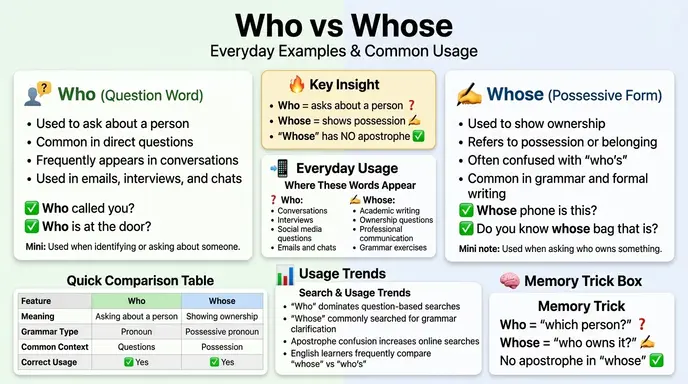
Understanding real-life usage helps build confidence.
Emails
- Who will attend the meeting tomorrow?
- Whose report should I review first?
News Writing
- The athlete who won the race broke a record.
- The company whose profits increased announced expansion.
Social Media
- Who wants coffee?
- Whose idea was this challenge?
Formal Writing
- The scientist whose research changed medicine received an award.
- Who is responsible for the project outcome?
Academic Writing
- Researchers who study language patterns analyze data carefully.
- A system whose design improves efficiency attracts attention.
Short sentences improve clarity. Avoid long chains of clauses.
Who or Whose: Google Trends & Usage Data
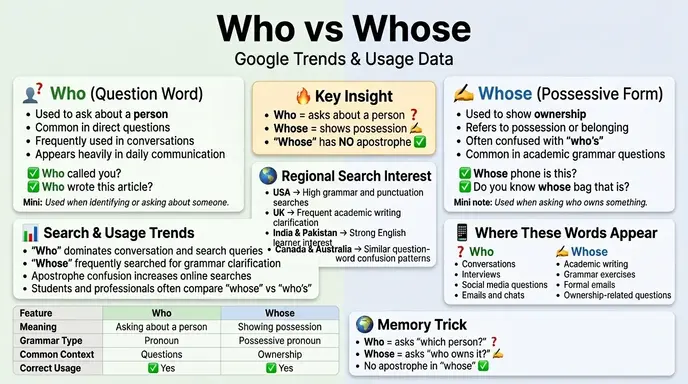
Search data shows steady interest in grammar questions about “who” and “whose.” Many learners seek quick clarification because the difference affects daily communication.
Popular Regions
- India
- Pakistan
- Philippines
- United States
- United Kingdom
These regions include many English learners and writers who use English professionally.
Contexts Driving Searches
- Academic writing
- Workplace communication
- Exams and grammar learning
- Online content creation
- Language learning apps
People often search this topic when writing essays or preparing for tests. Content creators also check usage to maintain credibility.
Trends Over Time
Interest stays consistent year after year. This shows that confusion remains common even among advanced learners.
Using “Whose” in Questions and Everyday English 💬
The word whose is extremely common in questions because English speakers often ask about ownership in daily conversation.
Examples:
✔ “Whose keys are these?”
✔ “Whose turn is it next?”
✔ “Whose shoes are by the door?”
Some learners also search phrases like “whose are they” because they are unsure how possessive questions work in English.
Correct examples include:
✔ “Whose books are they?”
✔ “Whose documents were left here?”
In casual and professional English, whose helps make questions shorter, clearer, and more natural.
Compare these sentences:
❌ “The bag belongs to who?”
✔ “Whose bag is this?”
The second version sounds more natural and grammatically correct.
Using whose correctly improves fluency and helps writing sound polished in emails, conversations, academic work, and business communication.
Comparison Table: Keyword Variations Side by Side
| Form | Function | Example Sentence | Key Tip |
| Who | Subject pronoun | Who called you? | Refers to person |
| Who | Relative pronoun | The man who spoke is kind. | Connects clause |
| Whose | Possessive determiner | Whose bag is this? | Shows ownership |
| Whose | Relative possessive | The author whose book sold well smiled. | Ownership link |
FAQs
1. What is the main difference between who and whose?
“Who” refers to a person or asks about identity. “Whose” shows ownership or possession.
2. Can “whose” refer to things?
Yes. Modern English allows “whose” for objects or organizations.
Example:
- A system whose features help users.
3. Is “who’s” the same as “whose”?
No. “Who’s” means “who is” or “who has.” “Whose” shows possession.
4. How can I remember the difference easily?
Think of ownership. If you can replace the word with “his,” “her,” or “their,” use “whose.”
5. Do British and American English use different forms?
No. Both use the same spelling and meaning.
6. Can I start a question with “whose”?
Yes.
Example:
- Whose turn is next?
7. Is it wrong to avoid “whose” in formal writing?
Avoiding it can make sentences longer. Using “whose” keeps writing natural and clear.
Conclusion
Understanding the difference between “who” and “whose” improves clarity and confidence in writing. The rule is simple. “Who” refers to people or asks about identity. “Whose” shows possession.
Despite sounding similar, their functions are very different. Many writers make mistakes because they rely on sound instead of meaning. Focus on ownership to choose correctly.
If the sentence needs a possessive idea, select “whose.” If you are asking about a person or linking information about someone, choose “who.”
Both words follow the same rules across English varieties, so you do not need to adjust spelling for different regions. Practice with short sentences and everyday examples to build habit and accuracy.
Over time, recognizing the correct form becomes natural. Clear grammar helps readers understand your message quickly.
Strong word choice also increases trust and professionalism in communication. Mastering this small distinction can make a big difference in both casual and formal writing.
Related More Posts!
Visiter or Visitor: Which One Is Correct?With In 30 Seconds
Sympathy or Empathy: What’s the Difference?With In 30 Minutes
Between or Among: What’s the Difference?

I am Sophia Martinez.I am an ESL grammar coach. I specialize in teaching English to non native speakers. My content focuses on commonly confused words like affect vs effect, their vs there, and verb tense comparisons. Sophia writes in a friendly, supportive tone designed to build confidence in learners.