Between is used for specific or separate items. Among is used for groups or collective situations. Many writers confuse these words because both show relationships or connections.
The mistake often happens in academic writing, emails, and daily conversations. Using the wrong word can make sentences unclear.
Students, bloggers, and professionals search for this topic to improve grammar accuracy and confidence.
This guide explains the difference,common mistakes, and practical advice. By the end, you will know exactly when to choose between or among in any situation.
Between or Among: Quick Answer
- Between → Used for two or more distinct items treated individually.
- Among → Used for groups where members are not separated individually.
Examples:
- “The agreement is between two companies.”
- “She felt comfortable among friends.”
Simple rule:
- Individual relationships → between.
- Group or collective setting → among.
The Origin of Between or Among
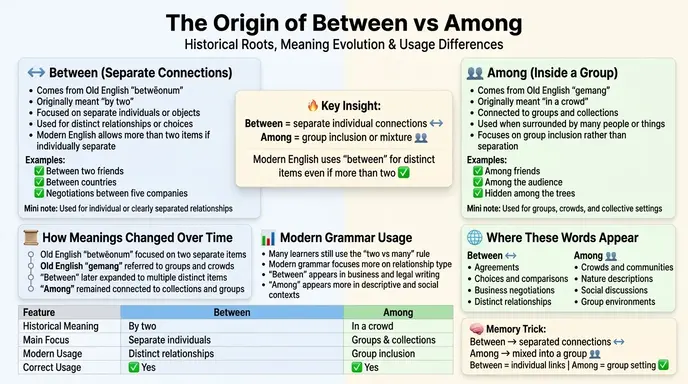
Both words come from Old English.
- Between comes from betweonum, meaning “by two” or “separating.”
- Among comes from on gemang, meaning “in a crowd” or “mixed together.”
Historically:
- Between focused on separation or clear distinction.
- Among described being inside a group or surrounded by many.
Over time, grammar rules developed:
- Between expanded to include more than two items when they are distinct.
- Among stayed linked to collective groups.
This history explains why many modern grammar guides accept “between” with more than two items when relationships are individual.
British English vs American English Usage
Both British and American English follow the same rules for these words. The difference is not about spelling but about usage style.
| Feature | British English | American English |
| Between | Same meaning | Same meaning |
| Among | Same meaning | Same meaning |
| Grammar Rule | Individual relationships | Same rule |
| Common Examples | “between three people” accepted | Same usage accepted |
Example:
- British: “The treaty between three nations.”
- American: “The treaty between three nations.”
Modern grammar allows “between” for more than two if relationships are clear and separate.
Which Word Should You Use?
Choose based on context.
Use between when:
- Comparing separate items.
- Showing individual relationships.
- Listing specific choices.
- Describing differences.
Examples:
- Choose between tea and coffee.
- Negotiations between five countries.
Use among when:
- Talking about groups or crowds.
- Describing shared feelings or actions.
- Referring to collective situations.
Examples:
- She walked among the trees.
- Trust among team members grew.
Quick decision tip:
- Are items separate? Use between.
- Is it a group together? Use among.
Common Mistakes with Between or Among
- Thinking between only works for two items.
- Correct: “The deal between three partners.”
- Correct: “The deal between three partners.”
- Using among when relationships are separate.
- Incorrect: “Choice among tea and coffee.”
- Correct: “Choice between tea and coffee.”
- Incorrect: “Choice among tea and coffee.”
- Overthinking rules. Modern usage is flexible.
- Mixing both words incorrectly in one sentence.
- Using among for comparisons.
Correct Examples:
- “Divide the money between the three children.”
- “He stood among strangers.”
Between or Among in Everyday Examples
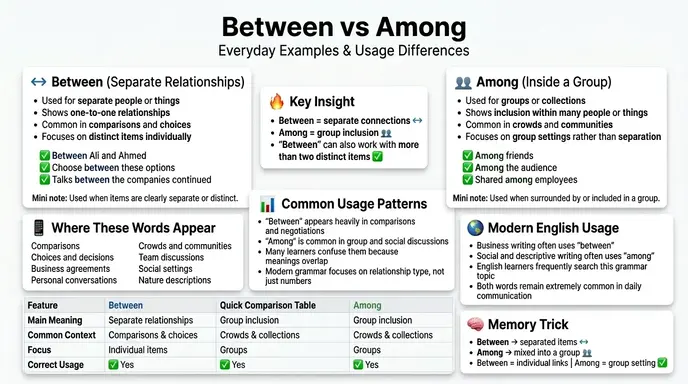
Emails:
- “The discussion between managers was productive.”
- “There is strong collaboration among employees.”
News writing:
- “Talks between nations continue.”
- “Unity among citizens increased.”
Social media:
- “Competition between brands is intense.”
- “Joy spread among fans after the victory.”
Formal writing:
- Use between for precise relationships.
- Use among for general group interaction.
Between or Among: Google Trends & Usage Data
Search interest shows that:
- Many learners search “between vs among” due to confusion about numbers.
- Educational websites explain the rule using individual vs group context.
- Usage questions increase during academic seasons.
Usage patterns:
- Academic writing often uses between for clear comparisons.
- Narrative writing often uses among to describe environment or setting.
Key insight:
Understanding context matters more than counting items.
Comparison Table: Between vs Among
| Feature | Between | Among |
| Main Use | Individual relationships | Group setting |
| Number of Items | Two or more distinct | Usually many |
| Focus | Separation or comparison | Inclusion or mixture |
| Example | between two friends | among friends |
| Precision Level | Specific | General |
| Common Contexts | Agreements, choices, differences | Crowds, groups, environments |
FAQs About Between or Among
1. Can between be used for more than two things?
Yes. Use between when items are distinct or separate.
2. Is among only for large groups?
Usually yes. It describes being inside a group or collective.
3. Which sounds more formal?
Both are formal. The choice depends on context.
4. Can I say “between three options”?
Yes. This is correct when options are separate.
5. What is easier to remember?
Between = individual items. Among = group setting.
6. Is among used in American English?
Yes. Both words are common in American and British English.
7. What about “amongst”?
Amongst is a traditional form. It sounds more formal or literary.
Conclusion
Understanding the difference between between and among improves clarity in writing. Between focuses on individual relationships or distinct items.
Among describes groups or collective settings. The old rule that between is only for two items is no longer strict. Modern grammar allows between with more than two when relationships are separate.
Writers should focus on context rather than counting numbers. Using the correct word makes sentences easier to understand.
It also improves professional tone. In emails, academic writing, social media posts, and everyday communication, choosing the right word helps readers follow your message quickly.
Remember this simple guide: if items are separate, use between. If items form a group, use among. Practice with real examples. With time, the difference becomes natural and automatic.
Related More Posts
Sympathy or Empathy: What’s the Difference?With In 30 Minutes
Between or Among: What’s the Difference?
Lasagna or Lasagne: Which One Is Correct?

My name is James Whitmore.I am a language research writer. I explore the history and evolution of English words. I write detailed comparisons explaining why spellings change over time and how British and American English diverged. My articles add depth and credibility to grammar comparison topics.