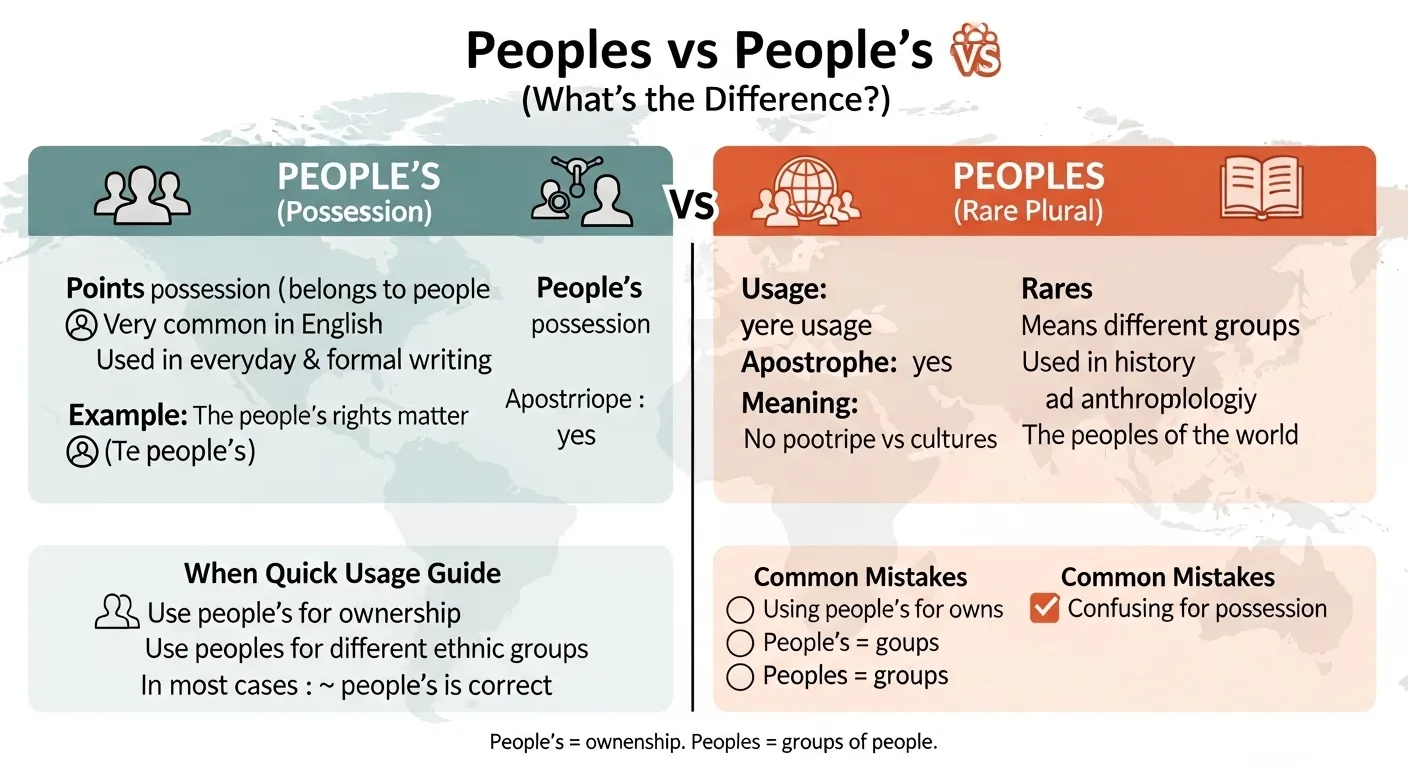
“People’s” shows possession, while “peoples” is a special plural used for different groups or cultures.
Many learners get confused because “people” already sounds plural, so adding -s or an apostrophe feels unclear. This confusion often appears in essays, exams, and everyday writing.
People search “peoples vs people’s” because they are not sure when to use an apostrophe and when to add -s.
The problem is simple: one form shows ownership, and the other has a specific meaning in formal or academic contexts.
Understanding this difference is important because using the wrong form can change your meaning completely.
This guide explains everything in simple words, with clear examples and easy rules. By the end, you will confidently use “peoples” and “people’s” correctly.
Peoples vs People’s: Quick Answer ⚡✅
👉 Peoples = different groups or cultures (rare use)
👉 People’s = something belongs to people (possession)
📌 Examples:
- ✔ The world has many peoples. (different cultures)
- ✔ The people’s voice matters. (possession)
- ✔ The people’s rights are important.
👉 Simple idea:
Peoples = groups
People’s = belonging
Peoples vs People’s: Definitions with Examples & Top Queries 📖✍️
🟢 Peoples (Definition)
“Peoples” means different groups of people, often used in cultural, historical, or academic contexts.
📌 Examples:
- ✔ Indigenous peoples live here.
- ✔ Many peoples have unique traditions.
🔵 People’s (Definition)
“People’s” shows possession, meaning something belongs to people.
📌 Examples:
- ✔ The people’s choice was clear.
- ✔ The people’s leader spoke today.
🔍User Queries:
People often search:
- peoples vs people’s difference
- is peoples correct word
- what does people’s mean
- peoples meaning in English
- people’s vs peoples grammar
- when to use peoples
- apostrophe in people’s
- examples of peoples usage
- plural of people
- common mistakes peoples vs people’s
👉 These show confusion about plural and possessive forms.
The Origin of Peoples vs People’s 📜⏳
The word “people” comes from Latin “populus,” meaning a group or nation.
Over time:
- “People” became plural (meaning many persons)
- “Peoples” developed to describe different nations or ethnic groups
👉 “People’s” follows the normal rule:
- Add ’s to show possession
Peoples vs People’s: British vs American English 🌍🇬🇧🇺🇸
👉 There is no difference between British and American English.
📊 Comparison Table
| Form | British English | American English |
| peoples | ✔ Correct | ✔ Correct |
| people’s | ✔ Correct | ✔ Correct |
👉 Same rules apply globally.
Peoples vs People’s : Which One Should You Use? 🎯📝
✔ Use “Peoples” When:
- Talking about cultures or ethnic groups
- Writing academic or historical content
👉 Example:
- The region has many peoples
✔ Use “People’s” When:
- Showing ownership
- Talking about something belonging to people
👉 Example:
- The people’s decision matters
🧠 Memory Trick:
👉 Peoples = groups
👉 People’s = has apostrophe → belongs
Common Mistakes with Peoples vs People’s ❌⚠️
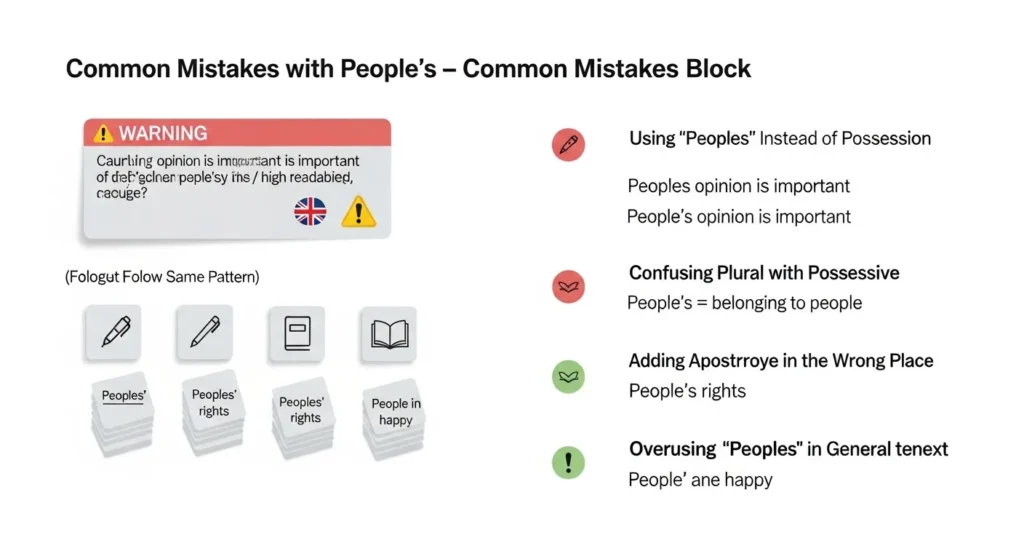
1. Using “peoples” for normal plural
❌ Many peoples are here
✔ Many people are here
2. Forgetting apostrophe
❌ The peoples rights
✔ The people’s rights
3. Confusing meanings
✔ Check context carefully
4. Overusing “peoples”
✔ Use only in special contexts
Peoples vs People’s in Everyday Examples 💬📱
🏠 Daily Life:
- The people’s opinion matters
- Different peoples have traditions
📱 Social Media:
- Respect all peoples 🌍
- The people’s voice is strong
📚 School Writing:
- Indigenous peoples lived here
- The people’s rights are protected
💼 Professional Writing:
- The people’s welfare is important
- Policies affect different peoples
Peoples vs People’s: Usage Trends & Popularity 📊📈
📌 Key Insight:
- “People’s” → very common
- “Peoples” → less common, formal use
📊 Trend:
- Everyday English → “people”
- Academic English → “peoples”
👉 Most learners mainly use “people’s.”
Comparison Table 📋⚖️
| Feature | Peoples | People’s |
| Meaning | Different groups | Possession |
| Usage | Rare / formal | Common |
| Apostrophe | ❌ No | ✔ Yes |
| Context | Cultural / academic | General use |
FAQs ❓💡
1. Is “peoples” correct?
✔ Yes, but limited use
2. What does “people’s” mean?
✔ It shows possession
3. Can peoples mean many people?
❌ No
4. When should I use peoples?
✔ For cultures or groups
5. Easy way to remember?
✔ Apostrophe = belonging
6. Which is more common?
✔ People’s
7. Are both correct?
✔ Yes
Conclusion 🧾📌
The difference between “peoples” and “people’s” is simple once you understand their meanings.
“People’s” is used to show possession, meaning something belongs to people. It is very common in everyday English and appears in sentences about rights, opinions, and ownership.
On the other hand, “peoples” is not just a regular plural. It is a special form used to describe different groups, cultures, or nations.
This form is mostly used in academic, historical, or formal contexts and is less common in daily conversation.
The key is to focus on meaning. If you are talking about ownership, use “people’s.” If you are talking about different cultural or ethnic groups, use “peoples.” Do not use “peoples” as a normal plural of “people.”
Once you understand this distinction, your writing will become clearer and more accurate. With practice, choosing the correct form will feel natural.
Discover More Articals!
IBS or IBD: What’s the Difference?In 30 Seconds
EMT or Paramedic: What Is the Real Difference?
Starter or Alternator: Which Car Part Does What?(2026)

I am Sophia Martinez.I am an ESL grammar coach. I specialize in teaching English to non native speakers. My content focuses on commonly confused words like affect vs effect, their vs there, and verb tense comparisons. Sophia writes in a friendly, supportive tone designed to build confidence in learners.