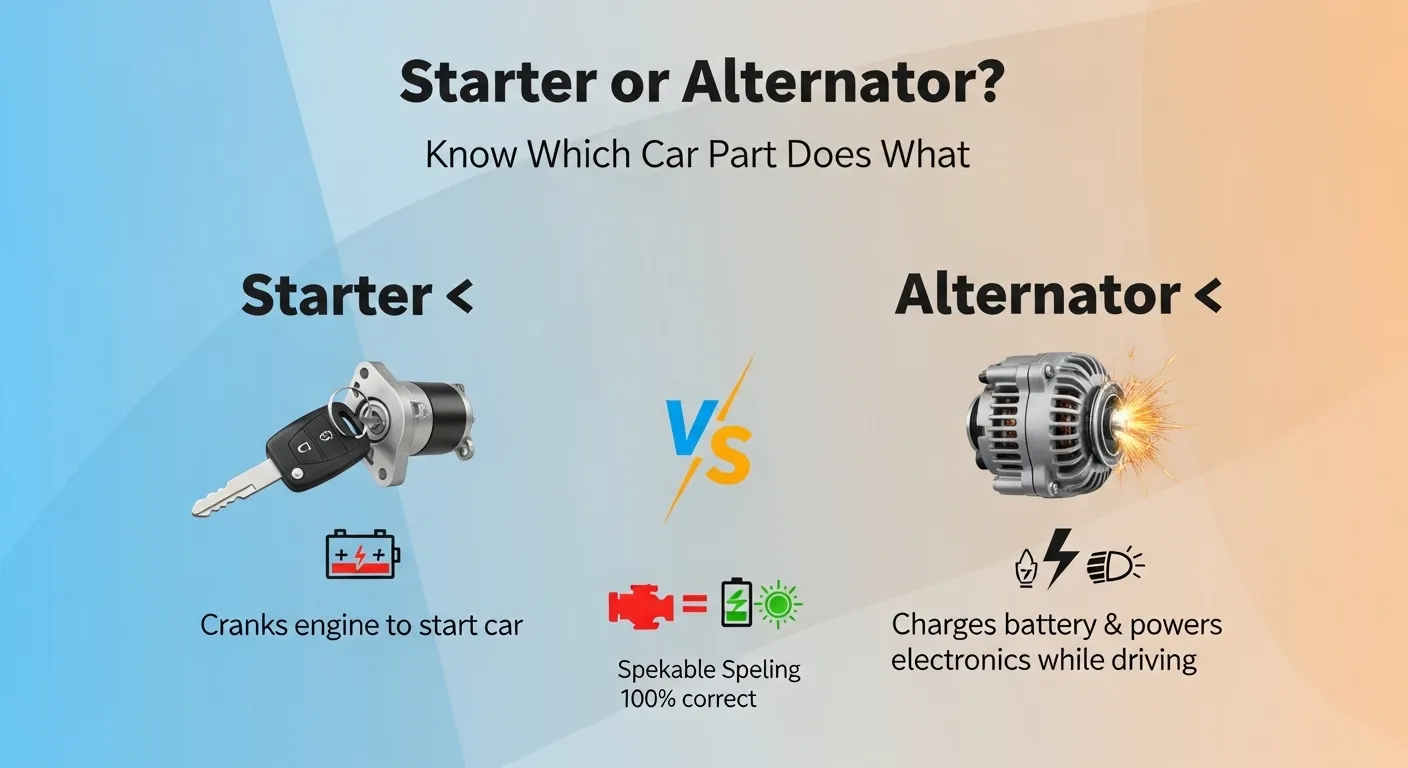
A starter starts the engine, while an alternator charges the battery.
Many people search for “starter or alternator” because both are essential car parts. They both involve electricity and the engine. But their functions are very different.
Confusing them can lead to misunderstandings, incorrect repairs, or wasted money. This article explains the differences clearly.
You will learn how each works, signs of problems,examples in cars, and tips for maintenance. By the end, you will confidently identify and explain starter and alternator functions.
⚡ Starter vs Alternator: Quick Answer
🔹 What Is a Starter?
A starter is a small electric motor.
It cranks the engine to start the car.
- Uses battery power.
- Works only when starting the car.
- Stops working once the engine runs.
Example:
- Turn the key → starter spins → engine starts.
🔹 What Is an Alternator?
An alternator is a generator.
It charges the car battery while the engine runs.
- Supplies electricity to the car.
- Powers lights, radio, and electronics.
- Works continuously after engine starts.
Example:
- Engine running → alternator charges battery → car electronics work.
🧠 Simple Memory Trick
- Starter = start → cranks engine.
- Alternator = alternate → supplies electricity while driving.
📜 The Origin of Starter and Alternator
📖 History of Starters
Before starters, drivers had to crank engines manually.
First electric starter was invented in 1911 by Charles Kettering.
It made starting cars easier and safer.
📖 History of Alternators
Early cars used generators.
Alternators replaced them because they produce AC electricity.
AC is then converted to DC to charge the battery.
Modern alternators became common in the 1960s.
🔧 How Starters Work
🧩 Starter Components
- Electric motor
- Solenoid
- Gear mechanism
When you turn the key:
- Battery sends power to starter.
- Solenoid engages gear with engine flywheel.
- Starter motor cranks the engine.
- Engine starts → starter disengages.
🔋 Signs of Starter Problems
- Engine doesn’t crank
- Clicking noise
- Intermittent starting
- Dim dashboard lights during start
⚡ How Alternators Work
🧩 Alternator Components
- Rotor
- Stator
- Diode bridge
- Voltage regulator
Engine spins rotor → AC electricity produced → DC via diodes → battery charged.
🔋 Signs of Alternator Problems
- Battery warning light
- Dim headlights
- Dead battery while driving
- Strange noises
🇬🇧 Starter vs Alternator: British vs American English
There is no spelling difference.
Both countries use starter and alternator universally.
📊 Comparison Table
| Feature | Starter | Alternator |
| Function | Cranks engine | Charges battery & powers electronics |
| Works | Only during start | Continuously while engine runs |
| Powered by | Battery | Engine :driven generator |
| Common Signs of Failure | Click, no crank | Battery light, dead battery, dim lights |
| First Invented | 1911 | Early 1900s, modern 1960s |
📝 Which Part Should You Know?
Both are crucial.
- Starter starts the engine.
- Alternator keeps the engine running with electricity.
Without a starter → car won’t start.
Without alternator → battery dies, car stops.
📧 Real :Life Examples
- Car won’t start → likely starter problem.
- Lights dim while driving → likely alternator problem.
- Both fail → car won’t start and battery dies.
⚠️ Common Mistakes with Starter vs Alternator
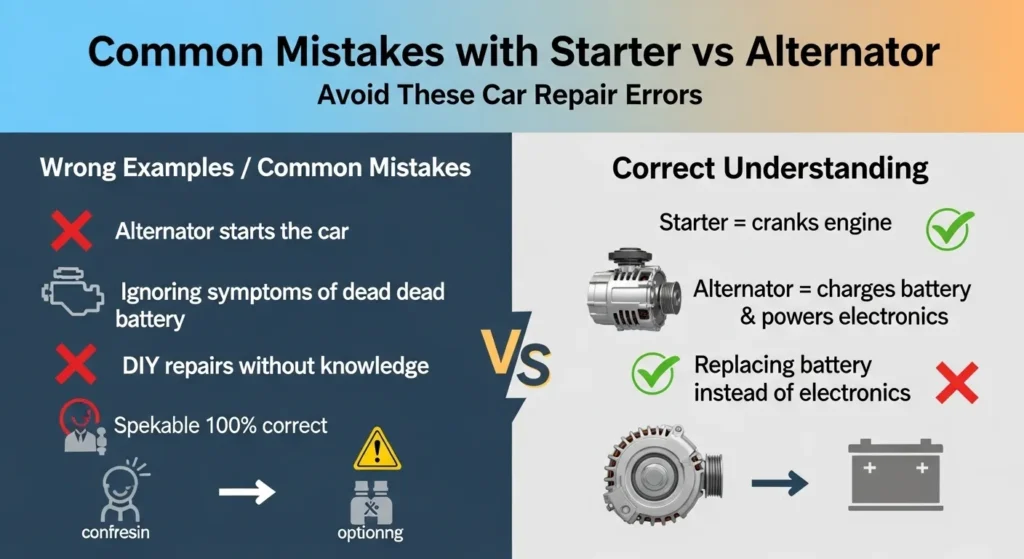
❌ Mistake 1: Confusing the Functions
Wrong: Alternator starts the car.
Correct: Starter starts the car.
❌ Mistake 2: Ignoring Symptoms
Dead battery may not mean alternator failure.
Starter could also be at fault.
❌ Mistake 3: DIY Repairs Without Knowledge
Starters and alternators involve electricity.
Wrong repairs can be dangerous.
❌ Mistake 4: Replacing Battery Instead of Alternator
Battery dies → replace battery?
Sometimes the alternator is failing, not battery.
🖊️ Starter or Alternator in Everyday Examples
📱 Social Media
“Car won’t start, need a new starter.”
“My battery keeps dying, maybe alternator problem.”
📰 News Example
“Mechanics advise checking the starter before replacing the battery.”
“Alternator failure caused multiple cars to stall on the highway.”
📄 Formal Writing
“The vehicle starter requires inspection.”
“The alternator regulates voltage and maintains battery charge.”
💬 Conversation
Friend: Car won’t start.
You: Likely the starter.
Friend: Battery light is on.
You: Might be the alternator.
📊 Starter and Alternator: Search Trends & Popularity
Common searches include:
- starter vs alternator
- alternator vs starter symptoms
- starter not working
- alternator replacement cost
Top searching countries:
- United States
- Canada
- Australia
- United Kingdom
- India
🧠 Easy Memory Tricks
🔹 Trick 1: Starter = Start
Starter = cranks engine.
Think: “Turn key → start engine.”
🔹 Trick 2: Alternator = Electricity
Alternator powers battery and electronics.
Think: “Alternates energy.”
🔹 Trick 3: Symptom Check
- No crank → starter
- Battery dies while running → alternator
❓ FAQs: Starter or Alternator
1️⃣ What is the main difference?
Starter starts the engine.
Alternator charges the battery.
2️⃣ Can alternator fail but battery be fine?
Yes, battery may hold charge temporarily.
3️⃣ Can starter fail while alternator works?
Yes, engine won’t crank but battery stays charged.
4️⃣ How long do starters last?
Typically 5 :7 years, depending on usage.
5️⃣ How long do alternators last?
About 7 :10 years on average.
6️⃣ Can a car run without alternator?
It will run until battery dies. Not sustainable.
7️⃣ Can a car run without starter?
No. Car cannot start without a starter.
✅ Conclusion
In conclusion, starters and alternators are essential but have different roles. The starter cranks the engine to begin motion.
The alternator supplies electricity and charges the battery while driving. Confusing them can lead to wrong repairs and expenses. Starter problems cause no :start issues.
Alternator problems cause battery failure and electrical malfunctions. Knowing the difference helps in diagnostics, maintenance, and communication with mechanics. Regular inspection of both ensures smooth car operation.
Understanding starter vs alternator is key for drivers, car enthusiasts, and anyone maintaining a vehicle. Master this knowledge and avoid unnecessary repairs.
Discovers More Posts!
Aluminium or Aluminum: Which One Is Correct?📚
Family’s or Families: Which One Is Correct? (2026)
Layed or Laid: Which One Is Correct? (2026)

My name is James Whitmore.I am a language research writer. I explore the history and evolution of English words. I write detailed comparisons explaining why spellings change over time and how British and American English diverged. My articles add depth and credibility to grammar comparison topics.