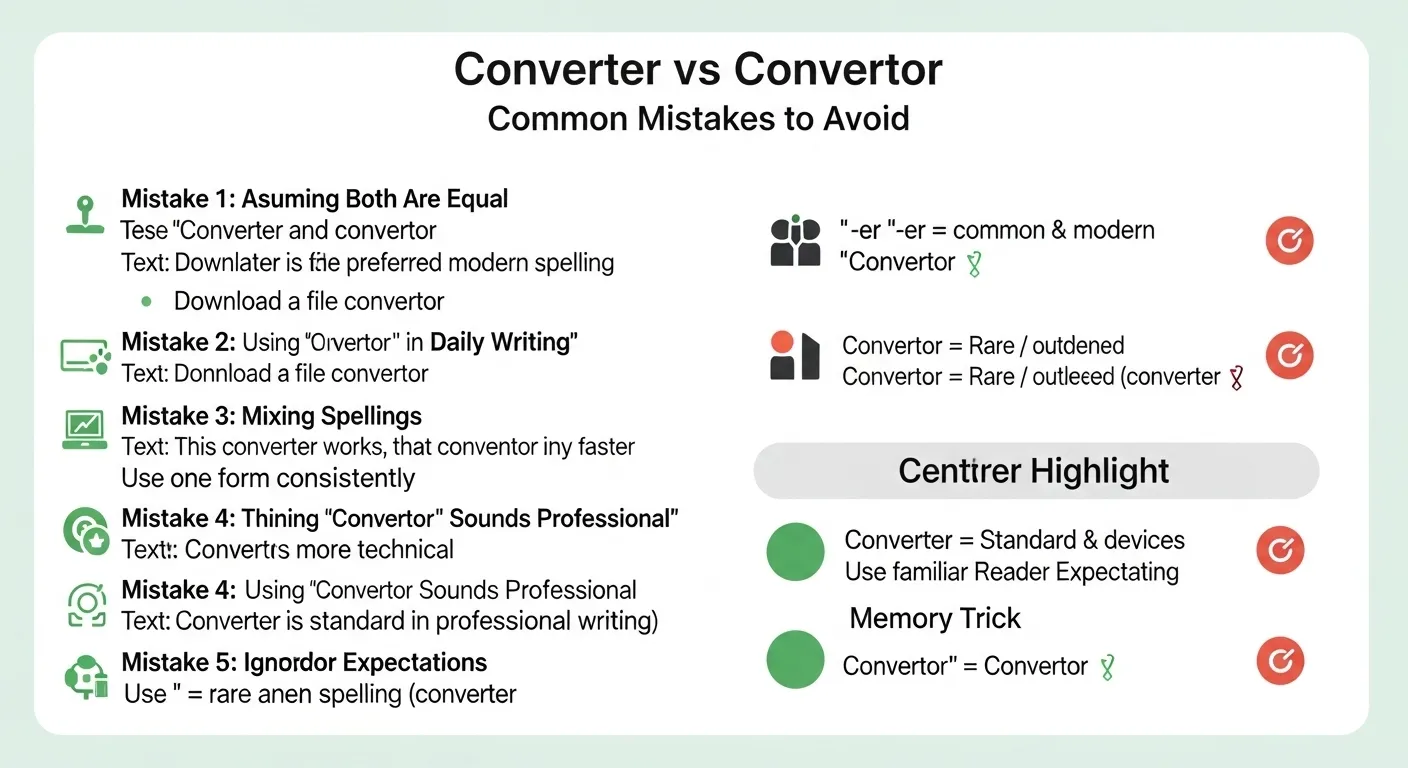
The correct and most common spelling is “converter,” while “convertor” exists but is rarely used.
Many people search this topic because both forms appear online, especially in technical content and product descriptions. Writers want to know which version looks professional and accepted in modern English.
The confusion happens because English allows some spelling variation, and older technical texts sometimes used “convertor.”
Today, usage trends strongly favor “converter.” This guide gives a clear answer first, then explains origin, spelling rules and common mistakes.
By the end, you will know which spelling to use in emails, websites, academic writing, and everyday communication.
Convertor or Converter: Quick Answer
The preferred and standard spelling is “converter.”
“Convertor” is considered a rare or alternative form. Most dictionaries, style guides, and modern publications recommend “converter.”
Examples:
✅ Video converter
✅ Power converter
✅ Currency converter
⚠️ Video convertor (less common and often avoided)
Simple rule
- Use converter in almost all situations.
- Avoid “convertor” unless you follow a specific technical style that requires it.
The Origin of Converter or Convertor
Understanding history helps explain why two spellings exist.
The word comes from the verb “convert,” which means to change something into a different form. English creates agent nouns by adding endings like “-er” or “-or.”
Historical background
- Latin roots influenced English word endings.
- Some words developed both “-er” and “-or” versions over time.
- Early technical writing sometimes used “convertor.”
As language standardized, usage patterns shifted. “Converter” became dominant because English commonly uses “-er” for tools or devices that perform actions.
Examples:
- printer
- mixer
- heater
- converter
British English vs American English Spelling
Unlike some words, this spelling does not change significantly between regions.
Key rule
Both British and American English strongly prefer “converter.”
Comparison table
| Region | Preferred Form | Example Sentence |
| British English | converter | The converter improved efficiency. |
| American English | converter | Install a video converter. |
| Technical manuals (modern) | converter | Use a voltage converter. |
| Older technical usage | convertor | Rare alternative |
| Standard writing | converter | Recommended choice |
Why “converter” wins
English often uses “-er” endings for devices or tools. This makes the spelling feel natural to readers worldwide.
Which Spelling Should You Use?
Always choose based on clarity and modern standards.
For US audiences
Use “converter.” It matches current usage in technology, education, and marketing.
For UK and Commonwealth audiences
Use “converter.” Publications and dictionaries favor this form.
For global communication
Use “converter.” It avoids confusion and aligns with search trends.
Quick advice
- Product descriptions → converter
- Technical documentation → converter
- Academic writing → converter
- Everyday writing → converter
🔤 Converter or Convertor: Spelling, Meaning, and Usage Questions
Many users search variations like “converter or convertor spelling,” “how do you spell converter,” “is it converter or convertor,” and “convertor vs converter.”
Here’s the simple clarification:
- Converter is the correct and standard spelling
- Convertor is a rare alternative, mostly seen in older or niche technical texts
Common search based explanations:
- “how do you spell converter” → The correct spelling is converter
- “converter spelling” → Always written with -er, not -or
- “convertor meaning” → Same meaning, but less commonly used
- “convertor vs converter” → Difference is usage frequency, not meaning
You may also see confusing variations like:
- “convertor converter”
- “converter convertor”
- “converter vs convertor”
👉 All of these point to the same conclusion:
Use “converter” in modern writing for clarity and correctness.
Common Mistakes with Convertor or Converter
1. Using “convertor” thinking it is more technical
Some writers believe “convertor” sounds more advanced, but this is incorrect.
❌ Power convertor
✅ Power converter
2. Mixing spellings in one document
Keep consistency throughout your text.
3. Copying outdated sources
Older manuals may use “convertor.” Modern standards prefer “converter.”
4. Assuming regional difference
There is no major regional rule here.
❓ Convertor vs Converter: Common Search Confusions Explained
Many spelling related queries come from real-world confusion, such as:
- “converter or convertor UK”
- “convertor or converter”
- “converter vs convertor”
- “convert or converter”
Let’s simplify everything clearly:
✔ Standard Spelling
- Converter → correct in all modern contexts
- Example: Use a file converter to change formats.
✔ Alternative Form
- Convertor → rare and outdated in most cases
- Example: Seen occasionally in older manuals
⚠️ Common Errors from Search Queries
- ❌ conertor → typo (missing “v”)
- ❌ convert-er or broken forms → incorrect
- ❌ confusing with convert (verb) vs converter (noun)
🧠 Related Word Confusion
Some users also search:
- “convert or converter” →
- Convert = verb (action)
- Converter = noun (tool/device)
- “conversor meaning” → unrelated or incorrect variation, not standard English spelling in this context
🌍 Regional Clarification
- “converter or convertor UK” →
Both UK and US English prefer converter
There is no regional difference here.
🧠 Easy Memory Trick
- Tool/device → -er (converter)
- Action → convert
Convertor or Converter in Everyday Examples
Emails
- Please install the file converter before starting.
- The converter supports multiple formats.
Technology content
- Video converter software improves compatibility.
- A digital converter changes signals.
News writing
- Engineers developed a new energy converter.
- The converter reduces power loss.
Social media
- This converter app works fast.
- I found a great audio converter.
Formal writing
- The converter transforms input data into output format.
- A voltage converter ensures safe operation.
Convertor or Converter: Google Trends & Usage Data
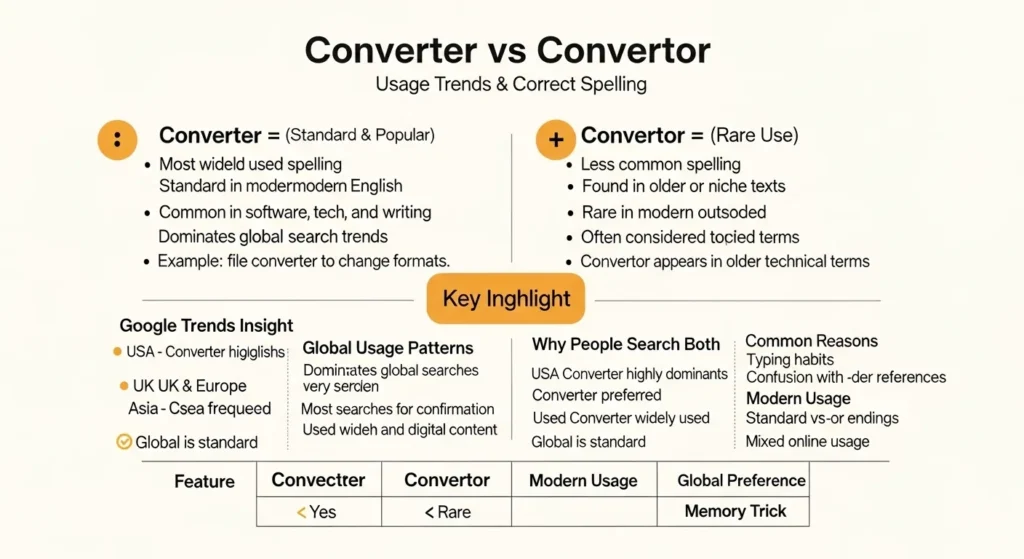
Search patterns show that “converter” is far more popular than “convertor.”
Why users search both forms
- Typing habits
- Older technical references
- Confusion about suffixes
Global usage patterns
- “Converter” dominates in North America, Europe, and Asia.
- “Convertor” appears occasionally but has low frequency.
Writing advice
Using “converter” improves clarity and matches reader expectations.
Keyword Comparison Table
| Variation | Correct or Incorrect | Usage Context | Recommendation |
| converter | Correct | All contexts | Always use |
| convertor | Rare alternative | Older or niche texts | Avoid if possible |
| convert-er | Incorrect | Typo | Avoid |
| convereter | Incorrect | Typo | Avoid |
FAQs About Convertor or Converter
1. Is “convertor” wrong?
It is not fully wrong, but it is uncommon and not preferred.
2. Why is “converter” more popular?
English often uses “-er” endings for tools or devices.
3. Do dictionaries accept both forms?
Some list both, but “converter” is marked as standard.
4. Is there a regional difference?
No. Both UK and US usage favor “converter.”
5. Which spelling is better?
Use “converter” because it matches common searches.
6. Can I use “convertor” in technical writing?
Only if your style guide specifically requires it.
7. Is pronunciation different?
No. Both are pronounced the same.
Conclusion
Choosing between “convertor or converter” becomes simple once you know modern usage patterns. The standard and widely accepted spelling is “converter,” and it works across all types of writing.
While “convertor” exists historically, it is rarely used today and may look outdated or incorrect to many readers. English tends to use “-er” endings for devices and tools, which explains why “converter” became dominant.
Using the preferred spelling improves clarity, professionalism, and consistency. Readers expect familiar forms, especially in technical or professional content.
Avoid mixing spellings within the same document, and always follow modern style guides unless you have a specific reason to choose the alternative form.
Practice using “converter” in emails, articles, product descriptions, and academic work. Small spelling choices shape reader trust and help your writing appear polished and reliable. Remember this simple rule: choose “converter” for clear, modern communication every time.
Discover More Posts!
Focused vs Focussed: Easy Guide for English Learners 🌟
Sari or Saree: What Is the Correct Spelling?
Sow or Sew: Which One Is Correct and When to Use Each?

My name is James Whitmore.I am a language research writer. I explore the history and evolution of English words. I write detailed comparisons explaining why spellings change over time and how British and American English diverged. My articles add depth and credibility to grammar comparison topics.