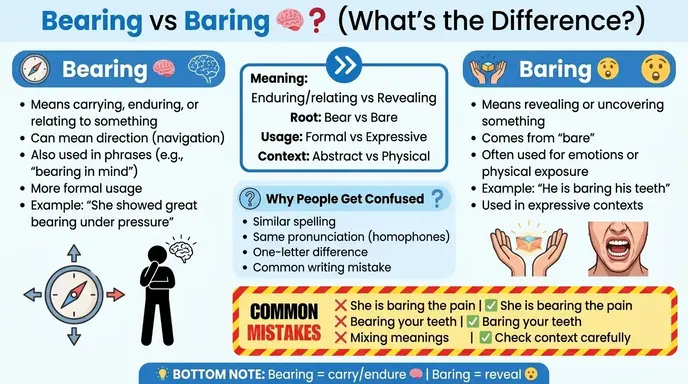
Answer: “Bearing” and “baring” are different words with distinct meanings. “Bearing” usually refers to posture, direction, or influence, while “baring” means exposing or revealing something.
Many people confuse these words because they sound the same, but using the wrong one can change the meaning of a sentence.
This guide explains the difference, shows examples, and provides clear rules for using them correctly.
By reading this, you can confidently choose the right word in writing, emails, social media posts, or formal documents.
Bearing or Baring: Quick Answer
- Bearing
Refers to posture, direction, influence, or tolerance.
Example: She maintained a calm bearing during the meeting. - Baring
Means exposing, uncovering, or revealing something.
Example: He was baring his emotions in the diary.
Tip: If it involves showing or exposing, use baring. If it involves position, direction, or attitude, use bearing.
The Origin of Bearing or Baring
The words have different roots.
- Bearing comes from Old English beran, meaning “to carry” or “to support.” Over time, it evolved to mean demeanor, direction, and influence.
- Baring comes from the verb bare, from Old English bær, meaning “naked” or “uncovered.” It is used for revealing something physically or emotionally.
The similarity in pronunciation leads to confusion. Spelling differences are critical because they completely change the meaning of a sentence.
British English vs American English Spelling
Both words exist in British and American English with the same spelling. However, the way people use them in writing and formal contexts can differ slightly.
| Word | British English Use | American English Use | Example (UK) | Example (US) |
| Bearing | Common in formal writing, navigation, and legal | Same as UK; slightly more in professional tone | She kept a dignified bearing. | The soldier’s bearing was strong. |
| Baring | Used in everyday speech and literature | Same usage; often in informal writing | He was baring his chest in winter. | The article was baring hidden facts. |
Observation: The spelling does not change. Confusion mainly arises from pronunciation and context, not regional spelling differences.
Which Spelling Should You Use?
For American audiences:
- Stick to bearing for posture, attitude, and direction.
- Use baring only when exposing or revealing.
For British/Commonwealth audiences:
- Same rules apply; context determines choice.
global or professional writing:
- Consider the audience’s familiarity.
- If unsure, read the sentence aloud; meaning usually becomes clear.
Rule of thumb:
- Bearing = posture/direction/influence
- Baring = exposing/revealing
🔎 Bearing vs Baring in Common Phrases (What People Actually Mean)
Many learners search phrases like “bearing or baring,” “is it bearing or baring,” and “difference between baring and bearing” because these words appear in common expressions.
Here are the most important real-life phrases explained clearly:
📌 “Bearing in Mind” or “Baring in Mind”?
✅ Correct: bearing in mind
❌ Incorrect: baring in mind
Meaning: considering something
Example: “Bearing in mind the deadline, we must hurry.”
📌 “Bearing With Me” or “Baring With Me”?
✅ Correct: bearing with me
❌ Incorrect: baring with me
Meaning: being patient
Example: “Thanks for bearing with me during the delay.”
📌 “No Bearing” or “No Baring”?
✅ Correct: no bearing
❌ Incorrect: no baring
Meaning: no relevance
Example: “This issue has no bearing on the final decision.”
📌 “Bearing Gifts” or “Baring Gifts”?
✅ Correct: bearing gifts
❌ Incorrect: baring gifts
Meaning: carrying or bringing something
Example: “He came bearing gifts.”
📌 “Weight Bearing” or “Weight Baring”?
✅ Correct: weight bearing
❌ Incorrect: weight baring
Meaning: supporting weight
Example: “This wall is weight bearing.”
📌 Simple Rule for All Cases
- Bearing = carry / support / relate / tolerate
- Baring = expose / reveal
Once you understand this, even tricky phrases become easy.
Common Mistakes with Bearing or Baring
Here are frequent errors and corrections:
- Incorrect: She was baring a confident attitude.
Correct: She was bearing a confident attitude. - Incorrect: He kept a serious bearing of his chest.
Correct: He kept a serious baring of his chest. - Incorrect: The compass shows the baring to the north.
Correct: The compass shows the bearing to the north. - Incorrect: He was bearing all his secrets to the friend.
Correct: He was baring all his secrets to the friend. - Incorrect: She walked with a bareing posture.
Correct: She walked with a bearing posture.
🧠 Baring vs Bearing vs Barring (Extra Confusion Explained)
Some confusion is not just between bearing vs baring, but also with a third word: barring.
Let’s break it down simply.
📌 Bearing vs Baring
- Bearing → posture, direction, patience
- Baring → exposing or revealing
Example:
“She kept a calm bearing.”
“He was baring his feelings.”
📌 Baring vs Barring
- Baring → exposing
- Barring → except for / preventing
Example:
“Barring rain, the event will continue.”
📌 Common Confusing Searches Explained
People often search:
- “baring vs barring”
- “barring or baring”
- “bearing vs bareing”
- “bareing meaning”
👉 Important clarification:
- Bareing ❌ is incorrect spelling
- Correct forms are:
- bearing ✅
- baring ✅
- barring ✅
📌 Special Expressions Explained
- “soul baring or soul bearing” → ✅ soul-baring (revealing emotions)
- “get my bearings or barings” → ✅ bearings (orientation)
- “bearing up or baring up” → ✅ bearing up (staying strong)
- “interest bearing or baring” → ✅ interest-bearing (financial term)
📌 Quick Memory Trick
- Bear = carry → bearing
- Bare = expose → baring
- Bar = block/except → barring
Bearing or Baring in Everyday Examples
Emails:
- Bearing: “Please maintain a professional bearing during the meeting.”
- Baring: “She was baring her concerns about the project in the email.”
News Articles:
- Bearing: “The general’s bearing impressed everyone during the inspection.”
- Baring: “The report is baring details of the corruption scandal.”
Social Media:
- Bearing: “I love her confident bearing in the video.”
- Baring: “The influencer is baring the truth about social media life.”
Formal Writing:
- Bearing: “The CEO’s bearing reflected authority and calm.”
- Baring: “The novel is baring the psychological depth of its characters.”
Bearing or Baring: Google Trends & Usage Data
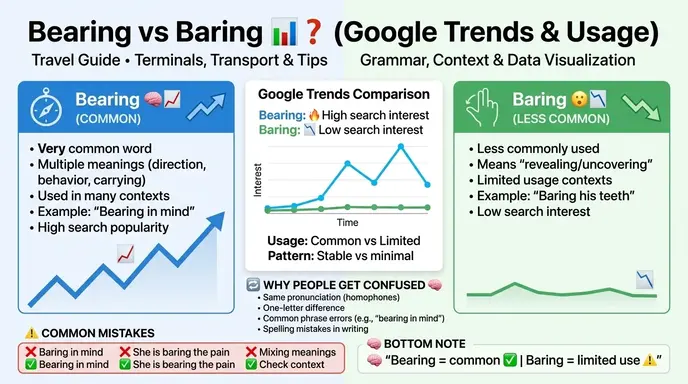
Based on recent searches and usage:
- Bearing is more frequently searched and used globally, especially in professional and academic contexts.
- Baring sees peaks in social media, lifestyle articles, and creative writing.
- Top countries searching for bearing include the US, UK, Canada, and Australia.
- Top countries searching for baring include the US, UK, India, and South Africa.
Insight: This suggests people confuse these words but lean toward bearing in serious contexts.
Comparison Table: Bearing vs Baring
| Aspect | Bearing | Baring |
| Meaning | Posture, direction, influence, tolerance | Exposing, uncovering, revealing |
| Part of Speech | Noun or verb | Verb |
| Example Sentence | “His bearing was confident.” | “She was baring her soul.” |
| Common Mistake | Using it for exposing things | Using it for posture or attitude |
| Pronunciation | /ˈbɛr.ɪŋ/ | /ˈbɛr.ɪŋ/ |
FAQs
- Is it “bearing” or “baring” when showing attitude?
- Always use bearing.
- Always use bearing.
- Can “baring” be used in business emails?
- Rarely; it is better for creative writing or personal communication.
- Rarely; it is better for creative writing or personal communication.
- Do British and American English spell them differently?
- No, spelling is the same. Context is key.
- No, spelling is the same. Context is key.
- Can “bearing” mean tolerance?
- Yes, e.g., “She showed great bearing under stress.”
- Yes, e.g., “She showed great bearing under stress.”
- Is “baring” only physical exposure?
- No, it can also mean revealing emotions, secrets, or facts.
- No, it can also mean revealing emotions, secrets, or facts.
- Which word is more common?
- Bearing is more common globally in formal writing.
- Bearing is more common globally in formal writing.
- How do I remember the difference?
- Baring = bare = expose. Bearing = carry = posture/direction.
- Baring = bare = expose. Bearing = carry = posture/direction.
Conclusion
Understanding the difference between bearing and baring is crucial for accurate writing. Using the wrong word can confuse readers and change the meaning of your sentence.
Bearing relates to posture, attitude, direction, and influence. It is common in professional, academic, and formal writing.
Baring, on the other hand, involves revealing, uncovering, or exposing something, If physical or emotional.
The key to avoiding mistakes is to focus on context: if you are talking about demeanor or navigation, choose bearing.
If you are showing or uncovering something, choose baring. Read your sentence aloud to check if it makes sense.
For global audiences, both words are recognized, but bearing is more frequent in professional settings, while baring appears in creative and informal writing.
By practicing these distinctions, you can write confidently, avoid common errors, and convey your intended meaning clearly.
Using our guide, you can now correctly apply bearing or baring in emails, social media, reports, and everyday communication. Keep the meaning in mind, and the right choice will always be obvious.
Discovers More Posts!
Focused vs Focussed: Easy Guide for English Learners 🌟
Sow or Sew: Which One Is Correct and When to Use Each?
Sari or Saree: What Is the Correct Spelling?

My name is James Whitmore.I am a language research writer. I explore the history and evolution of English words. I write detailed comparisons explaining why spellings change over time and how British and American English diverged. My articles add depth and credibility to grammar comparison topics.