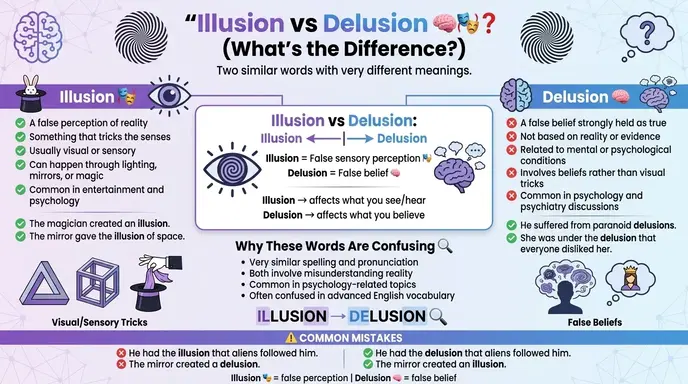
“Illusion” and “delusion” are related words, but they describe different kinds of false perception or belief.
An illusion is usually a misleading appearance or sensory trick, while a delusion is a strongly held false belief that persists despite evidence.
Strong rule:
Illusion = false perception | Delusion = false belief
People often search: “illusion vs delusion,” “difference between illusion and delusion,” “is delusion a mental health term,” and “what is an illusion in psychology.”
The confusion happens because both words involve things that are not completely real or accurate.
This article explains the meanings, psychology, examples, pronunciation, scientific usage, and memory tricks to help you clearly understand the difference.
Illusion or Delusion: Quick Answer ✅
An illusion is a misleading appearance or sensory trick, while a delusion is a false belief strongly accepted as true.
✔ Main Difference:
- Illusion → false perception or appearance
- Delusion → false belief or mistaken conviction
📌 Examples:
- ✔ The mirror created an optical illusion.
- ✔ He suffered from the delusion that everyone was watching him.
👉 Simple rule:
Illusion tricks the senses | Delusion tricks the mind
What Does “Illusion” Mean? 🎭
An illusion is:
- something that appears real but is not
- a sensory misunderstanding
- a visual or mental trick
📌 Examples:
- The magician performed an illusion.
- The desert mirage was an illusion.
- Optical illusions confuse the brain.
Common Types of Illusions 🧠✨
1. Optical Illusion
A visual trick affecting sight.
2. Auditory Illusion
A sound based sensory confusion.
3. Psychological Illusion
A misleading mental perception.
What Does “Delusion” Mean? 🧠📖
A delusion is:
- a false belief strongly held despite evidence
- a mistaken conviction disconnected from reality
📌 Examples:
- He had the delusion that he was famous.
- The patient experienced paranoid delusions.
- Believing impossible things without evidence may become delusional thinking.
Delusions in Psychology 🧠⚠️
In mental health contexts, delusions can involve:
- paranoia
- grandiosity
- false fears
- unrealistic beliefs
Belief concept:
\text{False belief firmly accepted as true} = \text{delusion}
Illusion vs Delusion: Core Difference
📊 Comparison Table:
| Feature | Illusion | Delusion |
| Main Meaning | False perception | False belief |
| Affects | Senses/perception | Thinking/beliefs |
| Common Field | Vision, psychology, magic | Psychology, psychiatry |
| Example | Optical illusion | Paranoid delusion |
| Reality Problem | Misinterpreted appearance | Incorrect belief |
Why People Confuse These Words 🧠⚠️
1. Similar Sound
Both words end with:
- “ lusion”
2. Similar Themes
Both involve:
- misunderstanding reality
- inaccurate perception
3. Psychological Usage
Both appear in:
- psychology
- philosophy
- mental health discussions
How to Pronounce Illusion and Delusion 🔊📖
Illusion Pronunciation
/ɪˈluː.ʒən/
Delusion Pronunciation
/dɪˈluː.ʒən/
👉 The beginning sound changes:
- i llusion
- de lusion
Illusion in Science and Magic 🎩🔬
Illusions are commonly studied in:
- neuroscience
- visual psychology
- stage magic
📌 Example:
- Magicians use illusions to entertain audiences.
Delusion in Mental Health 🧠⚠️
Delusions are often discussed in:
- psychiatry
- psychology
- mental health treatment
Examples of Delusion Types:
1. Paranoid Delusion
Believing others are secretly harmful.
2. Grandiose Delusion
Believing one has extreme importance or power.
3. Persecutory Delusion
Believing one is unfairly targeted.
Illusion vs Delusion in Everyday Language 💬📱
🏠 Daily Conversation
- The painting creates an illusion of movement.
- He lives under the delusion that he never makes mistakes.
📱 Social Media
- This staircase is an optical illusion 👀
📚 Academic Writing
- Delusions are important topics in abnormal psychology.
💼 Professional Usage
- The presentation discussed visual illusions in advertising.
Can Illusions Be Harmless? 🎭🙂
Yes, many illusions are harmless and entertaining.
Examples:
- magic tricks
- visual puzzles
- art effects
Can Delusions Be Serious? ⚠️🧠
Yes, severe delusions may affect:
- mental health
- relationships
- decision making
- safety
👉 Mental health professionals may help evaluate persistent delusions.
Common Mistakes with Illusion and Delusion ❌⚠️
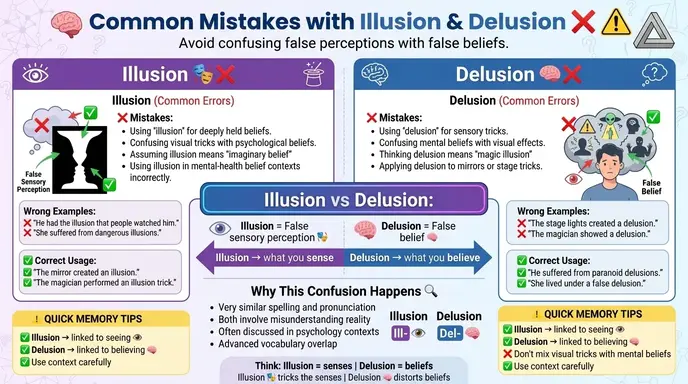
1. Using “Illusion” for False Beliefs
❌ He had the illusion he was a king.
✔ He had the delusion he was a king.
2. Using “Delusion” for Visual Tricks
❌ The magician performed a delusion.
✔ The magician performed an illusion.
3. Confusing Senses with Beliefs
✔ Illusion = perception problem
✔ Delusion = belief problem
4. Overusing “Delusional” Casually
✔ The term has psychological importance and should be used carefully.
Memory Tricks to Remember Easily 🧠✨
👉 Trick 1: Illusion = Image
Illusions often involve seeing.
✔ illusion → visual trick
👉 Trick 2: Delusion = Deep Belief
Delusions involve thoughts and beliefs.
✔ delusion → false belief
👉 Trick 3: Senses vs Mind
- illusion → senses
- delusion → beliefs
Psychology and Philosophy Discussions 📚🧠
Both words appear in:
- philosophy
- psychology
- neuroscience
- literature
Common Questions Include:
- What is reality?
- Can perception be trusted?
- How does the brain interpret information?
British vs American English Usage 🌍
📌 Key Point:
Both British and American English use:
- illusion
- delusion
with the same spellings and meanings.
📊 Comparison Table:
| Word | British English | American English |
| Illusion | Same | Same |
| Delusion | Same | Same |
👉 No major spelling difference exists.
Comparison Table ⚖️
| Feature | Illusion | Delusion |
| Meaning | False appearance | False belief |
| Main Area | Perception | Thinking |
| Common Usage | Magic, vision | Psychology |
| Seriousness | Often harmless | Can be serious |
| Example | Optical illusion | Paranoid delusion |
Common User Queries 🔍
- What is the difference between illusion and delusion?
- Is delusion a mental health term?
- What is an optical illusion?
- Can illusions be harmless?
- What causes delusions?
- Are illusions psychological?
- How do you remember illusion vs delusion?
- What are examples of delusions?
- Are delusions always dangerous?
- What is the role of illusions in magic?
FAQs 💡
1. What does illusion mean?
✔ False perception or misleading appearance
2. What does delusion mean?
✔ False belief strongly accepted as true
3. Are illusions visual?
✔ Often yes
4. Are delusions psychological?
✔ Usually yes
5. Which word relates to beliefs?
✔ Delusion
6. Which word relates to perception?
✔ Illusion
7. Easy rule?
✔ Illusion tricks senses, delusion tricks beliefs
Conclusion 🧾
“Illusion” and “delusion” are closely related words, but they describe different types of misunderstanding.
An illusion affects perception and creates false appearances, while a delusion affects beliefs and causes someone to strongly accept something untrue.
Illusions are often harmless and commonly appear in art, psychology, and entertainment, while delusions can involve serious mental health concerns when persistent and disconnected from reality.
Understanding the difference helps improve communication, psychological understanding, and accurate word usage in both everyday and academic English.
👉 Final takeaway: Illusions mislead the senses, while delusions mislead beliefs and thinking.
Discover More Articles!
Inpatient or Impatient: What’s the Difference?With In 30 Seconds
Kindergarten or Kindergarden: Which Spelling Is Correct? In 2026
Himself or Hisself: Which Word Is Correct?With In 30 Seconds

My name is James Whitmore.I am a language research writer. I explore the history and evolution of English words. I write detailed comparisons explaining why spellings change over time and how British and American English diverged. My articles add depth and credibility to grammar comparison topics.