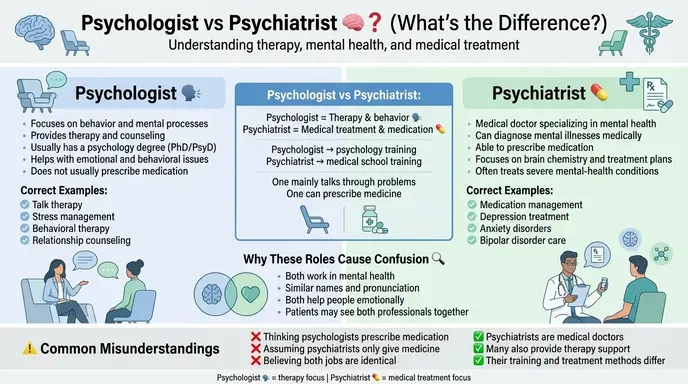
Psychologists and psychiatrists both work in mental health, but they have different training, methods, and medical responsibilities.
A psychologist mainly focuses on therapy, behavior, emotions, and mental processes, while a psychiatrist is a medical doctor who can diagnose conditions and prescribe medication.
Strong rule:
Psychologists mainly provide therapy and psychological assessment, while psychiatrists are medical doctors who can prescribe medicine.
People often search: “psychologist vs psychiatrist,” “who can prescribe medication,” “difference between psychologist and psychiatrist,” and “which mental health professional should I see.”
The confusion happens because both professions help people with mental and emotional challenges.
This article explains the differences, education, treatments, responsibilities, examples, and common misunderstandings so you can clearly understand both professions.
Psychologist or Psychiatrist: Quick Answer ⚡
A psychologist specializes in therapy and behavior, while a psychiatrist is a medical doctor specializing in mental health treatment and medication.
✔ Main Difference:
- Psychologist → therapy, behavior, mental processes
- Psychiatrist → medical doctor who can prescribe medication
📌 Examples:
- ✔ The psychologist helped him manage anxiety through therapy.
- ✔ The psychiatrist prescribed medication for depression.
👉 Simple rule:
Psychologists talk and assess | Psychiatrists diagnose medically and prescribe medication
What Is a Psychologist? 📖
A psychologist is a mental health professional who studies:
- behavior
- emotions
- thinking
- learning
- mental processes
Psychologists Often Provide:
- counseling
- psychotherapy
- behavioral therapy
- psychological testing
- emotional support
📌 Examples:
- The psychologist helped the child with learning difficulties.
- She sees a psychologist for stress management.
What Is a Psychiatrist? 👨⚕️💊
A psychiatrist is a medical doctor specializing in:
- mental illness
- psychiatric diagnosis
- medication treatment
- brain related disorders
Psychiatrists Can:
- diagnose medical mental disorders
- prescribe medications
- monitor medication effects
- provide some therapy
📌 Examples:
- The psychiatrist adjusted the patient’s medication.
- A psychiatrist diagnosed severe depression.
Education Difference 🎓📚
Psychologist Education
Usually studies:
- psychology
- counseling
- behavior science
Advanced education concept:
\text{Psychology training} \rightarrow \text{therapy and behavioral expertise}
Psychiatrist Education
Must complete:
- medical school
- psychiatric medical training
Medical specialization concept:
\text{Medical degree} + \text{psychiatric specialization} = \text{psychiatrist}
Psychologist vs Psychiatrist: Core Difference 📚⚖️
📊 Comparison Table:
| Feature | Psychologist | Psychiatrist |
| Medical Doctor | No | Yes |
| Prescribes Medication | Usually no | Yes |
| Main Focus | Therapy/behavior | Medical mental treatment |
| Education | Psychology training | Medical school |
| Treatment Style | Counseling/testing | Medication + diagnosis |
Who Can Prescribe Medication? 💊
Psychiatrists
✔ Can prescribe medication in most places.
Psychologists
❌ Usually cannot prescribe medication (rules vary by region).
What Conditions Do They Treat? 📋
Psychologists Commonly Help With:
- stress
- anxiety
- relationships
- learning problems
- emotional coping
Psychiatrists Commonly Treat:
- severe depression
- bipolar disorder
- schizophrenia
- major psychiatric disorders
- medication management
Therapy vs Medication 💬💊
Psychologists Often Focus On:
- talk therapy
- coping skills
- emotional patterns
- behavior changes
Psychiatrists Often Focus On:
- medication
- medical diagnosis
- biological mental health factors
Can Psychologists and Psychiatrists Work Together? 🤝🧠
Yes. Many mental health treatment plans involve both professionals.
Example Team Approach:
- psychologist → therapy
- psychiatrist → medication management
Collaborative care concept:
\text{Therapy} + \text{medical treatment} = \text{combined mental health care}
Psychologist in Everyday Examples 💬
🏠 Daily Life
- She visits a psychologist weekly for therapy.
📱 Social Media
- Mental health awareness encourages therapy support 🧠
📚 Educational Context
- Educational psychologists help students learn effectively.
Psychiatrist in Everyday Examples 💊
🏠 Daily Life
- The psychiatrist prescribed anxiety medication.
📱 Health Discussions
- Psychiatrists help manage serious mental illnesses.
💼 Clinical Setting
- The psychiatrist evaluated the patient’s symptoms.
Different Types of Psychologists 🧠
1. Clinical Psychologist
Works with mental health conditions.
2. Educational Psychologist
Focuses on learning and schools.
3. Sports Psychologist
Helps athletes mentally perform better.
4. Industrial Organizational Psychologist
Studies workplace behavior.
Different Types of Psychiatrists 👨⚕️📋
1. Child Psychiatrist
Works with children and teens.
2. Addiction Psychiatrist
Treats substance related disorders.
3. Forensic Psychiatrist
Works with legal and criminal systems.
4. Geriatric Psychiatrist
Specializes in older adults.
Common Mistakes About Psychologists and Psychiatrists ❌⚠️
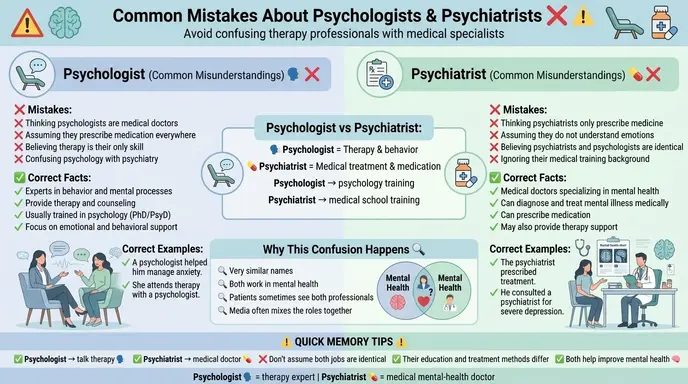
1. Thinking They Are the Same Job
❌ They have different training and roles.
2. Assuming Psychologists Prescribe Medicine
✔ Usually psychiatrists handle medication.
3. Believing Psychiatrists Only Use Medication
✔ Some also provide therapy.
4. Ignoring Mental Health Support
✔ Both professions can help improve well being.
Memory Tricks to Remember Easily ✨
👉 Trick 1: Psychiatrist = Physician
Psychiatrists are medical doctors.
✔ psychiatrist → medicine
👉 Trick 2: Psychologist = Psychology
Psychologists study behavior and therapy.
✔ psychologist → counseling
👉 Trick 3: Pills vs Talk
- psychiatrist → pills/medical treatment
- psychologist → talk therapy
Mental Health Awareness 🌍
Mental health professionals help people manage:
- emotions
- trauma
- stress
- disorders
- daily functioning
Seeking help is increasingly normalized worldwide.
Comparison Table 📋
| Feature | Psychologist | Psychiatrist |
| Therapy | Yes | Sometimes |
| Medication | Usually no | Yes |
| Medical Degree | No | Yes |
| Behavioral Expertise | Strong | Moderate |
| Mental Disorder Diagnosis | Yes | Yes |
Common User Queries 🔥
- What is the difference between psychologist and psychiatrist?
- Who can prescribe medication?
- Should I see a psychologist or psychiatrist?
- Are psychiatrists medical doctors?
- Can psychologists diagnose mental illness?
- What does a psychologist do?
- What does a psychiatrist do?
- Do psychiatrists provide therapy?
- Which profession studies behavior?
- Can both professionals work together?
FAQs 💡
1. Is a psychiatrist a doctor?
✔ Yes
2. Can psychologists prescribe medicine?
✔ Usually no
3. Who provides therapy?
✔ Psychologists commonly do
4. Who treats severe psychiatric disorders medically?
✔ Psychiatrists
5. Can someone see both professionals?
✔ Yes
6. Are both mental health professionals?
✔ Yes
7. Easy rule?
✔ Psychologists focus on therapy, psychiatrists focus on medical treatment
Conclusion 🧾
Psychologists and psychiatrists both play important roles in mental health care, but they differ significantly in education, treatment methods, and medical authority.
Psychologists primarily focus on therapy, behavior, emotional support, and psychological assessment, while psychiatrists are medical doctors who diagnose mental disorders and prescribe medication.
Many people benefit from working with both professionals together, especially when therapy and medication are combined as part of treatment.
Understanding the difference helps people make informed decisions about mental health support and reduces confusion about these closely related professions.
Final takeaway: Psychologists mainly provide therapy and behavioral support, while psychiatrists are medical doctors who can prescribe psychiatric medication.
Discover More Articles!
Esthetic or Aesthetic: What’s the Difference?With Examples
Skiis or Skis: Which Spelling Is Correct? With Examples 2026
Illusion or Delusion: What’s the Difference? With Examples 2026

thinkaora.com is my English grammar comparison website where I simplify confusing words, spelling differences, and usage rules through clear explanations and examples. My goal is to help learners, writers, and students understand English easily and use correct grammar with confidence.