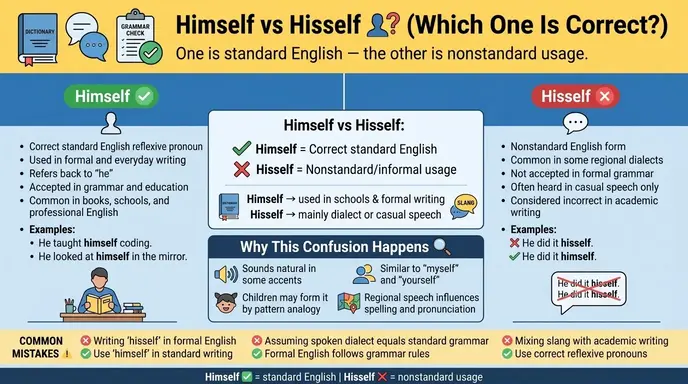
“Himself” is the correct standard English word, while “hisself” is considered nonstandard or dialectal English.
Many people hear “hisself” in informal speech, regional dialects, movies, or casual conversation, which creates confusion about If it is grammatically correct.
👉 Strong rule: Use “himself” in formal, academic, professional, and standard English writing.
People often search: “himself vs hisself,” “is hisself a real word,” “why do people say hisself,” and “difference between himself and hisself.”
The confusion happens because some regional dialects naturally use “hisself” in spoken language.
This article explains the meanings, grammar, pronunciation, history, dialect usage, examples, and common misunderstandings about “himself” and “hisself.”
Himself or Hisself: Quick Answer ✅⚡
“Himself” is the correct standard English form. “Hisself” is nonstandard and mainly used in certain dialects or informal speech.
✔ Main Difference:
- Himself → correct standard English
- Hisself → nonstandard dialect form
📌 Examples:
- ✔ He taught himself how to cook.
- ✔ He hurt himself while running.
- ❌ He taught hisself how to cook.
👉 Simple rule:
Always use “himself” in proper English writing.
What Does “Himself” Mean? 📖
“Himself” is a reflexive pronoun used when:
- the subject and object are the same person
📌 Examples:
- He blamed himself.
- He introduced himself politely.
- The boy dressed himself.
Grammar Structure 🧠📚
Reflexive pronoun formula:
\text{Subject} = \text{Object}
📌 Example:
- He hurt himself.
(He hurt HE.)
What Does “Hisself” Mean? 📖⚠️
“Hisself” is a nonstandard variation of “himself.”
Where It Appears:
- regional dialects
- informal speech
- historical rural English
- fictional dialogue
- certain cultural accents
📌 Example (Dialect Usage):
- He done it hisself.
👉 This may appear in speech or storytelling, but it is not standard formal English.
Why Do People Say “Hisself”? 🧠
1. Dialect Evolution
Some dialects developed alternative reflexive forms naturally.
2. Speech Simplification
People sometimes create patterns like:
- myself
- yourself
- hisself
even though “hisself” is not standard.
3. Regional and Cultural Identity
Dialect speech often reflects:
- local culture
- family speech patterns
- community traditions
Is “Hisself” a Real Word? 📚
📌 Technically:
Yes, dictionaries may list it as:
- dialectal
- nonstandard
- informal
But:
- it is NOT standard academic English.
📊 Status Comparison:
| Word | Status |
| Himself | Standard English |
| Hisself | Nonstandard dialect |
History of “Hisself” 📜⏳
“Hisself” has existed for centuries in:
- regional English dialects
- rural speech patterns
- older spoken English communities
It appeared historically because English grammar changed naturally over time.
Himself in Standard English 📚
Used In:
- schools
- business writing
- formal speaking
- journalism
- academic writing
📌 Examples:
- The president himself attended the meeting.
- He prepared himself carefully.
Hisself in Dialects and Pop Culture 🗣️
“Hisself” sometimes appears in:
- movies
- novels
- rural dialogue
- comedy
- character-based storytelling
Why Writers Use It:
To show:
- accent
- realism
- regional identity
How to Pronounce Himself and Hisself 🔊
Himself Pronunciation
/hɪmˈself/
Hisself Pronunciation
/hɪˈself/
👉 The pronunciation difference is small, which increases confusion.
Reflexive Pronouns in English 📚
Common Reflexive Pronouns:
| Subject | Reflexive Pronoun |
| I | myself |
| you | yourself |
| he | himself |
| she | herself |
| we | ourselves |
| they | themselves |
Pronoun structure:
\text{Pronoun} + \text{self/selves}
👉 “Himself” follows the correct standard pattern.
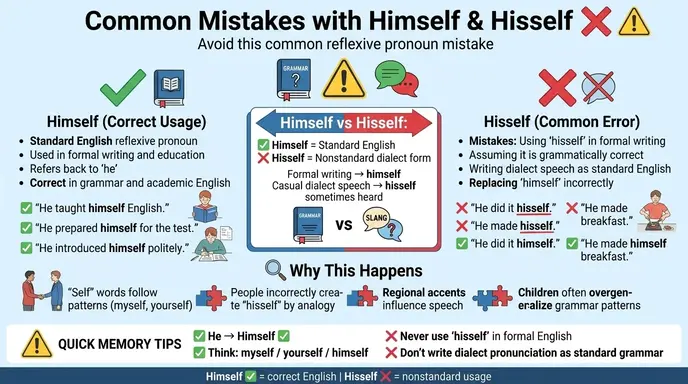
Common Mistakes with Himself and Hisself ❌⚠️
1. Using “Hisself” in Formal Writing
❌ He completed the work hisself.
✔ He completed the work himself.
2. Assuming Dialect Equals Standard Grammar
✔ Dialects have different rules from formal English.
3. Confusing Spoken Language with Academic English
✔ Informal speech does not always follow standard grammar.
4. Overcorrecting Fictional Dialogue
✔ Writers sometimes intentionally use dialect forms.
Everyday Examples 📱
🏠 Daily Conversation
- He fixed the bike himself.
📱 Informal Dialect Example
- He did it hisself.
📚 School Writing
- The student introduced himself.
💼 Professional Writing
- The manager himself approved the decision.
British vs American English Usage 🌍
📌 Key Point:
Both British and American standard English prefer:
✔ himself
📊 Comparison Table:
| Word | British English | American English |
| Himself | Standard | Standard |
| Hisself | Dialectal | Dialectal |
👉 No major standard variety accepts “hisself” formally.
Memory Tricks to Remember Easily ✨
👉 Trick 1: Think “Him + Self”
✔ him + self = himself
👉 Trick 2: Match Standard Pronouns
- myself
- yourself
- himself
👉 Trick 3: Formal Writing Rule
If writing for:
- school
- work
- exams
always use:
✔ himself
Comparison Table 📋⚖️
| Feature | Himself | Hisself |
| Correctness | Standard | Nonstandard |
| Formal Writing | Yes | No |
| Dialect Usage | Rare | Common in some dialects |
| Academic English | Accepted | Avoided |
| Example | He hurt himself | ❌ He hurt hisself |
Common User Queries 🔍
Is hisself a real word?
- Which is correct: himself or hisself?
- Why do people say hisself?
- Is hisself bad grammar?
- Is hisself used in dialects?
- Can I use hisself in writing?
- What is a reflexive pronoun?
- Is hisself used in British English?
- Why is himself standard?
- How do I remember the correct form?
FAQs ❓
1. Which word is correct?
✔ Himself
2. Is hisself always wrong?
✔ Wrong in standard English, but used in dialects
3. What type of word is himself?
✔ Reflexive pronoun
4. Why does hisself exist?
✔ Dialect development and speech patterns
5. Can writers use hisself intentionally?
✔ Yes, for realistic dialogue
6. Should students use hisself in essays?
❌ No
7. Easy rule?
✔ Formal English always uses “himself”
Conclusion 🧾
“Himself” is the correct standard English reflexive pronoun used in formal, academic, and professional communication.
“Hisself,” while historically and regionally used in some dialects, is considered nonstandard English and should generally be avoided in formal writing.
The confusion exists because dialect speech often develops its own grammatical patterns, and many people hear “hisself” in casual conversation, movies, or storytelling. However, standard English grammar consistently uses “himself.”
Understanding this distinction helps improve writing accuracy and grammar confidence in both spoken and written English.
👉 Final takeaway: Use “himself” in standard English and avoid “hisself” in formal writing.
Discover More Articles!
Lasagna or Lasagne: Which One Is Correct?
Inpatient or Impatient: What’s the Difference?With In 30 Seconds
Kindergarten or Kindergarden: Which Spelling Is Correct? In 2026

My name is James Whitmore.I am a language research writer. I explore the history and evolution of English words. I write detailed comparisons explaining why spellings change over time and how British and American English diverged. My articles add depth and credibility to grammar comparison topics.