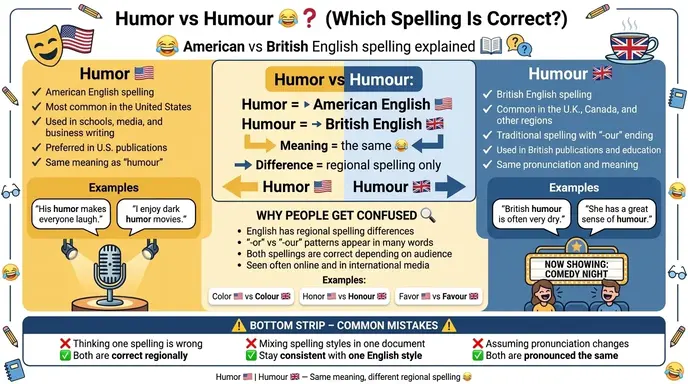
Both “humor” and “humour” are correct spellings, but the version you use depends on the type of English. “
Humor” is the preferred spelling in American English, while “humour” is used in British English and many Commonwealth countries.
👉 Strong rule:
Use “humor” in American English and “humour” in British English.
People often search: “humor vs humour,” “which spelling is correct,” “American vs British spelling,” and “why does British English use humour.”
The confusion happens because English spelling differs across regions, especially between the United States and the United Kingdom.
This article explains the meanings, spelling differences, pronunciation, history, examples, regional usage, and memory tricks so you can confidently choose the correct spelling.
Humor or Humour: Quick Answer ✅
Both spellings are correct. “Humor” is American English, while “humour” is British English.
✔ Main Difference:
- Humor → American English spelling
- Humour → British English spelling
📌 Examples:
- 🇺🇸 She has a great sense of humor.
- 🇬🇧 She has a great sense of humour.
👉 Simple rule:
US English = humor | UK English = humour
What Does “Humor/Humour” Mean? 📖😄
Humor means:
- the quality of being funny
- the ability to make people laugh
- amusement or comedy
📌 Examples:
- His humor made everyone laugh.
- British humour is often very dry.
- She enjoys dark humor.
Humor vs Humour: Core Difference ⚖️
📊 Comparison Table:
| Feature | Humor | Humour |
| English Type | American English | British English |
| Meaning | Same | Same |
| Pronunciation | Same | Same |
| Correctness | Correct | Correct |
| Regional Preference | USA | UK/Commonwealth |
👉 The meaning does not change only the spelling differs.
Why Are There Two Spellings? 📜
The spelling difference developed as British and American English evolved separately.
British English Often Keeps “OU”
Examples:
- colour
- favour
- humour
American English Often Simplifies
Examples:
- color
- favor
- humor
Spelling simplification concept:
\text{British English} \rightarrow \text{ou spellings} \quad | \quad \text{American English} \rightarrow \text{simplified spellings}
History of Humor/Humour 📚
The word originally came through:
- Latin
- French
- Middle English
Historically, “humour” was the older spelling. American English later simplified many “ou” spellings.
Noah Webster and American Spelling 🇺🇸📖
American spelling reforms were influenced by:
Noah Webster
His Goals Included:
- simpler spelling
- uniquely American English style
- easier writing and learning
How to Pronounce Humor and Humour 🔊
Both spellings are pronounced almost identically.
Pronunciation:
/ˈhjuː.mər/
👉 The pronunciation usually stays the same despite spelling differences.
Different Types of Humor 🎭
1. Dry Humor
Subtle and serious-style comedy.
2. Dark Humor
Comedy involving serious or uncomfortable topics.
3. Slapstick Humor
Physical comedy and exaggerated actions.
4. Sarcastic Humor
Humor involving irony or mockery.
5. Self-Deprecating Humor
Making jokes about oneself.
Humor/Humour in Everyday Examples 💬📱
🏠 Daily Life
- I love his sense of humor.
- Her humour makes conversations fun.
📱 Social Media
- Internet humor changes quickly 😂
📚 Academic Writing
- Humour plays an important role in literature.
💼 Professional Writing
- Good humor can improve workplace communication.
Humor in Psychology and Communication 🧠📚
Humor can:
- reduce stress
- improve social bonding
- help communication
- increase happiness
Psychological Effect Example
Positive emotion concept:
\text{Humor} \rightarrow \text{laughter} \rightarrow \text{positive emotional response}
British Humour vs American Humor
British Humour Often Includes:
- dry wit
- irony
- sarcasm
- understatement
American Humor Often Includes:
- direct jokes
- observational comedy
- expressive storytelling
👉 These are general trends, not strict rules.
Common Mistakes with Humor and Humour ❌⚠️
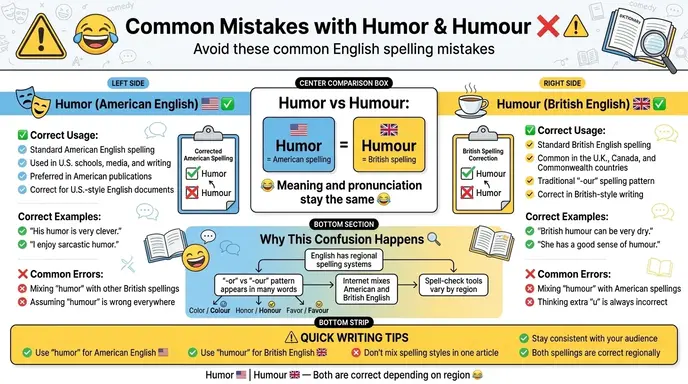
1. Mixing British and American Spelling
❌ Humour is important in American humor writing.
✔ Stay consistent in one style.
2. Thinking One Spelling Is Wrong
✔ Both are correct regionally.
3. Using British Spelling in US Style Guides
✔ Match audience expectations.
4. Forgetting Regional Context
✔ Different countries prefer different spellings.
Memory Tricks to Remember Easily ✨
👉 Trick 1: British English Loves “OU”
Examples:
- colour
- flavour
- humour
👉 Trick 2: American English Simplifies
Examples:
- color
- flavor
- humor
👉 Trick 3: Think Geography
🇺🇸 US → humor
🇬🇧 UK → humour
Humor/Humour in Formal and Informal Writing 📚
✔ Formal Usage
- Humour plays a role in political satire.
✔ Informal Usage
- Your humor is hilarious 😄
👉 Both spellings work formally and informally depending on region.
Comparison Table 📋
| Feature | Humor | Humour |
| Region | United States | UK/Commonwealth |
| Meaning | Funny quality | Funny quality |
| Correctness | Correct | Correct |
| Pronunciation | Same | Same |
| Style | American spelling | British spelling |
Humor or Humour: Usage Trends & Popularity 📊
📌 Trend Insight:
- “Humor” dominates in US publications
- “Humour” dominates in UK/Commonwealth publications
Search Trends:
Regional search engines often prioritize local spelling.
Common User Queries 🔍
- Is humor or humour correct?
- What is the difference between humor and humour?
- Is humour British spelling?
- Is humor American spelling?
- Why do British words use “ou”?
- Which spelling should I use?
- Are humor and humour pronounced differently?
- What types of humor exist?
- Why did American spelling simplify words?
- Can I use both spellings together?
FAQs ❓💡
1. Which spelling is correct?
✔ Both are correct
2. Is humor American English?
✔ Yes
3. Is humour British English?
✔ Yes
4. Do they mean different things?
❌ No
5. Is pronunciation different?
✔ Usually no
6. Which spelling should I use?
✔ Match your audience or style guide
7. Easy rule?
✔ US = humor, UK = humour
Conclusion 🧾📌
“Humor” and “humour” are both correct spellings of the same word, with the difference depending entirely on regional English preferences.
American English uses the simplified spelling “humor,” while British English and many Commonwealth countries prefer “humour.”
The meaning, pronunciation, and usage remain the same in both forms. If discussing comedy, laughter, or personality, both spellings communicate the same idea.
The most important thing is consistency. If writing in American English, use “humor.” If writing in British English, use “humour.”
Final takeaway: Both spellings are correct use “humor” for US English and “humour” for UK English.
Discover More Articles!
Himself or Hisself: Which Word Is Correct?With In 30 Seconds
Kindergarten or Kindergarden: Which Spelling Is Correct? In 2026
Inpatient or Impatient: What’s the Difference?With In 30 Seconds

thinkaora.com is my English grammar comparison website where I simplify confusing words, spelling differences, and usage rules through clear explanations and examples. My goal is to help learners, writers, and students understand English easily and use correct grammar with confidence.