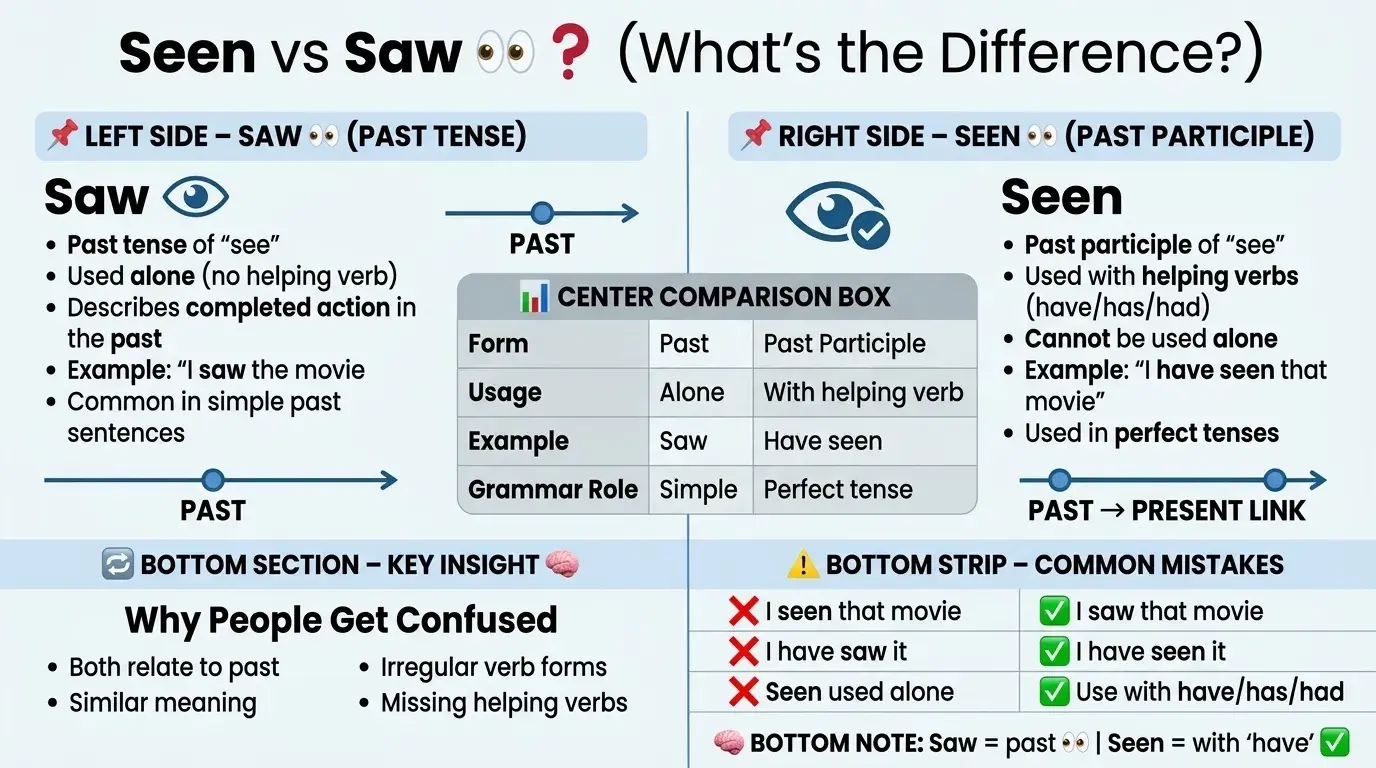
“Saw” is the past tense, and “seen” is the past participle used with a helping verb. This is one of the most common grammar mistakes in English.
Many learners say “I seen it” instead of “I saw it,” which creates confusion in speaking and writing.
👉 Quick rule: Use “saw” alone. Use “seen” with “have/has/had.”
People often search: “seen vs saw difference,” “when to use seen,” “is I seen correct,” and “how to use saw in a sentence.”
This article gives a clear and simple explanation. You will learn the meanings, grammar rules, examples, and common mistakes so you can use both words correctly with confidence.
Seen or Saw: Quick Answer ✅⚡
Both come from the verb “see,” but they are used differently in grammar.
✔ Main Difference:
- Saw → past tense (used alone)
- Seen → past participle (used with helping verbs)
📌 Examples:
- ✔ I saw the movie yesterday.
- ✔ I have seen that movie before.
- ✔ She had seen the place earlier.
👉 Simple rule:
Saw = past action
Seen = with have/has/had
Seen or Saw: Definitions with Examples 📖✍️
🟢 Saw (Definition)
Past tense of “see,” used for actions completed in the past.
📌 Examples:
- I saw him at the market.
- She saw a bird in the sky.
- We saw that film last night.
🔵 Seen (Definition)
Past participle of “see,” used with helping verbs like have, has, or had.
📌 Examples:
- I have seen this before.
- She has seen the result.
- They had seen the problem earlier.
🟡 Simple Meaning
- Saw → past
- Seen → used with helping verbs
The Origin of Seen or Saw 📜⏳
Both words come from the Old English verb “seon,” meaning to see.
Development:
- Saw → simple past form
- Seen → past participle form
Why confusion happens:
- Both relate to past actions
- Learners forget helping verbs
👉 That’s why people say incorrect sentences like “I seen it.”
British English vs American English Usage 🌍
📌 Key Point:
There is no regional difference.
📊 Comparison Table:
| Word | UK Usage | US Usage | Grammar Role |
| Saw | Same | Same | Past tense |
| Seen | Same | Same | Past participle |
👉 The difference is grammar, not spelling.
Which One Should You Use? 🎯📝
✔ Use “Saw” When:
- Talking about the past
- No helping verb is used
✔ Use “Seen” When:
- Using have / has / had
- Talking about completed actions with connection to present
🧠 Memory Trick (Easy)
👉 Seen = needs a helper
👉 Saw = stands alone
Common Mistakes with Seen or Saw ❌⚠️
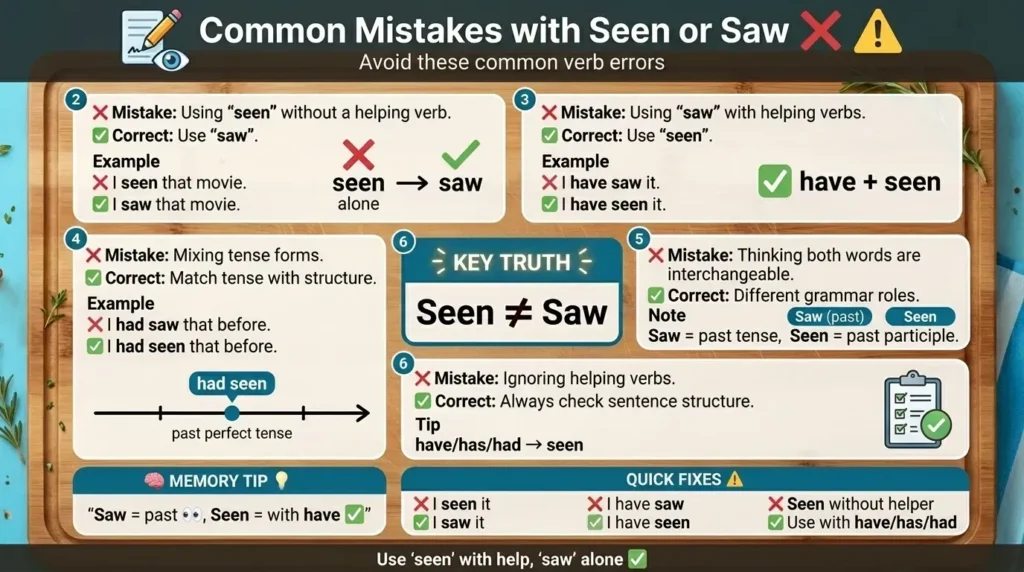
1. Using “Seen” Without Helping Verb
❌ I seen the movie.
✔ I saw the movie.
2. Using “Saw” with Helping Verb
❌ I have saw it.
✔ I have seen it.
3. Mixing Forms
❌ She has saw that before.
✔ She has seen that before.
4. Forgetting Grammar Rule
✔ Always check: Is there a helping verb?
Seen or Saw in Everyday Examples 💬📱
🏠 Daily Life
- I saw him yesterday.
- I have seen him before.
📱 Social Media
- I saw that post!
- I’ve seen this trend already.
📚 School Writing
- Students saw the experiment.
- They have seen the results.
💼 Professional Writing
- We saw a decline in sales.
- We have seen improvements this year.
Seen or Saw : Usage Trends & Popularity 📊📈
📌 Trend Insight:
- Saw → more common in simple past sentences
- Seen → common in perfect tense (have/has/had)
📊 Key Observation:
Errors like “I seen” are common in informal speech but incorrect in standard English.
👉 Correct grammar improves clarity and professionalism.
Comparison Table 📋⚖️
| Feature | Saw | Seen |
| Verb Form | Past tense | Past participle |
| Needs Helper? | No | Yes |
| Example | I saw it | I have seen it |
| Usage | Simple past | Perfect tense |
Common User Queries 🔍🔥
- What is the difference between seen and saw?
- Is “I seen” correct?
- When should I use seen?
- When should I use saw?
- Is seen past tense?
- Why is “I have saw” wrong?
- How to use seen in a sentence?
- What is the past tense of see?
- What is the past participle of see?
- How to remember seen vs saw?
FAQs ❓💡
1. Is “I seen it” correct?
❌ No
2. What is correct?
✔ I saw it or I have seen it
3. What is “seen”?
✔ Past participle
4. What is “saw”?
✔ Past tense
5. Does “seen” need a helping verb?
✔ Yes
6. Can “saw” be used with have?
❌ No
7. Easy rule?
✔ Seen = helper, Saw = alone
Conclusion 🧾
“Seen” and “saw” both come from the verb “see,” but they are used in different ways. “Saw” is the simple past tense and is used alone to describe something that happened in the past. “Seen” is the past participle and must be used with helping verbs like “have,” “has,” or “had.”
The most common mistake is using “seen” without a helping verb, such as saying “I seen it.” This is incorrect in standard English. Instead, you should say “I saw it” or “I have seen it.”
There is no difference between British and American English here—the rules are the same everywhere. The key is to remember the grammar structure and apply it correctly.
👉 Simple takeaway: Saw = past, Seen = with have/has/had.
Discover More Articals!
Recognise or Recognize: Which Spelling Is Correct?
Send or Sent: What’s the Difference? In 30 Seconds
Starring or Staring: What’s the Difference? (2026)

My name is James Whitmore.I am a language research writer. I explore the history and evolution of English words. I write detailed comparisons explaining why spellings change over time and how British and American English diverged. My articles add depth and credibility to grammar comparison topics.