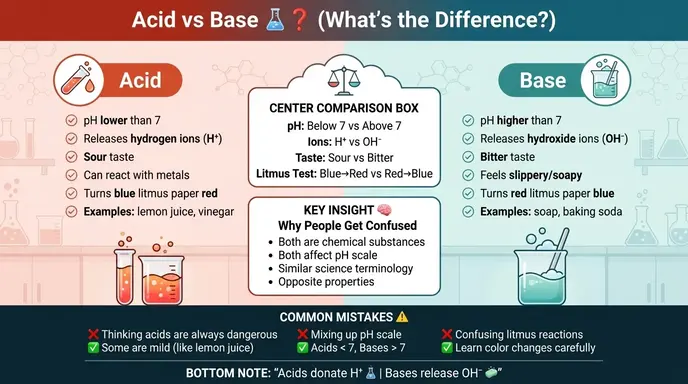
Acids release hydrogen ions in water, while bases accept hydrogen ions or produce hydroxide ions.
This is the core scientific difference and the main reason students compare these two concepts in chemistry.
Many learners get confused because acids and bases often react together, but they have opposite chemical behaviors.
👉 Strong rule: Acids are usually sour and have a lower pH, while bases are bitter or slippery and have a higher pH.
People often search: “acid vs base difference,” “what is an acid,” “what is a base,” and “examples of acids and bases.”
Understanding this topic is important in chemistry, biology, cooking, cleaning, and everyday life.
This guide explains everything in simple language with examples, comparisons, and easy rules so you can clearly understand acids and bases.
Acid or Base: Quick Answer ✅
An acid donates hydrogen ions (H⁺), while a base accepts hydrogen ions or releases hydroxide ions (OH⁻).
✔ Main Difference:
- Acid → lower pH, sour reaction
- Base → higher pH, slippery or bitter reaction
📌 Examples:
- ✔ Lemon juice is acidic
- ✔ Soap is basic
- ✔ Vinegar is an acid
- ✔ Baking soda is a base
👉 Simple rule:
Acid = low pH | Base = high pH
Acid or Base: Definitions with Examples 📖
🟢 Acid (Definition)
A substance that releases hydrogen ions (H⁺) in water.
Inline chemistry formula:
\mathrm{Acid} \rightarrow H^+
📌 Examples:
- Hydrochloric acid is strong.
- Lemon juice contains acid.
- Vinegar tastes sour because it is acidic.
🔵 Base (Definition)
A substance that accepts hydrogen ions or produces hydroxide ions (OH⁻).
Inline chemistry formula:
\mathrm{Base} \rightarrow OH^-
📌 Examples:
- Soap is a base.
- Baking soda is mildly basic.
- Ammonia is a common base.
🟡 Simple Meaning
- Acid → chemically active substance with low pH
- Base → opposite of acid with high pH
The Origin of Acid or Base 📜
The word “acid” comes from the Latin word “acidus,” meaning sour.
The word “base” was later introduced in chemistry to describe substances that react with acids.
Development:
- Acids identified by sour taste
- Bases identified by slippery feel and reactions
Why confusion happens:
- Both react together
- Scientific definitions can seem complex
👉 The simplest difference is low pH vs high pH.
Acid or Base: Definitions in Chemistry 🌍
📌 pH Scale Explanation
The pH scale measures how acidic or basic a substance is.
Inline pH relationship:
0 < \mathrm{pH} < 7 \Rightarrow \text{Acid} \quad ; \quad 7 < \mathrm{pH} < 14 \Rightarrow \text{Base}
📊 Comparison Table:
| Property | Acid | Base |
| pH Level | Below 7 | Above 7 |
| Taste | Sour | Bitter |
| Feel | Can sting | Slippery |
| Ion Type | H⁺ | OH⁻ |
👉 Acids and bases behave oppositely in chemistry.
Which One Should You Identify? 🎯
✔ Identify an Acid When:
- pH is below 7
- Substance tastes sour
- Reacts with metals
✔ Identify a Base When:
- pH is above 7
- Feels slippery
- Neutralizes acids
🧠 Memory Trick (Easy)
👉 Acid = sour
👉 Base = bitter/slippery
Common Mistakes with Acid or Base ❌⚠️
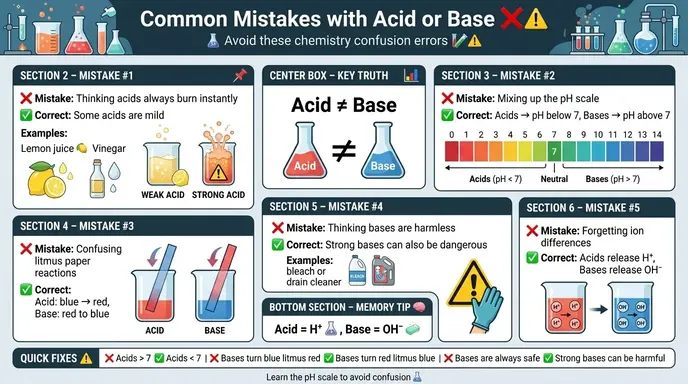
1. Thinking Strong Means Dangerous Only
✔ Some weak acids can still irritate
2. Confusing pH Direction
❌ Higher pH = stronger acid
✔ Lower pH = stronger acid
3. Assuming Bases Are Safe
✔ Strong bases can also burn skin
4. Ignoring Neutralization
✔ Acids and bases can cancel each other out
Neutralization formula:
\mathrm{Acid} + \mathrm{Base} \rightarrow \mathrm{Salt} + H_2O
Acid or Base in Everyday Examples 💬📱
🏠 Daily Life
- Lemon juice is acidic.
- Soap is basic.
📱 Food and Cleaning
- Vinegar contains acid.
- Detergent is usually basic.
📚 School Chemistry
- Students tested acids and bases using litmus paper.
💼 Science Writing
- Bases neutralize acids in chemical reactions.
Acid or Base: Usage Trends & Popularity 📊
📌 Trend Insight:
- Students commonly search this topic in chemistry courses
- pH and neutralization are major learning areas
📊 Key Observation:
People often search for:
- “examples of acids and bases”
- “difference between acid and base”
- “pH scale explained”
👉 This topic is essential in science education.
Comparison Table 📋
| Feature | Acid | Base |
| pH | Below 7 | Above 7 |
| Main Ion | H⁺ | OH⁻ |
| Taste | Sour | Bitter |
| Feel | Sharp / reactive | Slippery |
| Example | Vinegar | Soap |
| Reaction | Reacts with bases | Neutralizes acids |
Common User Queries 🔍
- What is the difference between acid and base?
- What is an acid?
- What is a base?
- What is the pH of acids and bases?
- Is vinegar an acid?
- Is soap a base?
- How do acids react with bases?
- What are common examples of bases?
- Why are acids sour?
- What is neutralization in chemistry?
FAQs ❓
1. What is an acid?
✔ A substance that releases hydrogen ions
2. What is a base?
✔ A substance that accepts hydrogen ions or releases hydroxide ions
3. What is the pH of acids?
✔ Below 7
4. What is the pH of bases?
✔ Above 7
5. Is water an acid or base?
✔ Neutral
6. What happens when acids and bases mix?
✔ They neutralize each other
7. Easy rule?
✔ Acid = low pH, Base = high pH
Conclusion 🧾
Acids and bases are opposite chemical substances with different properties and reactions. Acids release hydrogen ions and usually have a low pH, while bases accept hydrogen ions or produce hydroxide ions and have a high pH. This basic difference explains how they behave in chemistry and everyday life.
Understanding acids and bases becomes easier when you focus on simple patterns. Sour substances like vinegar and lemon juice are acidic, while slippery substances like soap are basic. Their reactions are important in science, cleaning, food preparation, medicine, and many industrial processes.
The pH scale is one of the easiest ways to identify them. Values below 7 are acidic, values above 7 are basic, and 7 is neutral. Once you understand this rule, most acid-base questions become much simpler.
👉 Final takeaway: Acids have low pH and release H⁺ ions, while bases have high pH and produce OH⁻ ions or accept H⁺ ions.
Discover More Articals!
Mold or Mildew: What’s the Difference? In 30 Seconds
Portland OR Tourism:With Simple Examples
Portland OR Airport (PDX): Complete Travel Guide

I am Sophia Martinez.I am an ESL grammar coach. I specialize in teaching English to non native speakers. My content focuses on commonly confused words like affect vs effect, their vs there, and verb tense comparisons. Sophia writes in a friendly, supportive tone designed to build confidence in learners.