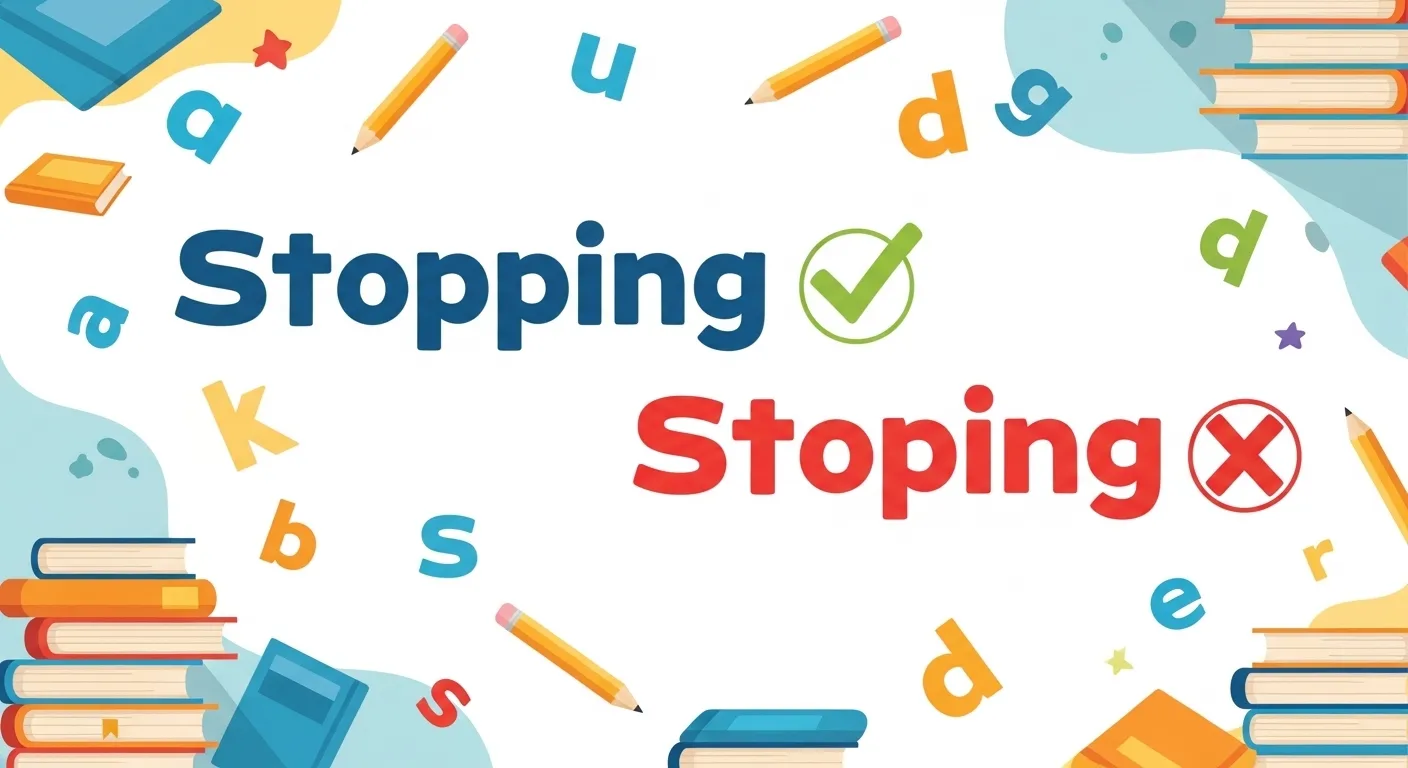
Stopping is the correct spelling, while stoping is incorrect in general English usage.
Many people are confused because both words sound similar, but only one follows standard spelling rules.
This guide will explain why “stopping” is correct, the history behind it, and how to use it correctly in writing.
Understanding the difference helps you write clearly in emails, reports, social media posts, and formal documents.
By the end, you will know the origin of the word, regional differences, common mistakes, and real life examples to ensure you never mix these spellings again.
Stopping or Stoping: Quick Answer
Quick Answer: The correct spelling is stopping.
- Stopping: Used as the present participle of “stop.”
- Example: “She is stopping at the store on her way home.”
- Example: “She is stopping at the store on her way home.”
- Stoping: Incorrect in standard English, though it exists in mining terminology to mean creating an underground space.
Remember: In most everyday writing, stopping is always correct.
The Origin of Stopping
The word stop comes from Middle English “stoppen,” meaning to block, close, or prevent movement.
When adding ing to form the present participle, English rules often double the final consonant if the word is short, stressed, and ends with a single vowel followed by a consonant.
- Stop → Stopping (double “p”)
- Example: “I am stopping the car.”
Stoping without doubling the “p” is not standard in everyday writing. Its usage exists in specialized contexts like mining, where it refers to excavating a space underground.
This history explains why English spelling can be confusing and why doubling consonants matters for proper grammar.
British English vs American English Spelling
English spelling rules differ slightly between regions, but in this case, both British and American English use stopping with double “p.”
| Aspect | British English | American English | Notes |
| Present participle of “stop” | stopping | stopping | Both double the “p” after a single vowel |
| Incorrect form | stoping | stoping | Rarely used, only in mining terminology |
| Past tense | stopped | stopped | Same in both variants |
| Spelling pattern | Consonant doubling after a short vowel | Consonant doubling after a short vowel | Standard rule applies universally |
Key takeaway: The double “p” rule applies regardless of region. Avoid using stoping unless discussing mining or geology.
Which Spelling Should You Use?
For everyday writing, reports, emails, social media, and formal documents, always use stopping.
- US Audience: “stopping” is standard in all writing.
- UK & Commonwealth Audience: “stopping” is also correct; no regional variation.
- Specialized Fields: Only use stoping in mining or geological contexts.
Tip: If unsure, just double the “p.” This simple rule keeps your writing correct across countries.
🔹 How to Spell “Stopping” Correctly (Common Questions)
Many learners search phrases like how to spell stopping, is it stopping or stoping, or what is the correct spelling of stopping because the double consonant rule can be confusing.
The correct spelling is stopping with double “p.”
Examples:
- Correct: stopping
- Incorrect: stoping
People also search:
- stopping spelling
- spelling of stopping
- how do you spell stopping
- stopping vs stoping
Simple rule:
Always double the “p” when adding -ing to stop.
Why do we double the “p”?
Because stop is:
- one syllable
- ends in vowel + consonant
So it follows the standard rule:
➡️ stop → stopping
What about “stopped”?
Another common confusion is stopped or stoped.
- Stopped ✅ correct
- Stoped ❌ incorrect
Example:
- The car stopped suddenly.
Same rule applies: double the “p” before adding -ed
Common Mistakes with Stopping
Even experienced writers make errors. Here are common mistakes and corrections:
| Mistake | Correction | Explanation |
| stoping | stopping | Always double the “p” for present participle |
| stoping the car | stopping the car | Verb form must follow standard spelling rules |
| I am stoping | I am stopping | Present continuous tense requires correct participle |
| Stoppinged | Stopped | “Stoppinged” is never correct; past tense is “stopped” |
| She is stoping here | She is stopping here | Correct form follows grammar rules |
Quick rule: If a one syllable verb ends in a single vowel + consonant, double the consonant before adding ing.
Stopping in Everyday Examples
Using stopping correctly improves readability and clarity. Here are examples across different contexts:
- Email:
- “I will be stopping by your office at 3 PM.”
- “I will be stopping by your office at 3 PM.”
- News headline:
- “Train services are stopping temporarily due to maintenance.”
- “Train services are stopping temporarily due to maintenance.”
- Social media post:
- “I’m stopping by the café before heading home. ☕️”
- “I’m stopping by the café before heading home. ☕️”
- Formal writing:
- “The project team is stopping all non essential tasks to meet the deadline.”
- “The project team is stopping all non essential tasks to meet the deadline.”
- Conversations:
- “He is stopping the car at the red light.”
- “He is stopping the car at the red light.”
Observation: You rarely, if ever, need stoping outside technical contexts.
Stopping: Google Trends & Usage Data
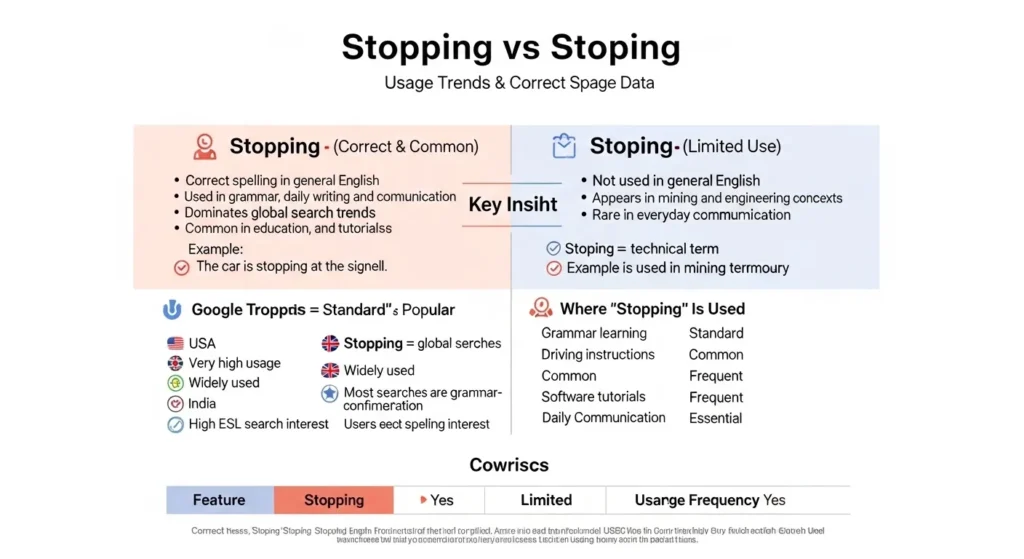
Search data shows that stopping is overwhelmingly more popular than stoping.
- Top countries searching “stopping”: United States, UK, Canada, Australia, India.
- Contexts: Grammar guides, language learning, driving instructions, software tutorials.
- Stoping: Mostly appears in mining, geology, or engineering articles.
This trend confirms that for general audiences, stopping is the only correct choice for communication.
Keyword Variations Comparison Table
| Keyword Variation | Correct Usage | Notes |
| stopping | ✅ Correct | Present participle, everyday use |
| stoping | ❌ Incorrect | Only in mining/geology context |
| stopped | ✅ Correct | Past tense of stop |
| stop | ✅ Correct | Base form |
| stops | ✅ Correct | Third person singular |
🔹 Stopping vs Stoping: Spelling Rules and Meaning
Many users search comparisons like stopping vs stoping, stoping or stopping which is correct, or stopping or stoping meaning.
Correct usage:
- Stopping → standard English (daily use)
- Stoping → technical term (mining/geology only)
Key difference:
| Word | Meaning | Usage |
|---|---|---|
| Stopping | Action of “stop” | Everyday English |
| Stoping | Mining process | Technical only |
Common search variations explained:
People often type:
- stoping spelling
- stoping vs stopping
- stopping or stoping
- is it stoping or stopping
👉 Clear answer:
For 99% of situations, use stopping.
Related verb forms (important for clarity)
Users also search:
- stop or stopped which is correct
- stopped spelling
- are you stopping
Correct forms:
- stop → base
- stops → present
- stopping → present participle
- stopped → past tense
Example:
- Are you stopping here?
- He stopped the car.
Final takeaway:
Only use “stoping” in technical mining contexts otherwise always choose “stopping.”
FAQs About Stopping or Stoping
1. Is “stoping” ever correct?
Yes, in mining or geology, “stoping” refers to creating underground cavities. Otherwise, it’s wrong.
2. Why do we double the “p” in stopping?
English spelling rules double the consonant after a short vowel in a stressed syllable before adding ing.
3. Can I use “stoping” in a sentence about driving?
No, for cars or general actions, always use stopping.
4. Does British and American English differ for stopping?
No, both use stopping with double “p.”
5. Is “stopped” the past form of stopping?
Yes, “stopped” is the past tense; “stopping” is the present participle.
6. How can I remember the spelling rule?
If a one syllable verb ends in consonant + vowel + consonant, double the final consonant before adding ing.
7. Are there other words with similar patterns?
Yes, words like running, beginning, and hopping follow the same rule.
Conclusion
Understanding the difference between stopping and stoping is simple but crucial for clear writing.
Stopping is the correct form in nearly all contexts, including emails, social media, formal writing, and conversation. Stoping is a rare exception, mostly reserved for mining or geological terms.
Remember the spelling rule: double the final consonant after a short vowel when forming the present participle of one syllable verbs.
By following this rule, your writing will appear professional, correct, and easy to read for audiences worldwide.
For both British and American English readers, stopping is standard. The past tense, stopped, also doubles the consonant.
Real world examples from news, social media, and emails show that stopping is widely accepted and recognized. Avoid mistakes by practicing the rule and observing its use in everyday writing.
In short, whenever you see stoping outside technical contexts, correct it to stopping. This ensures your writing is precise, professional, and universally understood.
If you are drafting an email, creating content, or writing a report, this knowledge will save you from common spelling mistakes and make your communication clear.
Related More Posts!
Tires or Tyres: Examples and Correct Usage 📝
IBS or IBD: What’s the Difference?In 30 Seconds
EMT or Paramedic: What Is the Real Difference?

My name is James Whitmore.I am a language research writer. I explore the history and evolution of English words. I write detailed comparisons explaining why spellings change over time and how British and American English diverged. My articles add depth and credibility to grammar comparison topics.