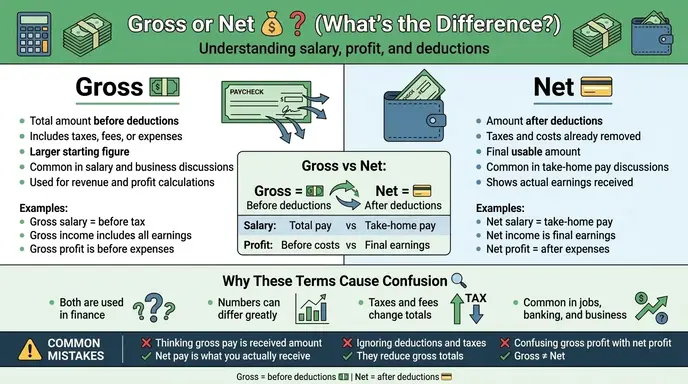
“Gross” and “net” are financial terms used to describe amounts before and after deductions.
Gross usually means the total amount before taxes, expenses, or deductions, while net means the final amount left after deductions are removed.
👉 Strong rule:
Gross = total before deductions | Net = final amount after deductions
People often search: “gross vs net,” “difference between gross and net salary,” “gross income meaning,” and “what is net pay.”
These terms are commonly used in salaries, business, banking, accounting, taxes, and everyday financial discussions.
This article explains the meanings, differences, formulas, examples, salary usage, business applications, and common mistakes about gross and net in simple English.
Gross or Net: Quick Answer ✅
Gross refers to the total amount before deductions, while net refers to the remaining amount after deductions.
✔ Main Difference:
- Gross → full amount before expenses or taxes
- Net → final amount after deductions
📌 Examples:
- ✔ Her gross salary is $5,000 per month.
- ✔ Her net salary is $4,200 after taxes.
👉 Simple rule:
Gross is bigger because nothing has been removed yet.
What Does “Gross” Mean? 💰📖
Gross means the total or complete amount before deductions.
📌 Examples:
- Gross income before taxes
- Gross profit before expenses
- Gross weight including packaging
Common Uses of Gross 📊
1. Gross Salary
Salary before taxes and deductions.
2. Gross Income
Total earnings before expenses.
3. Gross Profit
Revenue minus production costs only.
4. Gross Weight
Total weight including packaging.
What Does “Net” Mean? 📉📖
Net means the final amount remaining after deductions, taxes, or expenses.
📌 Examples:
- Net pay after taxes
- Net profit after expenses
- Net weight without packaging
Common Uses of Net 💵
1. Net Salary
Take-home pay after deductions.
2. Net Income
Final earnings after expenses.
3. Net Profit
Actual business profit after all costs.
4. Net Weight
Weight of the product alone.
Gross vs Net: Core Difference 🧠
📊 Comparison Table:
| Feature | Gross | Net |
| Meaning | Total amount | Final remaining amount |
| Deductions | Before deductions | After deductions |
| Usually Bigger? | Yes | Usually smaller |
| Used In | Salaries, profits, taxes | Final earnings, profits |
| Financial Stage | Starting amount | Ending amount |
Gross Salary vs Net Salary 💼
This is one of the most common areas of confusion.
Gross Salary
The total salary offered by an employer before deductions.
Net Salary
The amount actually received after:
- taxes
- insurance
- retirement contributions
- other deductions
📌 Example:
- Gross salary = $6,000
- Tax deductions = $1,000
- Net salary = $5,000
Salary calculation concept:
\text{Net Salary} = \text{Gross Salary} – \text{Deductions}
Gross Profit vs Net Profit 📈💼
Businesses use these terms regularly.
Gross Profit
Money left after subtracting production costs.
Net Profit
Money left after subtracting all business expenses.
📌 Example:
A company earns $100,000 in sales.
- Gross profit after production costs = $60,000
- Net profit after all expenses = $20,000
Gross vs Net in Weight ⚖️
These words are also used in shipping and packaging.
Gross Weight
Includes:
- product
- box
- packaging
Net Weight
Only the actual product weight.
📌 Example:
- Gross weight = 2 kg
- Packaging = 0.5 kg
- Net weight = 1.5 kg
Gross vs Net in Everyday Language 📱
🏠 Daily Conversation
- What’s your gross monthly income?
- How much do you get net after taxes?
💼 Workplace
- The offer mentions gross salary.
- Employees care more about net pay.
📦 Shopping and Shipping
- Net weight: 500g
- Gross weight: 650g
📚 Accounting
- The company’s net profit increased this year.
Why Gross Is Important 💰
Gross figures help people understand:
- total earnings
- full sales
- overall financial scale
- starting financial value
Businesses often use gross numbers to show growth potential.
Why Net Is More Important for Personal Finance 📉
Net amounts show:
- actual take-home money
- real profit
- final usable income
Key Idea:
People usually spend or save based on net income, not gross income.
Common Financial Deductions ⚠️
Typical Deductions Include:
- taxes
- insurance
- retirement contributions
- loan payments
- business expenses
These reduce gross amounts into net amounts.
Easy Formula to Remember 🧠📘
Financial relationship:
\text{Net Amount} = \text{Gross Amount} – \text{Expenses or Deductions}
👉 Gross starts high.
👉 Net becomes smaller after deductions.
Common Expressions with Gross 💰
📌 Examples:
- Gross income
- Gross pay
- Gross earnings
- Gross margin
Common Expressions with Net 📉
📌 Examples:
- Net income
- Net worth
- Net profit
- Net earnings
Common Mistakes About Gross and Net ❌⚠️
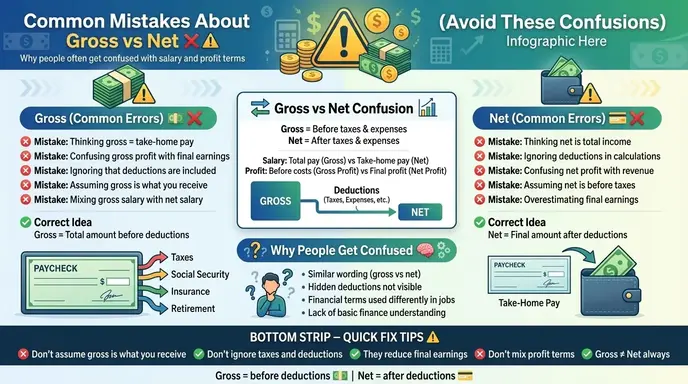
1. Confusing Salary Terms
❌ Thinking gross salary is take-home pay
✔ Net salary is actual take-home money
2. Ignoring Deductions
✔ Taxes and expenses greatly affect net amounts
3. Assuming Net and Profit Mean the Same Thing
✔ Net simply means after deductions
4. Forgetting Context
✔ Gross and net can apply to money, weight, profit, and more
Gross vs Net in Business and Accounting 📚
Companies use these figures to:
- measure performance
- calculate taxes
- evaluate profits
- manage expenses
Why It Matters:
Investors often compare:
- gross profit margins
- net profit margins
to understand business health.
Gross vs Net : Which Matters More? ⚖️
Gross Matters For:
- understanding total value
- comparing salaries
- measuring sales
Net Matters For:
- budgeting
- personal spending
- actual profit
- real financial planning
Comparison Table 📋⚖️
| Feature | Gross | Net |
| Definition | Before deductions | After deductions |
| Amount Size | Larger | Smaller |
| Includes Taxes? | Yes | No |
| Used For | Total calculations | Final calculations |
| Example | Gross salary | Net salary |
Common User Queries 🔍
- What is the difference between gross and net?
- What is gross salary?
- What is net salary?
- Is net income after taxes?
- Why is gross pay higher?
- What does net profit mean?
- What are common deductions?
- Is gross or net more important?
- What is gross weight?
- How do you calculate net income?
FAQs ❓
1. What does gross mean?
✔ Total amount before deductions
2. What does net mean?
✔ Final amount after deductions
3. Is gross always bigger than net?
✔ Usually yes
4. What is net salary?
✔ Your take-home pay
5. What reduces gross to net?
✔ Taxes and deductions
6. Is net income after taxes?
✔ Yes
7. Easy explanation?
✔ Gross is before deductions, net is after deductions
Conclusion 🧾
Gross and net are important financial terms used in salaries, profits, accounting, shipping, and everyday money discussions.
Gross refers to the total amount before deductions, while net refers to the remaining amount after taxes, expenses, or other deductions are removed.
Understanding the difference helps people manage salaries, business profits, taxes, and personal budgeting more effectively. In most situations, gross shows the starting value, while net shows the real usable amount.
👉 Final takeaway: Gross means the full amount before deductions, while net means the final amount left after deductions.
Discover More Articles!
Chosing or Choosing: Which Spelling Is Correct?In 2026
Starring Meaning : Simple Definition,With Examples
Sergeant or Sargent: Which Spelling Is Correct?In (2026)

I am Sophia Martinez.I am an ESL grammar coach. I specialize in teaching English to non native speakers. My content focuses on commonly confused words like affect vs effect, their vs there, and verb tense comparisons. Sophia writes in a friendly, supportive tone designed to build confidence in learners.