The correct choice between alumna and alumni depends on gender and number.
Many people get confused when writing about former students because both words sound similar but have different meanings.
“Alumna” refers to a single female graduate, while “alumni” can refer to multiple male graduates or a mixed-gender group.
Understanding the distinction is important for formal writing, social media posts, news articles, emails, and even school newsletters.
People search for this term to avoid embarrassing mistakes when addressing graduates. This guide will clearly explain the differences, compare British and American usage, and give practical advice for correct usage.
Alumna or Alumni: Quick Answer
Quick Answer:
- Alumna = one female graduate.
- Example: “Jane is an alumna of Harvard University.”
- Example: “Jane is an alumna of Harvard University.”
- Alumnus = one male graduate.
- Example: “John is an alumnus of Oxford University.”
- Example: “John is an alumnus of Oxford University.”
- Alumni = multiple graduates (male or mixed group).
- Example: “The alumni of the class of 2020 donated to the school.”
- Example: “The alumni of the class of 2020 donated to the school.”
- Alumnae = multiple female graduates.
- Example: “The alumnae organized a reunion party.”
- Example: “The alumnae organized a reunion party.”
Tip: Always check gender and number to use the right word. “Alumni” is often used as a general plural.
The Origin of Alumna or Alumni
Both alumna and alumni come from Latin, where the root word “alere” means “to nourish” or “to foster.” In ancient Roman context, “alumnus” meant “pupil” or “foster child.”
Over time, the words were adopted by English-speaking universities to indicate graduates. The endings changed according to Latin gender rules:
- Alumnus → male singular
- Alumna → female singular
- Alumni → male plural or mixed group plural
- Alumnae → female plural
English borrowed these terms without fully anglicizing the endings, which is why they can feel foreign to modern readers.
The difference in endings is strictly grammatical, not stylistic. Knowing the origin helps understand why these forms exist and why people often confuse them.
British English vs American English Spelling
Both British and American English retain the Latin forms, so spelling is mostly identical. However, usage frequency can differ:
| Term | US Usage | UK Usage | Notes |
| Alumna | Less common | Common | Refers to one female graduate |
| Alumnus | Less common | Common | Refers to one male graduate |
| Alumni | Most common (plural/general) | Most common (plural/general) | Used for male or mixed groups |
| Alumnae | Less used | Used but formal | Female plural |
Tip: In both variants, the spelling remains the same. Differences appear in frequency and context.
In professional and academic writing, knowing the exact gender/number is more important than the variant of English.
Which Spelling Should You Use?
Audience-based advice:
- US audience:
- “Alumni” is widely accepted for mixed groups or general references.
- Use “alumna” for individual female graduates only if clarity is needed.
- “Alumni” is widely accepted for mixed groups or general references.
- UK/Commonwealth audience:
- Traditional Latin endings are more strictly observed.
- Use “alumna” (female), “alumnus” (male), “alumnae” (female plural), and “alumni” (male or mixed plural).
- Traditional Latin endings are more strictly observed.
- Global audience:
- When unsure, “alumni” is safest for general plural.
- Avoid “alumna” unless specifically referring to a single female graduate.
- When unsure, “alumni” is safest for general plural.
Practical rule: Think gender → think number → pick the right word.
🔍 Alumna vs Alumni, Alumnus, and Alumnae (Complete Usage Guide)
Many users search terms like alumna vs alumni, alumni vs alumna, or alumni vs alumnus vs alumna because the forms look similar but follow different grammar rules.
Here’s a simple way to understand them:
- Alumna → one female graduate
- Alumnus → one male graduate
- Alumni → plural (male or mixed group)
- Alumnae → plural (female only)
This also answers common queries like:
- single alumni / alumni single → ❌ incorrect
✔ correct: alumnus (male) or alumna (female) - female alumni singular / alumni singular female →
✔ correct: alumna - alumni or alumna / alumna or alumni →
depends on number (one vs many) - alumnus female / female alumnus → ❌ incorrect
✔ correct: alumna - alumni for female / alumni female →
✔ acceptable only for plural group, not a single woman
👉 Simple rule:
Singular = alumna/alumnus
Plural = alumni/alumnae
Common Mistakes with Alumna or Alumni
People often make these errors:
- Using “alumna” for a group
- ❌ “The alumna of 2020 donated.”
- ✅ “The alumni of 2020 donated.”
- ❌ “The alumna of 2020 donated.”
- Using “alumni” for a single female
- ❌ “She is an alumni of Yale.”
- ✅ “She is an alumna of Yale.”
- ❌ “She is an alumni of Yale.”
- Mixing singular/plural endings
- ❌ “The alumnae donated, and the alumni thanked them.” (confusing)
- ✅ “The alumnae donated, and the alumni acknowledged their contribution.”
- ❌ “The alumnae donated, and the alumni thanked them.” (confusing)
- Ignoring gender when context matters
- Always check if the group is all female, all male, or mixed.
- Always check if the group is all female, all male, or mixed.
Quick tip: When in doubt, use “alumni” for general plural references.
❓ Singular, Plural, and Gender Confusion Explained
Many learners struggle with searches like:
- alumna plural
- plural of alumna
- single of alumni
- alumni singular
- female singular alumni
- alumna vs alumnae
- alumnae vs alumni
Let’s clarify them clearly:
Singular vs Plural
- Alumna (singular female)
Example: She is an alumna of the university. - Alumnae (plural female)
Example: The alumnae attended the event. - Alumni (plural male or mixed)
Example: Alumni gathered for the reunion.
👉 So:
- single female alumni → ❌ wrong
- ✔ correct: alumna
Gender-Based Usage
Some common confusion:
- alumni female singular / singular alumni female → ❌ incorrect
- ✔ correct: alumna
- alumni for women / alumni feminine →
✔ only correct if referring to a group (plural) - alumna vs alumnus →
female vs male (singular) - alumna vs alumnus vs alumni →
gender + number difference
Alternative Simple Terms
Because of this confusion, many people search:
- alum vs alumni
- another word for alumni
✔ In casual use:
- Alum = informal, gender-neutral (singular)
- Alumni = formal plural
👉 Example:
- “She is an alum of the college.” (informal)
- “She is an alumna of the college.” (formal)
Alumna or Alumni in Everyday Examples
Emails:
- “Dear alumni, thank you for your continued support.”
- “Dear alumna Smith, we invite you to our reunion.”
News articles:
- “The alumni of Cambridge University celebrated their 50-year reunion.”
- “An alumna donated a scholarship to the college.”
Social media:
- Instagram: “Shoutout to all the amazing alumni from our batch of 2015!”
- LinkedIn: “Proud alumna of XYZ University, now working in tech.”
Formal writing:
- Reports, newsletters, and invitations often follow strict Latin rules:
- Use “alumnae” for female-only groups.
- Use “alumni” for male or mixed groups.
- Use “alumnae” for female-only groups.
Alumna or Alumni: Google Trends & Usage Data
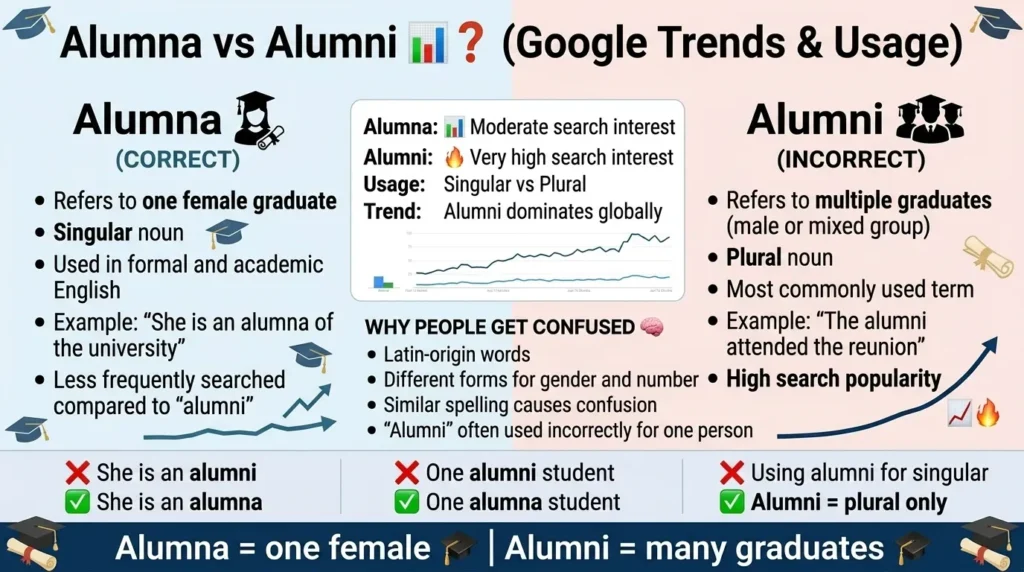
Data shows:
- Alumni is by far the most searched term worldwide.
- Alumna searches spike around graduations, reunions, and women-focused events.
- Alumnae is the least used term in search engines but appears in formal communications.
Country trends:
- US: Alumni > Alumna > Alumnae
- UK: Alumni ≈ Alumna > Alumnae
- India, Australia, Canada: Alumni dominates general use; alumna/alumnae appear in university communications.
Contextual tip: Use “alumni” if your audience is international or diverse.
Keyword Variations Comparison Table
| Term | Singular/Plural | Gender | Common Usage Context |
| Alumna | Singular | Female | Individual female graduate |
| Alumnus | Singular | Male | Individual male graduate |
| Alumni | Plural | Male/Mixed | Multiple graduates, general reference |
| Alumnae | Plural | Female | Multiple female graduates |
FAQs
1. Can I use alumni for one person?
- No, use “alumna” for a single female and “alumnus” for a single male.
2. Is alumnae only for women?
4. Are these words formal or informal?
- They are formal, often used in academic, professional, or official contexts.
5. Is there a shortcut to remember?
- Think: a = female, us = male, i = plural, ae = female plural.
6. Do British and American English spell them differently?
- No, spellings are the same. Only frequency and formality may differ.
7. Can I replace alumni with “graduates”?
- Yes, “graduates” is simpler and avoids gender confusion, but lacks the traditional Latin touch.
Conclusion
Understanding the difference between alumna and alumni is essential for clear communication.
Alumna refers to a single female graduate, alumnus to a single male, alumnae to multiple female graduates, and alumni to multiple male or mixed graduates.
While English borrowed these words from Latin, their endings have remained consistent, helping writers convey gender and number accurately.
In everyday usage, especially for emails, social media, news articles, or formal writing, it’s crucial to pick the correct form. When in doubt, “alumni” is safe for general plural references.
Awareness of British vs American usage can help international writers choose the right tone. Common mistakes, such as using “alumna” for a group or “alumni” for a single female, are easy to avoid once the rules are clear.
Using the right word shows attention to detail and respect for the audience,If you are addressing graduates, alumni associations, or school newsletters.
Following these guidelines ensures your writing is professional, accurate, and universally understood.
Related More Posts!
Tires or Tyres: Examples and Correct Usage 📝
Geese or Goose: Which One Is Correct? In 2026
Bison or Buffalo : What’s the Difference? in 2026

I am Sophia Martinez.I am an ESL grammar coach. I specialize in teaching English to non native speakers. My content focuses on commonly confused words like affect vs effect, their vs there, and verb tense comparisons. Sophia writes in a friendly, supportive tone designed to build confidence in learners.