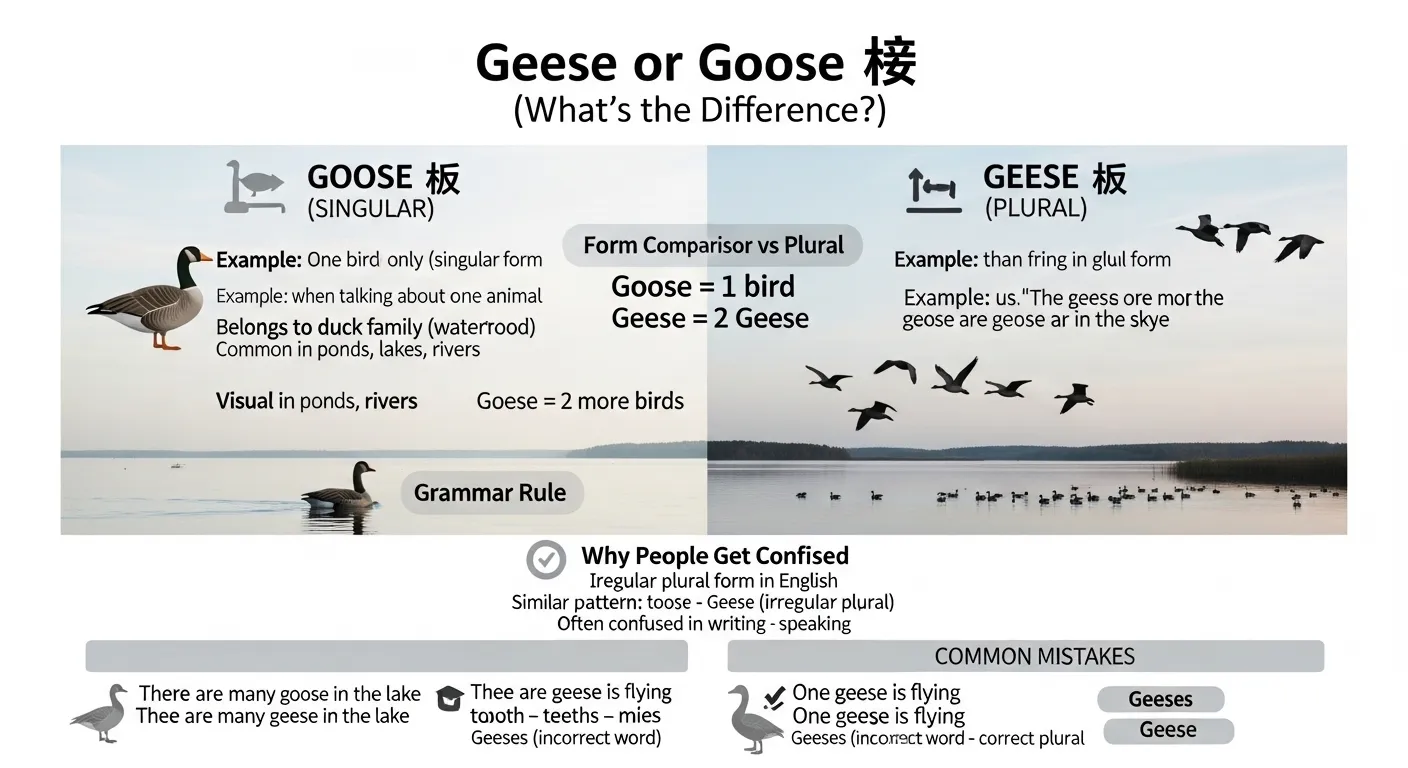
“Goose” is singular, while “geese” is the correct plural form.
Many learners get confused because most English words form plurals by adding “-s,” but this one is irregular. That is why people often search “geese or goose,” “what is the plural of goose,” or “is geese correct English.”
The confusion also appears in exams, writing tasks, and everyday speech. Some people incorrectly write “gooses,” while others are unsure when to use each form.
👉 Goose = one bird | Geese = more than one bird
This guide will make everything simple. You will learn the difference, origin, rules, examples, and common mistakes so you can use both forms confidently in writing and speaking.
Geese or Goose : Quick Answer ✅⚡
✔ Main Difference:
- Goose → Singular (one bird)
- Geese → Plural (more than one bird)
📌 Examples:
- ✔ A goose is swimming in the lake.
- ✔ Two geese are flying in the sky.
- ✔ A flock of geese is near the river.
👉 Rule: One = goose, Many = geese
Geese or Goose : Definitions with Examples 📖✍️
🟢 Goose (Definition)
A goose is a large water bird with a long neck, often found near lakes and rivers.
📌 Examples:
- A goose is walking near the pond.
- The goose is feeding its babies.
- I saw a white goose today.
🔵 Geese (Definition)
Geese is the plural form of goose, meaning more than one bird.
📌 Examples:
- The geese are flying south for winter.
- We saw geese near the lake.
- A group of geese is called a flock.
🟡 Simple Meaning
- Goose → one bird
- Geese → more than one bird
The Origin of Goose and Geese 📜⏳
The word comes from Old English:
- Goose → Old English “gōs”
- Geese → Old plural form from Germanic language rules
👉 English has irregular plurals because it evolved from multiple languages (Latin, Germanic, Old English). That is why we do not say “gooses.”
Why “geese” is irregular:
- Old English used vowel change for plurals
- Instead of adding “-s,” the vowel changed (oo → ee)
👉 This is called a vowel mutation plural
Geese or Goose : British vs American English 🌍🇬🇧🇺🇸
📌 Key Point:
Both British and American English use the same rule.
📊 Comparison Table:
| Form | Meaning | Usage Region |
| Goose | Singular bird | UK / USA / Global |
| Geese | Plural birds | UK / USA / Global |
👉 No difference in spelling rules between UK and US English for this word.
Which One Should You Use? 🎯📝
✔ Use “Goose” When:
- Talking about one bird
- Writing singular sentences
- Describing a single animal
✔ Use “Geese” When:
- Talking about multiple birds
- Describing groups or flocks
- Writing plural sentences
🧠 Easy Memory Trick
👉 Goose = One (O = One)
👉 Geese = Many (EE = Extra birds 😄)
Common Mistakes with Geese or Goose ❌⚠️
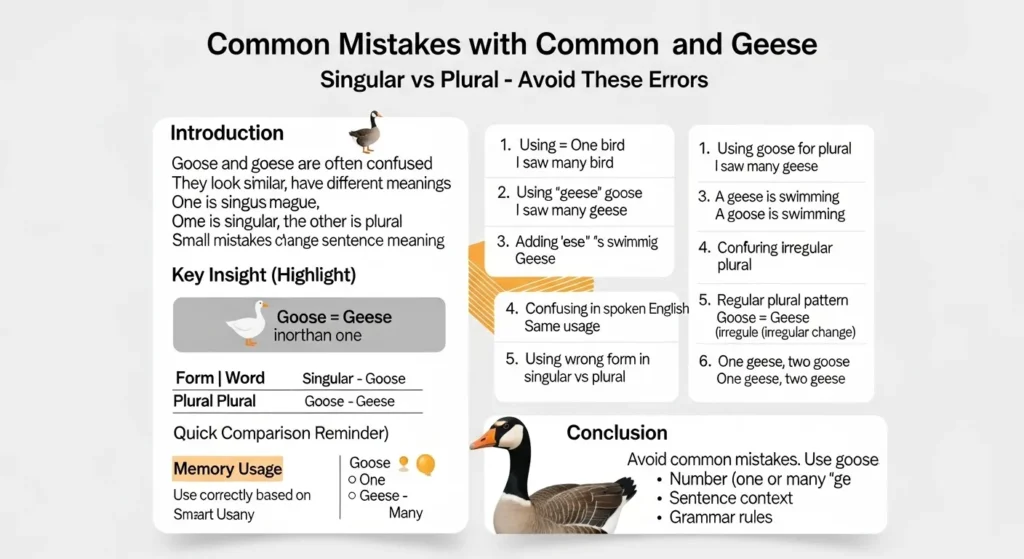
1. Writing “Gooses”
❌ There are gooses in the park
✔ There are geese in the park
2. Using Singular for Plural
❌ The goose are flying
✔ The geese are flying
3. Confusing Verb Agreement
✔ The geese are here (plural verb)
✔ The goose is here (singular verb)
4. Overgeneralizing English Plurals
❌ Thinking all plurals end in “-s”
✔ Some words are irregular
Geese or Goose in Everyday Examples 💬📱
🏠 Daily Life
- A goose is swimming in the lake.
- The geese are crossing the road.
📱 Social Media
- Saw a goose today 🦆
- So many geese flying together! 😍
📚 School Writing
- The goose is a water bird.
- Geese migrate in winter.
💼 Academic Writing
- The goose belongs to the Anatidae family.
- Geese migrate seasonally in groups.
Geese or Goose : Usage Trends & Popularity 📊📈
📌 Trend Insight:
- “Goose” → common in singular descriptions
- “Geese” → more common in natural and group descriptions
- Both are widely used correctly in education
👉 This word is often searched because it is an irregular plural, which is less predictable for learners.
Comparison Table 📋⚖️
| Feature | Goose | Geese |
| Number | One | More than one |
| Type | Singular | Plural |
| Rule | Basic form | Irregular plural |
| Example | A goose is here | Two geese are here |
| Verb Use | is | are |
Common User Queries 🔍🔥
- What is the plural of goose?
- Is geese correct English?
- Why is goose plural geese?
- Can we say gooses?
- What is the difference between goose and geese?
- Is geese singular or plural?
- How do you use geese in a sentence?
- Why is English plural irregular?
- What is a group of geese called?
- Is goose countable or uncountable?
FAQs ❓💡
1. What is the correct plural of goose?
✔ Geese
2. Is “gooses” correct?
❌ No, it is wrong
3. Is geese singular or plural?
✔ Plural
4. Why is geese not goose + s?
✔ Because it is an irregular English word
5. Can I say “a geese”?
❌ No, use “a goose”
6. What verb do we use with geese?
✔ “Are” (plural verb)
7. Easy way to remember?
✔ Goose = one, Geese = many
Conclusion 🧾📌
The difference between goose and geese is simple but important in English grammar. “Goose” is used for one bird, while “geese” is the correct plural form for more than one.
Many learners get confused because English has irregular plural rules, and this is one of the most common examples.
Instead of following the regular “add -s” rule, the word changes internally from “oo” to “ee,” which makes it unique. This is why “gooses” is incorrect and should never be used.
Understanding this rule helps you write correctly in exams, essays, and daily communication. The key is simple: use “goose” for one and “geese” for many.
In short, once you remember this pattern, you will never confuse it again. English has many irregular plurals, and “goose/geese” is one of the easiest to learn with practice.
Discover More Articals!
Affect vs Effect: What’s the Difference? In 30 Seconds
Your vs You’re: What’s the Difference? With Examples
Then vs Than: What’s the Difference? With Examples

I am Sophia Martinez.I am an ESL grammar coach. I specialize in teaching English to non native speakers. My content focuses on commonly confused words like affect vs effect, their vs there, and verb tense comparisons. Sophia writes in a friendly, supportive tone designed to build confidence in learners.