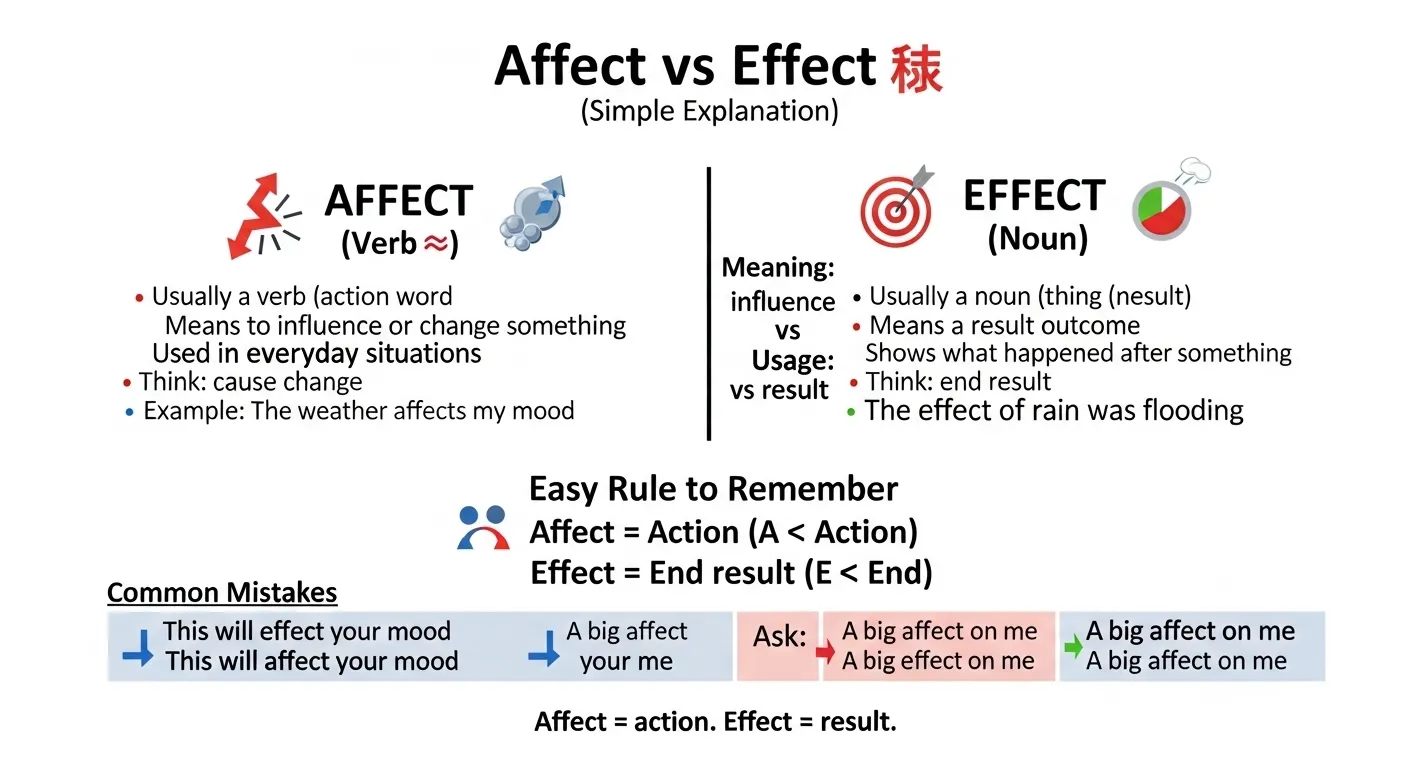
“Affect” is usually a verb (action), while “effect” is usually a noun (result).
Many learners search “affect vs effect” because both words sound similar and are often confused in writing. This confusion appears in exams, essays, emails, and everyday communication.
People often make mistakes like writing “this will effect your mood” or “a big affect on health.” These small errors can change the meaning of a sentence. The good news is that the rule is simple once you understand it.
This guide will help you clearly understand the difference between affect and effect using easy explanations, simple examples, and practical tips. By the end, you will be able to use both words correctly and confidently in any situation.
Affect vs Effect: Quick Answer ⚡✅
👉 Affect = verb (to influence or change)
👉 Effect = noun (a result or outcome)
👉 Featured Rule:
“Affect” changes something, while “effect” is the result of that change.
📌 Examples:
- ✔ The weather can affect your mood.
- ✔ The medicine had a positive effect.
- ✔ Lack of sleep affects health.
👉 Simple rule:
Affect = action
Effect = result
Affect vs Effect: Definitions with Examples & Top Queries 📖✍️
🟢 Affect (Definition)
“Affect” means to influence, change, or impact something.
📌 Examples:
- ✔ Stress can affect your health.
- ✔ Weather affects travel plans.
- ✔ Noise can affect concentration.
🔵 Effect (Definition)
“Effect” means the result or outcome of a change.
📌 Examples:
- ✔ The new rule had a strong effect.
- ✔ One effect of exercise is better health.
- ✔ The medicine produced a quick effect.
🔍User Queries:
People commonly search:
- affect vs effect difference
- when to use affect
- when to use effect
- affect meaning simple
- effect meaning with examples
- affect vs effect sentence examples
- is affect a verb or noun
- is effect a noun or verb
- easy trick affect vs effect
- common mistakes affect effect
👉 These searches show that most confusion is about usage and meaning.
The Origin of Affect vs Effect 📜⏳
Both words come from Latin:
- Affect → from afficere (to influence or act upon)
- Effect → from effectus (result or outcome)
👉 Over time, English kept both words but gave them different roles:
- Affect → action
- Effect → result
This is why both words sound similar but have different meanings.
Affect vs Effect: British vs American English 🌍🇬🇧🇺🇸
👉 There is no spelling difference between British and American English.
📊 Comparison Table
| Word | British English | American English |
| Affect | ✔ Same | ✔ Same |
| Effect | ✔ Same | ✔ Same |
👉 The difference is about usage, not spelling.
Affect vs Effect: Which One Should You Use? 🎯📝
✔ Use “Affect” When:
- Talking about influence or change
- Describing an action
👉 Example:
- This can affect your performance
✔ Use “Effect” When:
- Talking about a result
- Describing an outcome
👉 Example:
- This has a positive effect
🧠 Memory Trick:
👉 A = Action = Affect
👉 E = End result = Effect
Common Mistakes with Affect vs Effect ❌⚠️
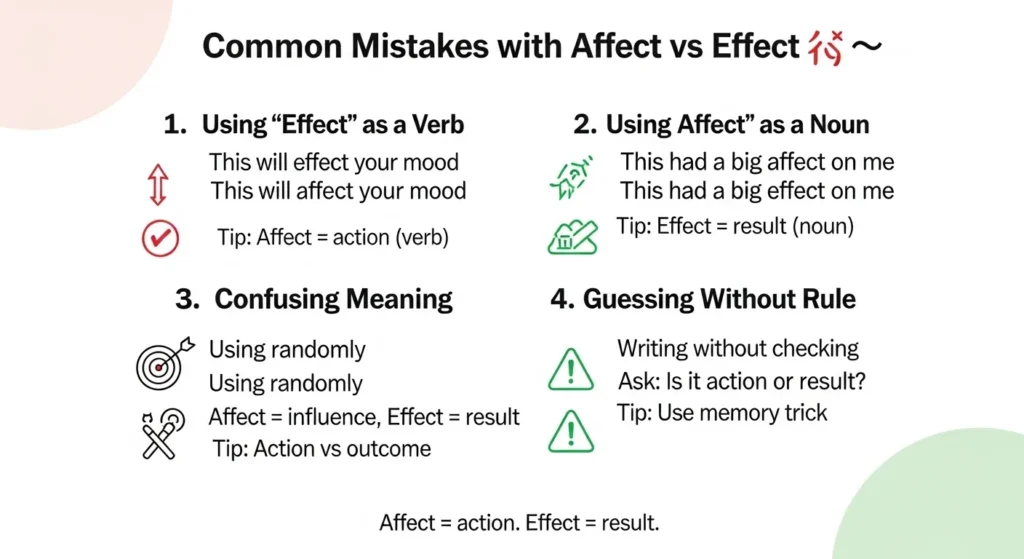
1. Using “affect” as a noun
❌ A big affect on health
✔ A big effect on health
2. Using “effect” as a verb (incorrectly)
❌ This will effect your mood
✔ This will affect your mood
3. Confusing roles
✔ Remember: verb vs noun
4. Guessing without rule
✔ Use the memory trick
Affect vs Effect in Everyday Examples 💬📱
🏠 Daily Life:
- Sleep can affect your mood
- Lack of sleep has a bad effect
📱 Social Media:
- Negativity can affect mindset
- Positivity has a strong effect
📚 School Writing:
- Pollution affects health
- Pollution has harmful effects
💼 Professional Writing:
- Market changes affect business
- Policy changes have major effects
Affect vs Effect: Usage Trends & Popularity 📊📈
📌 Key Insight:
- “Affect” → used as a verb (common in actions)
- “Effect” → used as a noun (common in results)
👉 Both words are widely used but in different contexts.
Comparison Table 📋⚖️
| Feature | Affect | Effect |
| Part of Speech | Verb | Noun |
| Meaning | To influence | Result or outcome |
| Usage | Action | Result |
| Example | Affect mood | Effect of stress |
FAQs ❓💡
1. What is the difference between affect and effect?
✔ Affect = action, Effect = result
2. Is affect a verb?
✔ Yes
3. Is effect a noun?
✔ Yes
4. Can effect be a verb?
✔ Rarely (means “to bring about”), but not common
5. Easy way to remember?
✔ A = action, E = end result
6. Which is more common?
✔ Both, depending on context
7. Are they interchangeable?
❌ No
Conclusion 🧾📌
The difference between “affect” and “effect” is simple when you understand their roles. “Affect” is usually a verb and means to influence or change something. “Effect” is usually a noun and refers to the result of that change.
The easiest way to remember is this: affect is the action, and effect is the outcome. This small difference is important in writing because using the wrong word can confuse your meaning.
A helpful tip is to always check the sentence. If you are describing an action, use “affect.” If you are describing a result, use “effect.” With practice, this rule becomes natural and easy.
By following these simple guidelines, you can avoid common mistakes and write clearly and correctly in exams, emails, and professional communication.
Discover More articals!
Layed or Laid: Which One Is Correct? (2026)
Family’s or Families: Which One Is Correct? (2026)
Knives or Knifes: Which One Is Correct? (Simple English Guide)

My name is James Whitmore.I am a language research writer. I explore the history and evolution of English words. I write detailed comparisons explaining why spellings change over time and how British and American English diverged. My articles add depth and credibility to grammar comparison topics.