“Loveable” and “lovable” are two spellings of the same adjective, but one is far more common and widely accepted in modern English.
Both words describe someone or something that inspires affection, warmth, or admiration. However, dictionaries, style guides, publishers, and professional writers overwhelmingly prefer “lovable.”
Strong rule:
Lovable = Standard and preferred spelling | Loveable = Less common variant
People often search:
- loveable vs lovable
- which spelling is correct
- is loveable a word
- lovable or loveable in British English
- how do you spell lovable
The confusion happens because many English words keep the silent e before adding a suffix. In this case, however, modern English usually drops the e, making lovable the standard form.
This guide explains the meanings, spelling rules, pronunciation, examples, usage trends, common mistakes, FAQs, and memory tricks so you can confidently choose the correct spelling.
Lovable or Loveable: Quick Answer ✅
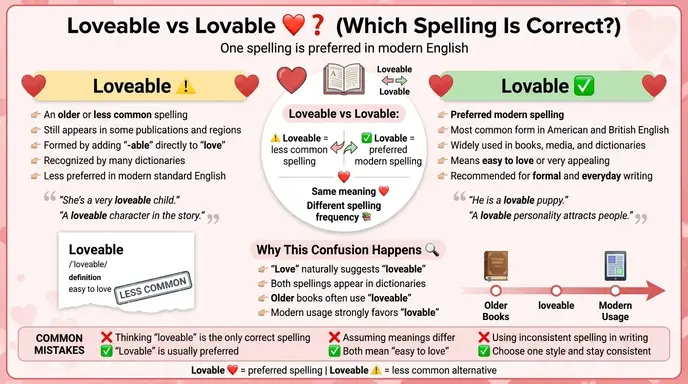
Both spellings exist, but “lovable” is the preferred and standard spelling in modern English.
| Spelling | Status |
| Lovable | ✅ Preferred |
| Loveable | ⚠ Less common variant |
Examples
✅ She has a lovable personality.
✅ The puppy is incredibly lovable.
⚠ She has a loveable personality.
While loveable is sometimes seen, lovable is the spelling recommended by most dictionaries and style guides.
👉 Simple rule: Use lovable in nearly all writing.
What Does Lovable Mean?
Lovable means:
- deserving love
- easy to love
- inspiring affection
- charming and appealing
It describes people, animals, characters, and even objects that naturally attract positive feelings.
Examples
✅ The child has a lovable smile.
✅ The dog is playful and lovable.
His lovable nature makes him popular.
Lovable in Everyday Life
People often use lovable to describe:
- family members
- friends
- pets
- fictional characters
Examples
✅ Her lovable personality wins people over.
✅ The kitten is adorable and lovable.
Animal example:
Golden Retriever
Is Loveable Also Correct?
Technically, yes.
Some dictionaries recognize loveable as a variant spelling.
However:
- It is much less common.
- It appears less frequently in professional writing.
- Many editors prefer lovable.
Examples
✔ A loveable character (acceptable)
✔ A lovable character (preferred)
In modern usage, lovable is generally considered the standard spelling.
Why Is Lovable More Common?
The reason comes from English spelling patterns.
Many words ending in -e drop the final e before adding a suffix.
Examples:
- move → movable
- believe → believable
- adore → adorable
- love → lovable
Pattern:
\text{love} + able \rightarrow \text{lovable}
This spelling became the dominant form over time.
Loveable vs Lovable: Core Difference 📊
Comparison Table
| Feature | Lovable | Loveable |
| Meaning | Same | Same |
| Standard Modern Spelling | ✔ | ❌ |
| Dictionary Recognition | ✔ | ✔ |
| Common Usage | Very Common | Less Common |
| Recommended for Writing | ✔ | Usually No |
The meaning is identical.
The difference is simply frequency and preference.
How to Pronounce Lovable and Loveable 🔊
Both spellings are pronounced the same way.
Pronunciation
/ˈlʌv.ə.bəl/
There is no pronunciation difference between them.
Lovable in Literature and Media
Writers frequently use lovable to describe characters who earn affection from readers and viewers.
Examples
✅ The story features a lovable hero.
✅ Audiences connected with the lovable character.
Character example:
Winnie the Pooh
Why Lovable Characters Matter
A lovable character often:
- creates emotional connection
- gains audience sympathy
- becomes memorable
Examples include:
- friendly heroes
- loyal companions
- humorous side characters
Lovable in Relationships ❤️
The word is commonly used to describe positive personal qualities.
Examples
✅ His lovable sense of humor attracts people.
✅ She has a lovable and caring personality.
Common Traits of Lovable People
- kindness
- empathy
- generosity
- warmth
- authenticity
Lovable in Marketing and Branding
Companies often try to create lovable brands.
A lovable brand is:
- trusted
- relatable
- emotionally appealing
Brand example:
Disney
Example
✅ The company created a lovable mascot.
Lovable in Psychology 🧠
Psychologists often discuss qualities that make people socially appealing.
Examples include:
- friendliness
- emotional intelligence
- warmth
- trustworthiness
Field example:
Psychology
Example
✅ People often perceive kindness as a lovable trait.
Usage Trends and Popularity
Across English-speaking countries, lovable is overwhelmingly more common.
United States 🇺🇸
✔ lovable dominates
United Kingdom 🇬🇧
✔ lovable dominates
Canada 🇨🇦
✔ lovable dominates
Australia 🇦🇺
✔ lovable dominates
Although loveable still appears occasionally, it is much rarer.
Why People Misspell Lovable as Loveable
Several factors contribute to the confusion.
The Base Word Is “Love”
People naturally assume:
love + able = loveable
This seems logical.
Other Words Keep the E
Examples:
- peaceable
- noticeable
- serviceable
This leads some writers to expect the same pattern.
Older Variants Still Exist
Older texts sometimes used loveable more frequently.
Common Mistakes with Loveable and Lovable ❌
Mistake #1: Assuming Loveable Is the Standard Form
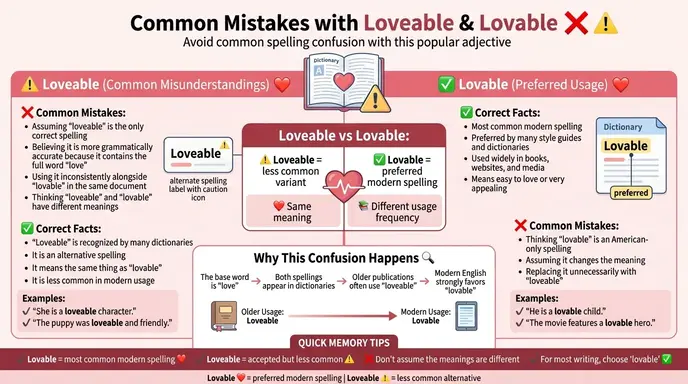
❌ Not usually
✔ Lovable is preferred.
Mistake #2: Thinking They Have Different Meanings
❌ Incorrect
They mean exactly the same thing.
Mistake #3: Mixing Spellings
Choose one spelling style and remain consistent.
Professional writers usually choose lovable.
Mistake #4: Believing Loveable Is Wrong
❌ Not entirely wrong
✔ It is simply less common.
Memory Tricks ✨
Trick #1: Think of Believable
- believe → believable
- love → lovable
The pattern is similar.
Trick #2: Dictionaries Prefer Lovable
If unsure:
✔ lovable
Trick #3: Remember the Shorter Form
Modern English often favors simplified spellings.
lovable = shorter and more common.
Loveable vs Lovable in British and American English 🌍
Unlike many spelling differences, there is no major UK-US split here.
American English 🇺🇸
✔ lovable
British English 🇬🇧
✔ lovable
Australian English 🇦🇺
✔ lovable
Canadian English 🇨🇦
✔ lovable
Both regions overwhelmingly prefer the same spelling.
Comparison Table
| Feature | Lovable | Loveable |
| Correct | ✔ | ✔ |
| Preferred | ✔ | ❌ |
| Modern Usage | Very Common | Less Common |
| Meaning | Same | Same |
| Pronunciation | Same | Same |
| Recommended | ✔ | ❌ |
Common User Queries
- Is it lovable or loveable?
- Which spelling is correct?
- Is loveable a real word?
- Why is lovable more common?
- Do lovable and loveable mean the same thing?
- Which spelling should I use?
- Is lovable American English?
- Is lovable British English?
- How do you pronounce lovable?
- Which spelling do dictionaries prefer?
FAQs
Is lovable correct?
Yes. It is the preferred modern spelling.
Is loveable correct?
Yes, but it is less common.
Do they have different meanings?
No. They mean exactly the same thing.
Which spelling should I use in professional writing?
✔ Lovable
Which spelling is more common?
✔ Lovable
Is lovable used in both British and American English?
Yes.
Which spelling is best?
✔ Lovable
Conclusion
Both “lovable” and “loveable” are recognized spellings, but “lovable” is the standard and overwhelmingly preferred form in modern English. It appears more frequently in dictionaries, books, websites, newspapers, and professional writing.
The meanings are identical, and the pronunciation is the same. The only real difference is that lovable has become the accepted mainstream spelling.
👉 Final takeaway: Use “lovable” in almost all situations. While “loveable” isn’t necessarily wrong, it is much less common and generally not recommended for modern writing.
Discover More Articles!
Now or Laters: What’s the Difference? With Simple Examples
Modelling or Modeling: Which Spelling Is Correct?
Resale or Resell: What’s the Difference? With Examples

My name is James Whitmore.I am a language research writer. I explore the history and evolution of English words. I write detailed comparisons explaining why spellings change over time and how British and American English diverged. My articles add depth and credibility to grammar comparison topics.