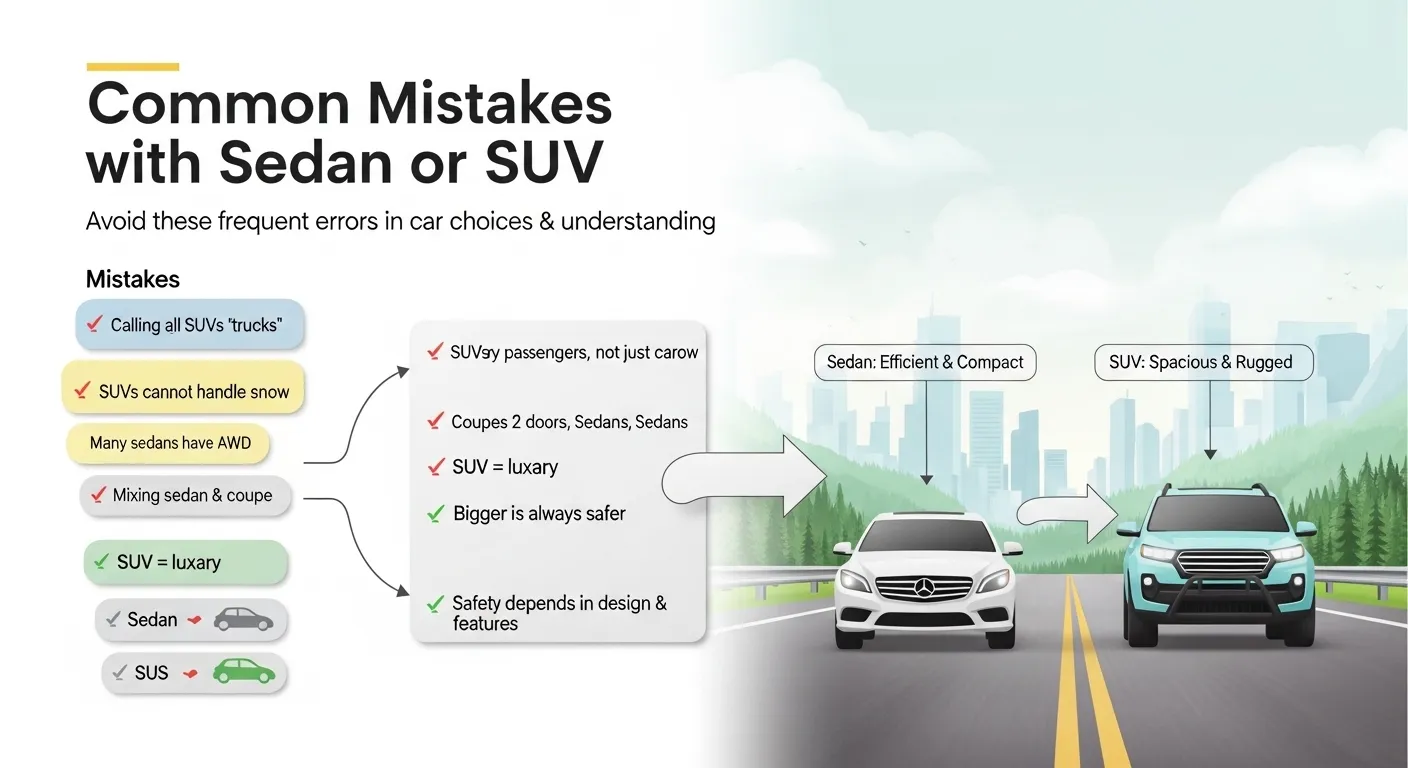
SUV is better for space and rough roads, while Sedan is better for fuel efficiency and city driving.
A sedan vs SUV depends on your lifestyle, needs, and driving habits. Sedans are smaller, fuel efficient, and easy to park. SUVs are larger, provide more space, and handle rough roads better.
Many people search “sedan or SUV” to figure out which car type fits them. Choosing the wrong type can lead to regret, higher costs, and inconvenience.
This guide explains the difference between a sedan and an SUV, their benefits, common mistakes, and real life usage. By the end, you will know which option suits you best.
Sedan and SUV: Quick Answer
A sedan is a smaller, passenger focused vehicle with a fixed roof and a trunk. Ideal for city driving and fuel efficiency.
An SUV (Sport Utility Vehicle) is larger, higher off the ground, and often comes with all wheel drive. Good for families, off road driving, and carrying cargo.
Examples:
| Vehicle Type | Example Models | Best For |
| Sedan | Toyota Camry, Honda Accord | City driving, commuting, small families |
| SUV | Ford Explorer, Toyota RAV4 | Road trips, outdoor activities, large families |
Sedans save fuel and are cheaper to maintain. SUVs provide space, safety, and versatility. The choice depends on what matters more to you: efficiency or space.
The Origin of Sedan and SUV
Sedan: The term comes from the Italian word “sedia”, meaning chair. Historically, a sedan was a covered chair carried by people.
In the 20th century, it became associated with passenger cars with four doors and a separate trunk.
SUV: Stands for Sport Utility Vehicle. SUVs originated from off road vehicles used by militaries and explorers. In the 1980s, manufacturers created family friendly SUVs combining off road capability with comfort.
These terms evolved over decades, and their meaning is now standard worldwide. Knowing the history helps understand why these vehicles have distinct designs and uses.
British English vs American English Spelling
Both sedan and SUV have consistent spelling globally, but their usage varies slightly:
| Feature | British English | American English |
| Term for sedan | Saloon | Sedan |
| Term for SUV | SUV | SUV |
| Common use | “Saloon car” in UK | “Sedan” in US |
| Abbreviations | Rarely abbreviated | Often abbreviated |
| Vehicle marketing | Saloon cars, 4x4s | Sedans, SUVs |
In the UK, people often say saloon instead of sedan, while SUV is universal. Awareness of regional terms helps avoid confusion when buying or selling cars internationally.
Which Spelling Should You Use?
- US audience: Use sedan and SUV.
- UK/Commonwealth: Use saloon or sedan, SUV remains the same.
- Global platforms: Use sedan or SUV for clarity.
For websites, social media, or emails targeting mixed audiences, “sedan or SUV” is most widely recognized. Always consider your readers’ location and familiarity with car terminology.
Common Mistakes with Sedan or SUV
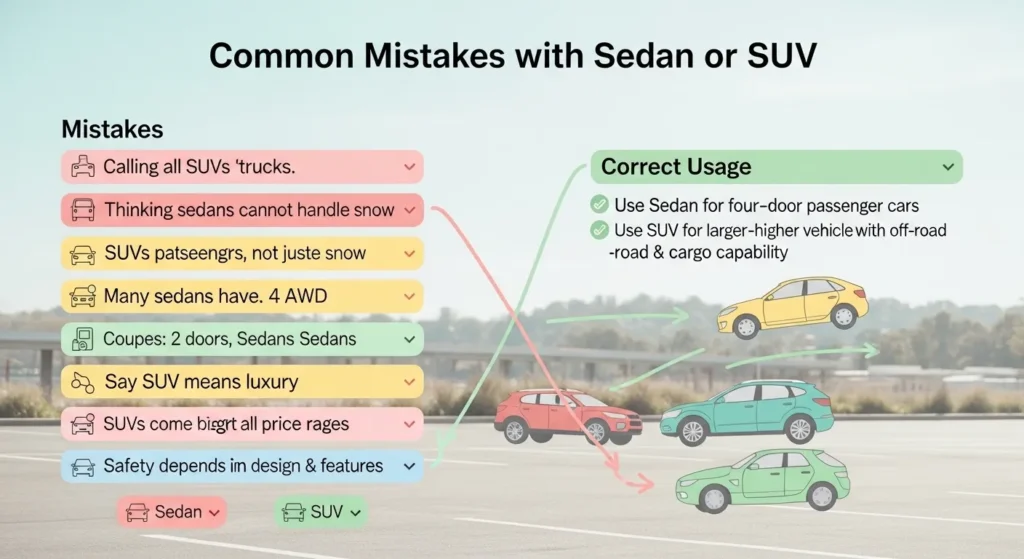
Many people confuse features or use the terms incorrectly.
Frequent errors:
- Calling all SUVs “trucks.” : Trucks are cargo focused; SUVs carry passengers too.
- Thinking sedans cannot handle snow or hills : Many sedans have all wheel drive.
- Mixing sedan and coupe : Coupes usually have two doors; sedans have four.
- Saying SUV means luxury : SUVs come in all price ranges.
- Assuming bigger is always safer : Size helps, but safety depends on design and features.
Corrections:
- Use sedan for four door passenger cars.
- Use SUV for larger, higher vehicles with off road or cargo capability.
SUV or Sedan in Everyday Examples
Emails:
- “We recommend a sedan or SUV for your company fleet based on fuel and cargo needs.”
News:
- “Sales of SUVs surpassed sedans in 2025 as more families prefer space and versatility.”
Social media:
- “Choosing between a sedan or SUV? Check your lifestyle first!”
Formal writing:
- “Consumers face a decision between sedan or SUV, weighing efficiency against passenger capacity.”
Daily conversation:
- “I prefer an SUV for road trips, but a sedan is better for city traffic.”
Sedan or SUV: Google Trends & Usage Data
Data shows that interest in SUVs has grown in the last decade, particularly in the US, Canada, and Australia. Sedans remain popular in cities where fuel efficiency and parking are crucial.
Top countries searching:
| Country | Most Searched Vehicle Type |
| United States | SUV |
| United Kingdom | Sedan / Saloon |
| Canada | SUV |
| Australia | SUV |
| India | Sedan |
The trend shows that SUVs are becoming the default family choice in suburban and rural areas, while sedans dominate urban markets.
Comparison Table: Sedan vs SUV
| Feature | Sedan | SUV |
| Size | Smaller | Larger |
| Fuel efficiency | High | Medium Low |
| Passenger space | 4 :5 people | 5 :7 people |
| Cargo space | Small trunk | Large trunk / foldable seats |
| Off road capability | Low | High |
| Price range | Affordable : Mid range | Mid range : High end |
| Driving style | Smooth, urban | High, rugged, versatile |
FAQs: Sedan or SUV
1. Which is cheaper to maintain, sedan or SUV?
Sedans are usually cheaper. SUVs consume more fuel and may have higher insurance costs.
2. Can a sedan handle off road roads?
Not usually. SUVs are better for rough terrain, though some sedans have AWD.
3. Which is safer, sedan or SUV?
Safety depends on features, not size alone. SUVs offer higher driving positions; sedans have lower rollover risk.
4. Are SUVs good for city driving?
They can be bulky in traffic and parking. Sedans are more convenient in cities.
5. Do SUVs use more fuel than sedans?
Yes, SUVs are larger and heavier, so they consume more fuel.
6. Is a sedan better for long trips?
Sedans are comfortable for long trips but have less cargo space than SUVs.
7. Which vehicle holds more passengers?
SUVs usually seat 5 :7 people; sedans typically seat 4 :5.
Conclusion
Choosing a sedan or SUV depends on your priorities. Sedans offer efficiency, easy parking, and comfort for everyday city use.
SUVs provide space, versatility, and better handling for families and outdoor activities. Consider where you drive most often, your family size, and how much cargo you need to carry.
Also, factor in costs like fuel, insurance, and maintenance. If you commute in the city, a sedan is ideal. For suburban life, long trips, or rough terrain, an SUV is better.
Understanding these differences helps you make a smart, satisfying choice. Remember, the right choice enhances safety, comfort, and convenience in your daily life.
Discover More Posts!
Aluminium or Aluminum: Which One Is Correct?📚
Elses or Else’s: Which One Is Correct?
Tile or AirTag: Which One Should You Choose?

My name is James Whitmore.I am a language research writer. I explore the history and evolution of English words. I write detailed comparisons explaining why spellings change over time and how British and American English diverged. My articles add depth and credibility to grammar comparison topics.