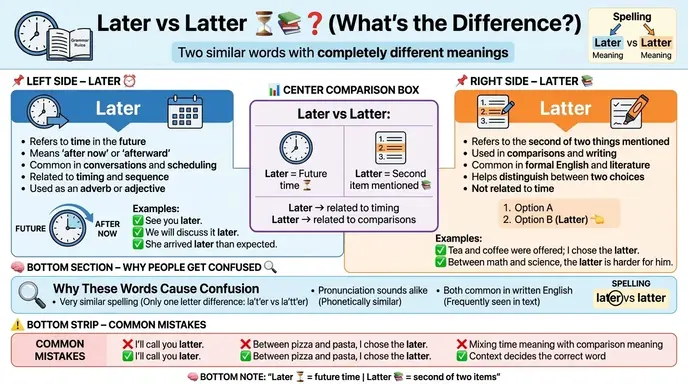
“Later” and “latter” are commonly confused English words because they look similar, but they have completely different meanings. “Later” relates to time, while “latter” refers to the second item in a pair or list.
Strong rule:
Later = time | Latter = second of two things
People often search: “later vs latter,” “difference between later and latter,” “how to use latter,” and “when should I use later.” The confusion happens because the words differ by only one letter.
This article explains the meanings, pronunciation, grammar, examples, comparison rules, and memory tricks to help you confidently use the correct word.
Later or Latter : Quick Answer ✅
“Later” refers to time, while “latter” refers to the second of two mentioned things.
✔ Main Difference:
- Later → after some time
- Latter → the second item mentioned
📌 Examples:
- ✔ I’ll call you later.
- ✔ Tea and coffee are both popular, but I prefer the latter.
👉 Simple rule:
Later = time | Latter = second choice
What Does “Later” Mean? ⏰📖
“Later” means:
- after a certain time
- in the future
- afterward
📌 Examples:
- We can meet later tonight.
- She finished the work later than expected.
- Talk to you later!
Time sequence concept:
\text{now} \rightarrow \text{later}
What Does “Latter” Mean? 📚
“Latter” refers to:
- the second of two things mentioned
- the last-mentioned option in a pair
📌 Examples:
- Between summer and winter, I prefer the latter.
- He considered law and medicine but chose the latter.
Comparison concept:
\text{first item} \quad | \quad \text{latter = second item}
Latter vs Later: Core Difference 📚
📊 Comparison Table:
| Feature | Later | Latter |
| Main Meaning | Future time | Second of two items |
| Grammar Role | Adverb/adjective | Noun/adjective |
| Topic | Time | Comparison |
| Example | See you later | Prefer the latter |
| Opposite | Earlier | Former |
Why People Confuse Later and Latter 🧠
1. Similar Spelling
Only one extra “t” separates them:
- later
- latter
2. Similar Pronunciation
The words sound somewhat alike in fast speech.
3. Academic Usage
“Latter” appears more in:
- formal writing
- essays
- comparisons
while “later” appears in daily conversation.
How to Pronounce Later and Latter 🔊
Later Pronunciation
/ˈleɪ.tɚ/
Latter Pronunciation
/ˈlæt̬.ɚ/
👉 The vowel sound changes:
- lay-ter
- lat-ter
Using “Later” Correctly ⏰
Common Uses of Later:
1. Future Time
- I’ll eat later.
2. Comparative Timing
- She arrived later than me.
3. Informal Goodbye
- See you later!
Using “Latter” Correctly 📚✨
“Latter” works best when:
- comparing two choices
- discussing two mentioned items
📌 Examples:
- Between cats and dogs, I prefer the latter.
- The movie and the book were good, but the latter was better.
Former and Latter Pair 📖⚖️
“Latter” is often paired with:
✔ former
Meaning:
- former → first item
- latter → second item
📌 Example:
- Between science and history, the former is harder for me, but the latter is more interesting.
Former/latter relationship:
\text{former} = \text{first} \quad | \quad \text{latter} = \text{second}
Everyday Examples 📱
🏠 Daily Life
- I’ll clean the room later.
- Coffee and tea are both good, but I prefer the latter.
📱 Social Media
- Talk to you later 👋
📚 Academic Writing
- The latter argument is more convincing.
💼 Professional Writing
- The latter proposal offered lower costs.
Common Mistakes with Later and Latter ❌⚠️
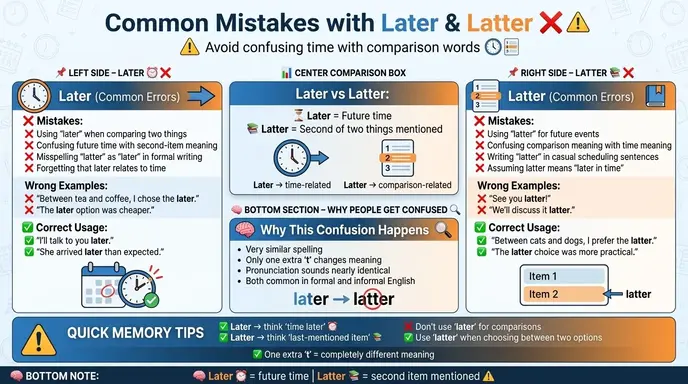
1. Using “Latter” for Time
❌ I’ll see you latter.
✔ I’ll see you later.
2. Using “Later” for Comparisons
❌ I chose the later option.
✔ I chose the latter option.
3. Forgetting “Latter” Needs Two Items
✔ Usually used after mentioning two choices.
4. Spelling Confusion
✔ One extra “t” changes the meaning completely.
Memory Tricks to Remember Easily 🧠✨
👉 Trick 1: Later = Time Later
Both involve:
✔ future time
👉 Trick 2: Latter Has Extra “T” for “Two”
Latter helps compare:
✔ two items
👉 Trick 3: Former and Latter Pair Together
- former → first
- latter → second
British vs American English Usage 🌍
📌 Key Point:
Both British and American English use:
- later
- latter
with the same spellings and meanings.
📊 Comparison Table:
| Word | British English | American English |
| Later | Same | Same |
| Latter | Same | Same |
👉 No major regional spelling difference exists.
Comparison Table 📋
| Feature | Later | Latter |
| Meaning | Future time | Second item |
| Common Usage | Very common | More formal |
| Used for Time | Yes | No |
| Used for Comparison | No | Yes |
| Example | Later today | The latter option |
Common User Queries 🔍
- What is the difference between later and latter?
- How do you use latter in a sentence?
- Is latter related to time?
- What does later mean?
- What does latter mean?
- What is former and latter?
- Why are these words confusing?
- How do you pronounce latter?
- Can latter be used casually?
- How can I remember later vs latter?
FAQs 💡
1. What does later mean?
✔ After some time
2. What does latter mean?
✔ The second of two mentioned items
3. Is latter about time?
❌ No
4. Can later mean future?
✔ Yes
5. What is the opposite of latter?
✔ Former
6. Is latter formal?
✔ Often more formal than later
7. Easy rule?
✔ Later = time, latter = second item
Conclusion 🧾
“Later” and “latter” may look similar, but they serve very different purposes in English. “Later” refers to time and means afterward or in the future, while “latter” refers to the second item in a pair or comparison.
The confusion often comes from their similar spelling, but remembering the connection between “latter” and “former” can make usage much easier.
If writing casually or formally, understanding the distinction improves clarity and grammar accuracy.
Final takeaway: Use “later” for time and “latter” for the second of two mentioned things.
Discover More Articles!
Psychologist or Psychiatrist: What’s the Difference? 🧠👨⚕️2026
Kiss or Die: What Does It Mean? 💋In 30 Seconds
Whit or Without: What’s the Difference? ✨With Examples

My name is James Whitmore.I am a language research writer. I explore the history and evolution of English words. I write detailed comparisons explaining why spellings change over time and how British and American English diverged. My articles add depth and credibility to grammar comparison topics.