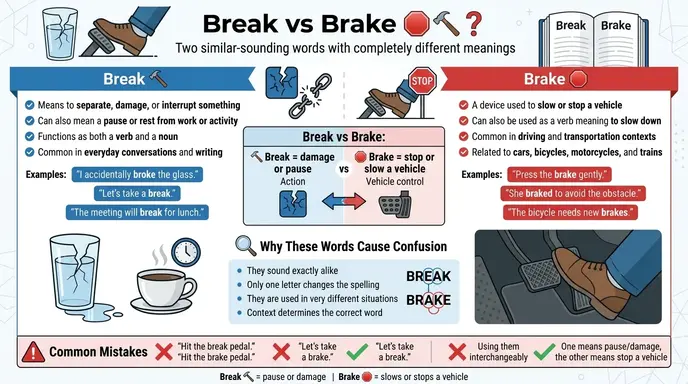
Have you ever stopped while writing and wondered If to use break or brake? You’re not alone. These two words sound exactly the same, making them homophones words with the same pronunciation but different meanings and spellings.
Because they sound alike, many English learners and even native speakers accidentally use one when they mean the other.
People commonly search for “break or brake” because they want to know which word fits a particular sentence.
For example, should you write “take a break” or “take a brake”? Is it “brake pedal” or “break pedal”?
The confusion becomes even greater in emails, school assignments, business writing, and social media posts, where spelling mistakes can change the meaning completely.
The good news is that the difference is easy to remember once you understand each word’s purpose.
Break usually means to separate, damage, interrupt, or pause, while brake refers to the device used to slow or stop a vehicle.
This guide explains their meanings, origins, correct usage, examples, common mistakes, and practical tips so you’ll never confuse them again.
Break or Brake : Quick Answer ✅
The simple answer is:
- Break = To separate, damage, interrupt, or take a pause.
- Brake = A device or action used to slow or stop a vehicle.
Examples
✅ Let’s take a break after lunch.
✅ Be careful not to break the glass.
Press the brake before turning.
The car’s brake pedal feels soft.
❌ Take a brake from work.
❌ He used the break pedal to stop the car.
Quick Comparison
| Word | Meaning | Example |
| Break | Pause, damage, separate | Let’s take a break. |
| Brake | Stops or slows a vehicle | Press the brake gently. |
Quick Tip:
If you’re talking about resting or something breaking, use break.
If you’re talking about cars, bikes, or stopping, use brake.
The Origin of Break or Brake 📜
Although they sound identical today, break and brake developed from different historical roots and meanings.
The Origin of “Break”
The word break comes from the Old English word brecan, meaning:
- to split
- to shatter
- to separate
- to destroy
For centuries, English speakers have used break to describe physical damage as well as interruptions.
Examples:
- break a window
- break a promise
- break the silence
- coffee break
Over time, the meaning expanded beyond physical objects to include pauses, interruptions, and even emotional situations.
The Origin of “Brake”
The word brake originally referred to a tool or mechanism used to slow movement. It later became associated with vehicles as transportation evolved.
Today, brake almost always refers to:
- a car brake
- bicycle brakes
- motorcycle brakes
- train brakes
Unlike break, this word is strongly connected with transportation and safety.
Why the Confusion Exists
The confusion exists because both words are pronounced the same:
/breɪk/
However, their meanings are completely different.
One refers to stopping or pausing.
The other refers to a mechanical system that slows a vehicle.
Because English spelling doesn’t always match pronunciation, many people accidentally type the wrong word.
British English vs American English Spelling 🌍
Unlike words such as colour/color or organise/organize, there is no spelling difference between British and American English.
Both countries use exactly the same spellings.
Comparison Table
| American English | British English |
| Break | Break |
| Brake | Brake |
Examples
🇺🇸 American English
✅ Take a break.
✅ Apply the brake slowly.
🇬🇧 British English
✅ Take a break.
✅ Apply the brake slowly.
The spellings never change based on region.
Which Spelling Should You Use? ✍️
Choosing the correct spelling depends entirely on the meaning not on your audience or country.
Use Break When Talking About:
- resting
- damaging something
- interrupting
- separating
- ending something temporarily
Examples:
✅ We need a short break.
✅ Don’t break the vase.
She broke the world record.
Use Brake When Talking About:
- cars
- buses
- bicycles
- motorcycles
- trains
- stopping a vehicle
Examples:
✅ The driver hit the brake.
✅ My bicycle brake needs repair.
Always test your brakes before driving.
Audience-Based Advice
| Audience | Recommended Usage |
| United States | Break / Brake |
| United Kingdom | Break / Brake |
| Canada | Break / Brake |
| Australia | Break / Brake |
| Global Audience | Break / Brake |
The meaning not geography determines which word you should choose.
What Does “Break” Mean? 💥
Break is both a verb and a noun.
As a Verb
It means:
- to separate into pieces
- to damage
- to interrupt
- to stop working
Examples:
✅ Don’t break the plate.
✅ He accidentally broke his phone.
The machine broke yesterday.
As a Noun
It means a pause or interruption.
Examples:
✅ Let’s take a lunch break.
✅ The students had a short break between classes.
She needs a break from work.
Common Phrases with Break
- break the news
- break a promise
- break the law
- break a record
- coffee break
- spring break
- break the silence
- break free
These expressions all use break, never brake.
What Does “Brake” Mean? 🚗
Brake can also be a noun or a verb.
As a Noun
A brake is the mechanical system that slows or stops a moving vehicle.
Examples:
✅ The brake pedal is stuck.
✅ My car needs new brakes.
The bicycle brake is loose.
As a Verb
To brake means to slow down or stop by using the braking system.
Examples:
✅ Brake gently on wet roads.
✅ The driver braked to avoid the accident.
Always brake before sharp turns.
Common Phrases with Brake
- brake pedal
- emergency brake
- parking brake
- brake fluid
- brake pads
- brake lights
- brake system
These expressions always use brake because they relate to vehicles.
Break vs Brake : Key Differences 📊
| Feature | Break | Brake |
| Meaning | Pause, damage, separate | Slow or stop a vehicle |
| Part of Speech | Noun & Verb | Noun & Verb |
| Used for Vehicles | ❌ | ✅ |
| Used for Rest | ✅ | ❌ |
| Used for Damage | ✅ | ❌ |
| Used in Mechanical Systems | Rarely | ✅ |
Break or Brake in Everyday Examples 💬
In Emails
✅ I’m taking a short break and will reply later.
❌ I’m taking a short brake and will reply later.
At Work
✅ Employees receive a 30-minute lunch break.
At School
✅ Students have a morning break after two classes.
While Driving
✅ Press the brake slowly before the stop sign.
❌ Press the break slowly before the stop sign.
In Vehicle Repairs
✅ The mechanic replaced the front brake pads.
❌ The mechanic replaced the front break pads.
Break or Brake : Google Trends & Usage Data 📊
Both break and brake are searched millions of times each year, but for different reasons.
“Break” is one of the most common words in the English language. It appears in everyday conversations, education, business, sports, technology, and entertainment.
People search it when learning English, writing emails, or looking up common phrases such as “take a break” or “break a record.”
“Brake” is searched most often by drivers, vehicle owners, mechanics, and people studying driving rules.
Popular searches include “brake pads,” “brake fluid,” “brake warning light,” and “how to brake safely.”
Search Popularity by Context
| Keyword | Common Search Intent |
| Break | Grammar, phrases, meanings, writing |
| Brake | Cars, bikes, driving, repairs |
Countries Where the Searches Are Popular
Both keywords receive significant search interest in:
- United States 🇺🇸
- United Kingdom 🇬🇧
- Canada 🇨🇦
- Australia 🇦🇺
- India 🇮🇳
Why People Confuse Them
The biggest reason is pronunciation.
Both words sound exactly the same:
/breɪk/
Since English has many homophones, writers often type the wrong spelling even though they know the meaning.
Common Mistakes with Break or Brake ❌
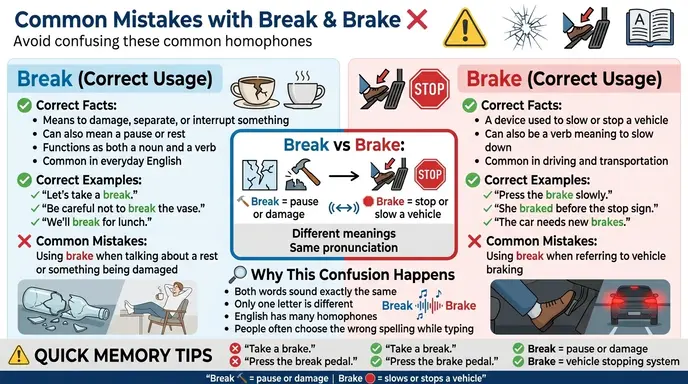
These are the mistakes English learners make most often.
Mistake #1: Writing “Brake” Instead of “Break”
❌ Let’s take a brake.
✅ Let’s take a break.
A pause is always a break.
Mistake #2: Writing “Break” for Car Parts
❌ My car needs new break pads.
✅ My car needs new brake pads.
Vehicle parts always use brake.
Mistake #3: Confusing the Verbs
❌ He breaked suddenly.
✅ He braked suddenly.
If someone slows a vehicle, the verb is brake.
Mistake #4: Mixing Up Common Expressions
Correct expressions include:
- take a break
- coffee break
- lunch break
- break the rules
- break a promise
Never replace break with brake in these expressions.
Mistake #5: Forgetting That Both Are Verbs
Many people think brake is only a noun.
Actually:
✅ The driver braked quickly.
Brake is also a verb.
Memory Tricks 🧠✨
Remembering the difference is much easier with these simple tricks.
Trick #1: Brake Has an “A”
Think:
A = Automobile
Brake is used for cars.
Trick #2: Break Means Rest
Think:
Coffee Break
You never drink a coffee brake.
Trick #3: Break = Broken
Both words begin with Break.
If something is damaged, it is broken.
Trick #4: Brake Stops Movement
If your car stops,
you use the brake.
Break vs Brake Comparison Table 📋
| Feature | Break | Brake |
| Correct Spelling | ✔ | ✔ |
| Main Meaning | Pause, damage, interrupt | Stop or slow a vehicle |
| Pronunciation | /breɪk/ | /breɪk/ |
| Part of Speech | Noun & Verb | Noun & Verb |
| Used for Cars | ❌ | ✔ |
| Used for Rest | ✔ | ❌ |
| Used for Damage | ✔ | ❌ |
| Used in Driving | ❌ | ✔ |
| Common Phrase | Take a break | Brake pedal |
Break or Brake in Common Expressions 📝
Expressions with Break
- break the law
- break the news
- break a promise
- break the silence
- break a record
- coffee break
- lunch break
- spring break
Expressions with Brake
- brake pedal
- brake pads
- brake fluid
- parking brake
- emergency brake
- brake lights
- brake system
Common User Queries 🔍
- Is it break or brake?
- What is the difference between break and brake?
- How do you spell brake for a car?
- Is “take a break” correct?
- Is “brake pedal” correct?
- Can brake be a verb?
- Why do break and brake sound the same?
- Is brake used outside driving?
- How can I remember break vs brake?
- Which word is more common?
FAQs
Is it “take a break” or “take a brake”?
✅ Take a break is correct.
Is it brake pedal or break pedal?
✅ Brake pedal is correct.
What does break mean?
It means to pause, damage, interrupt, or separate.
What does brake mean?
It means a device or action used to slow or stop a vehicle.
Are break and brake pronounced differently?
No.
Both are pronounced:
/breɪk/
Can brake be used as a verb?
Yes.
Example:
✅ The driver braked suddenly.
Which word is used more often?
Break is much more common because it appears in everyday conversation and many idioms.
Conclusion 📌
Although break and brake sound exactly alike, they have completely different meanings and uses.
Break refers to stopping, pausing, interrupting, or damaging something. It appears in many everyday expressions, such as “take a break,” “break a promise,” and “break the law.”
Brake, on the other hand, is connected to vehicles and means the system or action used to slow down or stop a car, bicycle, motorcycle, or other form of transportation.
The easiest way to remember the difference is to think about the context. If you’re talking about resting, interrupting, or something becoming damaged, choose break.
If you’re talking about driving or stopping a vehicle, choose brake. Since both words are pronounced the same, spelling is especially important in writing.
By understanding their meanings, practicing common examples, and using the simple memory tricks in this guide, you’ll be able to choose the correct word every time.
👉 Final takeaway: Break = pause or damage. Brake = stop a vehicle. Remember the meaning, not just the sound.
Discover More Articles!
Red or Blue: Which One Should You Choose?
Spotting or Period: What’s the Difference? 🩸
Weird or Wierd: Which Spelling Is Correct? 🤔

My name is James Whitmore.I am a language research writer. I explore the history and evolution of English words. I write detailed comparisons explaining why spellings change over time and how British and American English diverged. My articles add depth and credibility to grammar comparison topics.