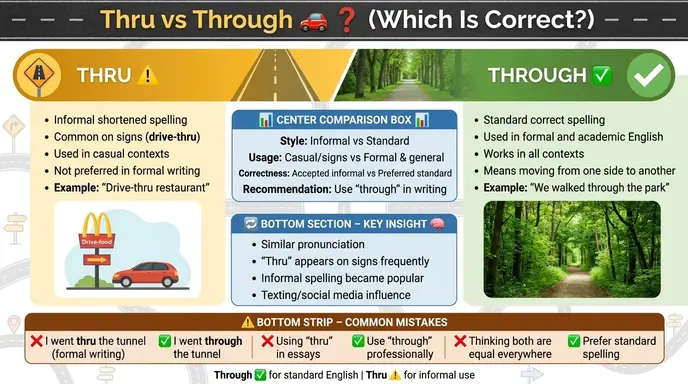
“Through” is the standard and correct spelling in formal English, while “thru” is an informal shortened version mainly used in signs, branding, and casual writing.
Many learners get confused because both spellings appear in daily life, especially in phrases like “drive-thru.”
👉 Strong rule: Use “through” in formal, academic, and professional writing.
People often search: “thru vs through,” “is thru a real word,” “when to use thru,” and “which spelling is correct.” The confusion happens because English sometimes accepts shortened spellings in informal situations.
This guide explains the meanings, differences, examples, and common mistakes so you can confidently choose the correct spelling in every situation.
Thru or Through : Quick Answer ✅
“Through” is the correct standard spelling. “Thru” is an informal alternative mainly used in casual contexts.
✔ Main Difference:
- Through → formal and standard English
- Thru → informal simplified spelling
📌 Examples:
- ✔ We walked through the park.
- ✔ The tunnel goes through the mountain.
- ✔ Drive-thru restaurants are popular.
- ❌ Please read the document thru carefully.
👉 Simple rule:
Through = formal | Thru = informal
Thru or Through : Definitions with Examples 📖
🟢 Through (Definition)
A standard English word meaning from one side to another, during a process, or by means of something.
📌 Examples:
- She walked through the door.
- We worked through the night.
- The river flows through the city.
🔵 Thru (Definition)
An informal shortened spelling of “through.”
📌 Examples:
- Drive-thru service is available.
- The café has a walk-thru window.
👉 Mostly used in signs, advertisements, and casual branding.
🟡 Simple Meaning
- Through → correct standard form
- Thru → casual abbreviation
The Origin of Thru or Through 📜
The word “through” comes from Old English and has existed for centuries.
Development:
- “Through” became the official standard spelling
- “Thru” appeared later as a simplified informal form
Why confusion happens:
- “Thru” is common on road signs and restaurants
- Simplified spelling seems easier
👉 Standard English still strongly prefers “through.”
British English vs American English Usage 🌍
📌 Key Point:
Both British and American English use “through” as the formal standard spelling.
📊 Comparison Table:
| Word | British English | American English | Status |
| Through | Correct | Correct | Standard |
| Thru | Informal | Informal | Casual use |
👉 “Thru” is more common in American commercial usage like drive-thru.
Which Spelling Should You Use? 🎯
✔ Use “Through” When:
- Writing essays
- Professional communication
- Academic work
- Formal emails
- Business writing
✔ Use “Thru” When:
- Writing casually
- Using brand names or signs
- Referring to “drive-thru” services
🌍 Audience Tip
- Formal English → always choose “through”
🧠 Memory Trick (Easy)
👉 Through = full formal spelling
👉 Thru = shortcut spelling
Think:
- School/work → through ✔
- Fast-food sign → thru ✔
Common Mistakes with Thru or Through ❌⚠️
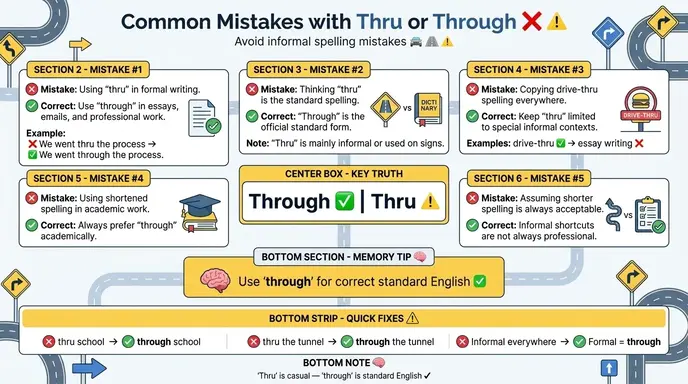
1. Using “Thru” Formally
❌ Please read thru the report.
✔ Please read through the report.
2. Thinking “Thru” Is Standard English
✔ It is informal only
3. Using Informal Spelling in Academic Writing
✔ Teachers and editors usually prefer “through”
4. Assuming Both Are Equal Everywhere
✔ “Through” is universally safer
Thru or Through in Everyday Examples 💬
🏠 Daily Life
- We drove through the tunnel.
- The restaurant has a drive-thru.
📱 Social Media
- Just went thru a tough week 😅
👉 Casual but informal usage.
📚 School Writing
- The story moves through several time periods.
💼 Professional Writing
- Applications must go through approval.
Thru or Through: Usage Trends & Popularity 📊
📌 Trend Insight:
- Through → dominant in books, schools, and formal writing
- Thru → popular in advertising and casual communication
📊 Key Observation:
“Drive-thru” is one of the most recognized informal uses of “thru.”
👉 Dictionaries still list “through” as the standard form.
Comparison Table 📋
| Feature | Through | Thru |
| Correctness | Standard English | Informal spelling |
| Formal Writing | Preferred | Avoided |
| Casual Usage | Accepted | Common |
| Professional Use | Yes | Rare |
| Example | Walk through | Drive-thru |
Common User Queries 🔍
- Is thru or through correct?
- Is thru a real word?
- When should I use through?
- Can I use thru in essays?
- Why is drive-thru spelled that way?
- Is thru informal?
- What is the difference between thru and through?
- Which spelling is professional?
- Is thru accepted in dictionaries?
- How to use through in a sentence?
FAQs ❓
1. Which spelling is correct?
✔ Through
2. Is thru wrong?
✔ Not completely, but informal
3. Can I use thru in school writing?
❌ Usually no
4. Why is thru common in restaurants?
✔ Shorter and easier for signs
5. Is through formal English?
✔ Yes
6. Is thru accepted in dictionaries?
✔ Yes, as informal usage
7. Easy rule?
✔ Formal = through, Casual = thru
Conclusion 🧾
“Through” is the correct and standard spelling used in formal English, academic writing, professional communication, and most everyday situations. “Thru” is an informal shortened version mainly seen in casual writing, advertising, and phrases like “drive-thru.”
The confusion exists because “thru” appears frequently on signs and in modern branding, especially in American English. However, it is still considered informal and should generally be avoided in serious or professional writing.
Both British and American English recognize “through” as the standard spelling. If you are unsure which form to choose, “through” is always the safest and most widely accepted option.
👉 Final takeaway: Use “through” for formal writing and “thru” only in casual or branded contexts.
Discover More Articles!
Business or Bussiness: Which Spelling Is Correct?In 30 Seconds
Other Than or Other Then: Which One Is Correct?In 30 Seconds
High School or Highschool: Which Spelling Is Correct?

thinkaora.com is my English grammar comparison website where I simplify confusing words, spelling differences, and usage rules through clear explanations and examples. My goal is to help learners, writers, and students understand English easily and use correct grammar with confidence.