Resonate is correct; resignate is usually wrong in modern English.
Many writers search for “resignate or resonate” because the words look similar and sound close. This creates confusion, especially for learners, bloggers, and content creators.
Some people think “resignate” is an alternative form, but in most cases, they actually mean “resonate.”
Knowing the difference helps you avoid mistakes in professional writing, and social media posts. It also improves clarity and confidence in communication.
This guide explains the meaning, spelling rules and real life examples. By the end, you will know exactly when to use resonate and why resignate is rarely correct.
Resignate or Resonate: Quick Answer
The correct word in most contexts is resonate.
Resonate means:
- To produce or reflect sound.
- To create a strong emotional connection.
- To feel meaningful or relatable.
Examples:
- Her speech resonated with the audience.
- The music resonated through the hall.
- His story resonates with many readers.
Resignate is not standard English in modern usage. Most dictionaries do not list it as a valid everyday word. When people write “resignate,” they often make a spelling mistake.
Quick tip:
👉 If you want to say something connects emotionally or has impact, use resonate.
The Origin of Resignate or Resonate
Understanding word origin helps remove confusion.
Origin of “Resonate”
“Resonate” comes from the Latin word resonare, which means “to sound again” or “to echo.” Over time, English adopted this word to describe sound vibrations. Later, people used it metaphorically. It began to describe emotional or intellectual connection.
Early usage focused on sound:
- Bells resonated across valleys.
- Voices resonated in large halls.
Modern usage expanded:
- Ideas resonate with people.
- Stories resonate emotionally.
About “Resignate”
The form “resignate” does not have a strong historical presence in standard English. Some believe it came from confusion with:
- Resign
- Resignation
- Designate
These similar looking words cause mixing errors. Language learners may combine patterns and create “resignate,” but it is not accepted in normal writing.
Why Confusion Exists
- Similar spelling patterns.
- Fast typing errors.
- Auto correct mistakes.
- Pronunciation similarities.
Because “resonate” is common in emotional expression, people often hear it but miswrite it.
British English vs American English Spelling
In many English words, spelling changes between regions. Examples include color/colour or center/centre. However, this is not the case here.
Both British English and American English use the same spelling:
👉 Resonate
There is no accepted British variant called “resignate.”
Key Differences to Know
Although spelling stays the same, usage style may differ slightly. British writing sometimes uses more formal tone, while American writing may use shorter expressions. Still, the word itself remains identical.
Comparison Table
| Feature | Resonate (US) | Resonate (UK) | Resignate |
| Correct spelling | Yes | Yes | No (modern usage) |
| Dictionary acceptance | Yes | Yes | Rare/No |
| Common meaning | Emotional or sound connection | Emotional or sound connection | Usually an error |
| Professional writing | Recommended | Recommended | Avoid |
Which Spelling Should You Use?
Choosing the right word depends on audience and clarity.
For US readers
Use resonate. It is standard in all forms of communication. Avoid “resignate,” as it may appear incorrect or unprofessional.
For UK and Commonwealth readers
Also use resonate. Dictionaries across regions accept this spelling. No regional alternative exists.
For global audiences
Choose words that reduce confusion. “Resonate” is clear and widely understood worldwide.
Professional Advice
- Check spelling before publishing.
- Use grammar tools if unsure.
- Read sentences aloud to confirm meaning.
When you want to express emotional impact or strong connection, always choose resonate.
Common Mistakes with Resignate or Resonate
Many writers make predictable errors.
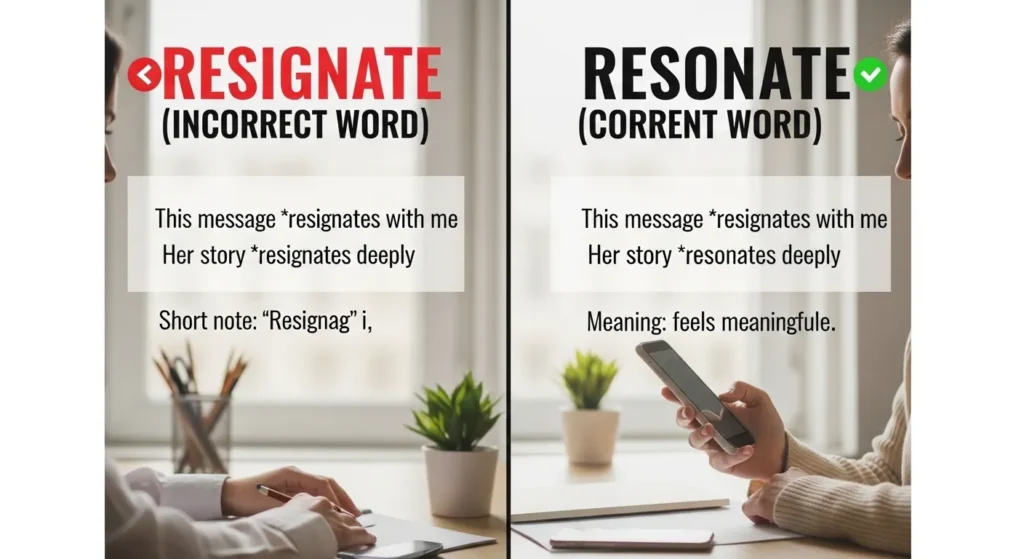
Mistake 1: Typing “resignate” instead of “resonate”
Incorrect:
❌ This message really resignates with me.
Correct:
✅ This message really resonates with me.
Mistake 2: Confusing with “resign”
Some people mix emotional meaning with quitting.
Incorrect:
❌ Her story resignates deeply.
Correct:
✅ Her story resonates deeply.
Mistake 3: Misunderstanding meaning
Resonate does not always mean agreement. It means something feels meaningful or relatable.
Example:
- The film resonated with audiences even if they disagreed with its message.
Mistake 4: Overusing the word
While useful, avoid repeating too often. Use variation:
- Connects
- Echoes
- Feels meaningful
Resignate or Resonate in Everyday Examples
Learning through real examples helps memory.
Emails
- Your feedback resonated with our team.
- The proposal resonates with our goals.
News Writing
- The speech resonated with young voters.
- The message resonated across the country.
Social Media
- This quote resonates with me today.
- That video really resonates emotionally.
Formal Writing
- The research resonates with current trends.
- The theory resonates with historical patterns.
Notice how the word expresses connection or impact.
Resignate or Resonate: Google Trends & Usage Data
Usage data shows clear patterns.
“Resonate” appears frequently in:
- Business communication
- Marketing language
- Psychology discussions
- Personal storytelling
Countries with high usage include:
- United States
- United Kingdom
- Canada
- Australia
- India
Many searches occur because users see “resignate” written somewhere and want to confirm accuracy. Search data shows that most people eventually switch to the correct form after learning.
Common contexts:
- Emotional connection
- Branding messages
- Public speeches
- Online content writing
Popularity continues to grow because modern communication values emotional connection and authenticity.
Keyword Comparison Table
| Word | Meaning | Correct Usage | Example |
| Resonate | Create emotional or sound connection | Yes | The story resonates with readers. |
| Resignate | Common spelling mistake | No | Avoid using. |
| Resign | Quit a job or position | Yes (different meaning) | She resigned from work. |
| Designate | Assign or choose | Yes (different meaning) | He was designated leader. |
FAQs About Resignate or Resonate
1. Is resignate a real word?
No. It is usually a spelling mistake. Most dictionaries do not accept it as standard usage.
2. What does resonate mean?
It means to produce sound or create emotional impact. It also means something feels relatable.
3. Why do people confuse these words?
They look similar. Fast typing and pronunciation differences cause mistakes.
4. Can resonate describe emotions?
Yes. It often describes emotional connection.
Example:
- Her story resonates deeply.
5. Is resonate formal or informal?
It works in both. You can use it in emails, academic writing, and social media.
6. Does spelling change by country?
No. The spelling remains “resonate” worldwide.
7. Are there synonyms for resonate?
Yes:
- Connect
- Echo
- Relate
- Strike a chord
Conclusion
Understanding the difference between resignate and resonate helps improve writing clarity. The correct word in modern English is resonate. It describes sound reflection and emotional connection.
The form “resignate” usually appears due to spelling confusion or typing errors. Both American and British English use the same spelling, so there is no regional variation to remember.
Writers should focus on meaning first. If you want to show impact, connection, or emotional response, choose resonate confidently.
Clear communication builds trust. Readers expect accurate spelling and professional language. By learning common mistakes, and examples and write more effectively. Practice using resonate in sentences.
Read your text before publishing. Small improvements create strong results over time. With this knowledge, you can write confidently and avoid confusion forever.
Mastering small word differences leads to better content, stronger communication, and clearer expression across every platform you use.
Related More Posts!
Lie or Lye: Meaning, Differences and Complete Grammar Guide✨
Colum or Column: How Should You Use It?
Sympathy or Empathy: What’s the Difference?With In 30 Minutes

I am Sophia Martinez.I am an ESL grammar coach. I specialize in teaching English to non native speakers. My content focuses on commonly confused words like affect vs effect, their vs there, and verb tense comparisons. Sophia writes in a friendly, supportive tone designed to build confidence in learners.