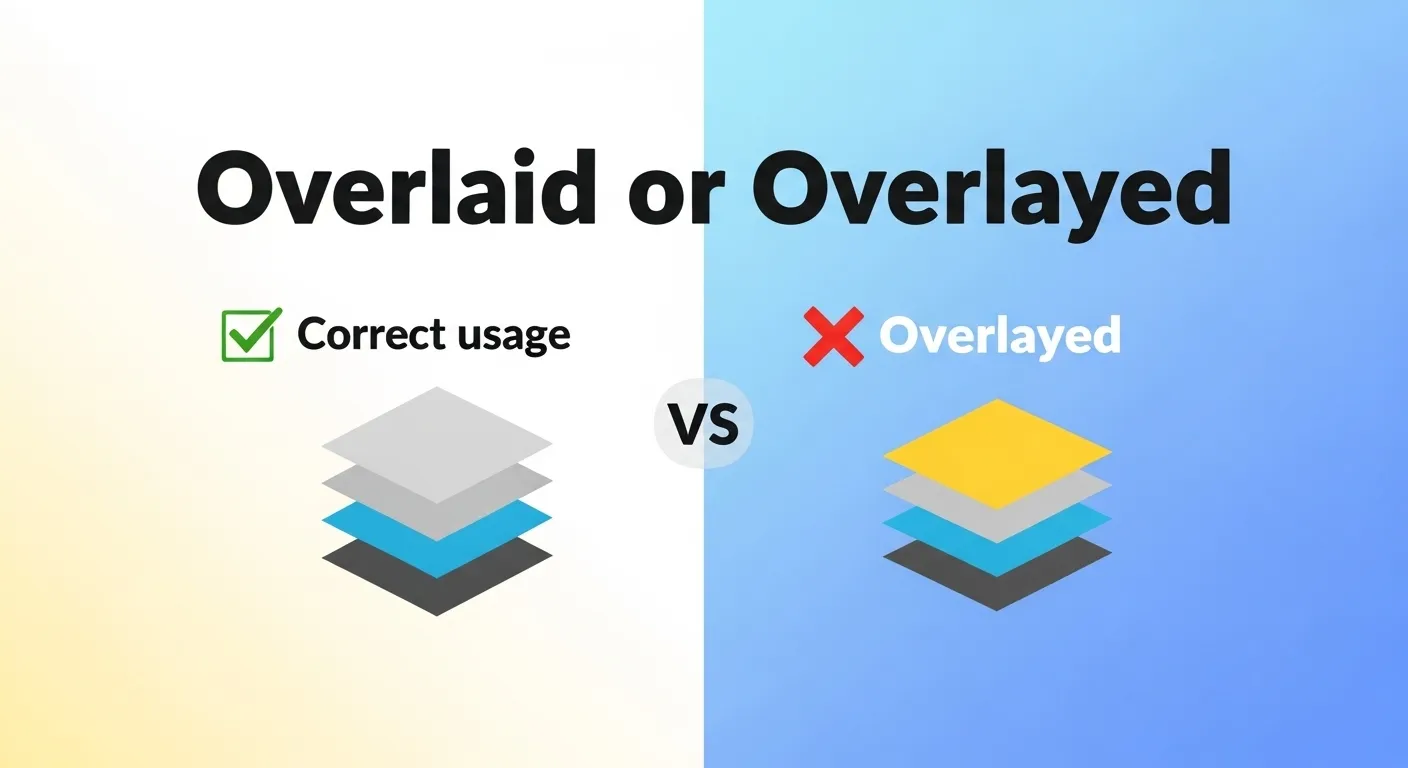
“Overlaid” is the correct past tense and past participle of “overlay,” while “overlayed” is usually considered incorrect. Many writers feel confused when they see both forms online.
Designers, photographers, video editors, and everyday writers often search this question because they want accurate grammar. Some tools and websites show different spellings, which creates doubt.
People also mix this word with regular verb patterns, so mistakes happen easily. This guide explains the correct form, simple rules, and practical examples.
You will learn where each spelling comes from, how real users write it today, and how to choose the best option for professional and casual writing.
Overlaid or Overlayed: Quick Answer
The correct spelling is overlaid. It is the past tense and past participle of the verb overlay.
“Overlay” is an irregular verb. Its past form does not follow the simple “-ed” pattern.
Correct Examples
- The designer overlaid text on the image.
- She overlaid the map with data points.
- A graphic was overlaid on the video clip.
Incorrect or Nonstandard
- The designer overlayed text on the image. ❌
Many people assume “overlayed” is correct because most verbs add “-ed.” However, English has many irregular verbs, and this is one of them.
Simple Rule
- Present: overlay
- Past: overlaid
- Past participle: overlaid
If you remember this pattern, you will avoid most mistakes.
The Origin of Overlaid or Overlayed
Understanding the origin helps explain the spelling difference.
The word “overlay” comes from two parts:
- over : meaning above or on top
- lay : a verb meaning to place something down
The key detail is that “lay” is an irregular verb. Its past tense is laid, not “layed.” When “overlay” formed, it kept the same pattern.
History and Development
Early English texts used “overlie” and “overlay” to describe placing one thing over another. Over time, the language kept the irregular structure because speakers were already familiar with “lay → laid.”
Because English learners expect regular endings, many began writing “overlayed.” This spelling appears online, but it developed from misunderstanding rather than accepted grammar rules.
Language evolves, but dictionaries and major style guides still list “overlaid” as standard.
Why Confusion Exists
- Most verbs use “-ed” endings.
- Spell check tools sometimes fail to flag uncommon mistakes.
- Users follow pronunciation instead of grammar patterns.
Knowing the root verb “lay” makes the rule easy to remember.
British English vs American English Spelling
Unlike many spelling differences, this word does not change between regions.
Both British and American English prefer overlaid.
Some writers think “overlayed” may be acceptable in one region, but standard grammar references agree that “overlaid” remains correct worldwide.
Comparison Table
| Usage Type | British English | American English | Notes |
| Past tense of overlay | overlaid | overlaid | Standard form |
| Alternative spelling | overlayed (rare) | overlayed (rare) | Usually nonstandard |
| Formal writing | overlaid | overlaid | Strongly recommended |
| Academic or professional use | overlaid | overlaid | Preferred choice |
Example Sentences
- UK style: The engineer overlaid two charts.
- US style: The editor overlaid captions onto the footage.
Both examples use the same spelling.
Which Spelling Should You Use?
Choosing the right spelling depends on clarity and professionalism.
For US Audiences
Use overlaid. It aligns with dictionaries, editorial standards, and professional writing.
For UK and Commonwealth Readers
Use overlaid. The rule stays the same.
For Global Communication
Always use overlaid. It reduces confusion and ensures consistency.
For Creative or Casual Writing
Some creators use “overlayed,” but it may appear unpolished. If accuracy matters, stick with “overlaid.”
Professional Tip
When in doubt, check the root verb. If the base verb is irregular, the combined form often follows the same pattern.
Common Mistakes with Overlaid or Overlayed
Many errors come from applying regular verb rules.
Mistake 1: Adding “-ed” Automatically
Incorrect: She overlayed graphics on the video.
Correct: She overlaid graphics on the video.
Mistake 2: Mixing Tense Forms
Incorrect: He has overlayed the logo.
Correct: He has overlaid the logo.
Mistake 3: Confusing with “Overlie”
“Overlie” has different meanings and forms. Do not mix them.
Mistake 4: Software Influence
Some editing tools display incorrect suggestions. Always verify spelling.
Mistake 5: Assuming Regional Variation
This is not a regional spelling difference. One form remains standard.
Quick Fix Checklist
- Does the sentence describe a past action? Use overlaid.
- Is it formal or professional text? Use overlaid.
- Unsure? Replace with “placed over” to confirm meaning.
Overlaid or Overlayed in Everyday Examples
Seeing real-world usage makes the rule clear.
Emails
- I overlaid the new logo on the presentation slide.
- The design team overlaid updated colors.
News Writing
- Data analysts overlaid satellite images with weather patterns.
- Officials overlaid maps to study changes.
Social Media
- I overlaid music on my video today.
- The creator overlaid captions for accessibility.
Formal Reports
- Researchers overlaid multiple datasets to identify trends.
- The architect overlaid plans to compare revisions.
Creative Writing
- Shadows overlaid the walls as evening came.
In every context, the same spelling appears.
Overlaid or Overlayed: Google Trends & Usage Data
Search data shows many users typing both versions.
Why People Search This Question
- Writers notice different spellings online.
- Autocorrect tools vary.
- Content creators use the word often in editing tasks.
Popularity by Country
- United States: High searches from video editing and design communities.
- United Kingdom: Searches often relate to grammar checks.
- India and Pakistan: Many English learners look for simple rules.
- Australia and Canada: Professional writing contexts drive searches.
Usage Contexts
- Graphic design tutorials
- Video editing software guides
- Data visualization discussions
- Writing and grammar blogs
Data suggests that “overlaid” dominates professional usage, while “overlayed” appears mostly in informal content or user-generated text.
Comparison Table: Keyword Variations Side by Side
| Form | Grammar Status | Example | Recommended? |
| overlay | Present tense | I overlay text on images. | Yes |
| overlaid | Past tense | I overlaid text yesterday. | Yes |
| overlaid | Past participle | The image has been overlaid. | Yes |
| overlayed | Alternative spelling | She overlayed graphics. | No (avoid) |
FAQs About Overlaid or Overlayed
1. Is “overlayed” ever correct?
It appears online but is generally considered incorrect in standard grammar. Use “overlaid” instead.
2. Why is “overlaid” irregular?
Because it comes from the verb “lay,” which changes to “laid” in past tense.
3. Do dictionaries accept both spellings?
Most major dictionaries list “overlaid” as the primary and correct form.
4. Does pronunciation change the spelling?
No. Even if both sound similar, only one is standard in writing.
5. Is there any regional preference?
No major regional difference exists. Both British and American English use “overlaid.”
6. Can “overlayed” become accepted in the future?
Language changes over time, but current standards strongly favor “overlaid.”
7. How can I remember the correct form easily?
Think of “lay → laid.” Then apply the same pattern to “overlay → overlaid.”
Conclusion
Choosing between “overlaid” and “overlayed” becomes simple once you understand the grammar rule behind the word.
The verb “overlay” follows the pattern of “lay,” which changes to “laid” in the past tense. Because of this, “overlaid” is the correct form for both past tense and past participle.
Many people make mistakes because they expect every verb to follow a regular “-ed” ending, but English includes many irregular verbs that keep older patterns.
Using the correct spelling improves clarity and makes your writing look professional. If you work in design, media, research, or everyday communication, consistency matters.
Readers trust writing that follows standard grammar rules, and editors prefer established forms. When writing for global audiences, using “overlaid” avoids confusion and ensures your message remains clear.
Practice the examples, remember the root verb, and apply the rule across emails, reports, and creative content. Over time, the correct spelling will feel natural and automatic.
Related More Posts!
Lie or Lye: Meaning, Differences and Complete Grammar Guide✨
Feel or Feal: Which Spelling Is Correct?
Reinforce or Re-Enforce: Which One Is Correct?

I am Sophia Martinez.I am an ESL grammar coach. I specialize in teaching English to non native speakers. My content focuses on commonly confused words like affect vs effect, their vs there, and verb tense comparisons. Sophia writes in a friendly, supportive tone designed to build confidence in learners.