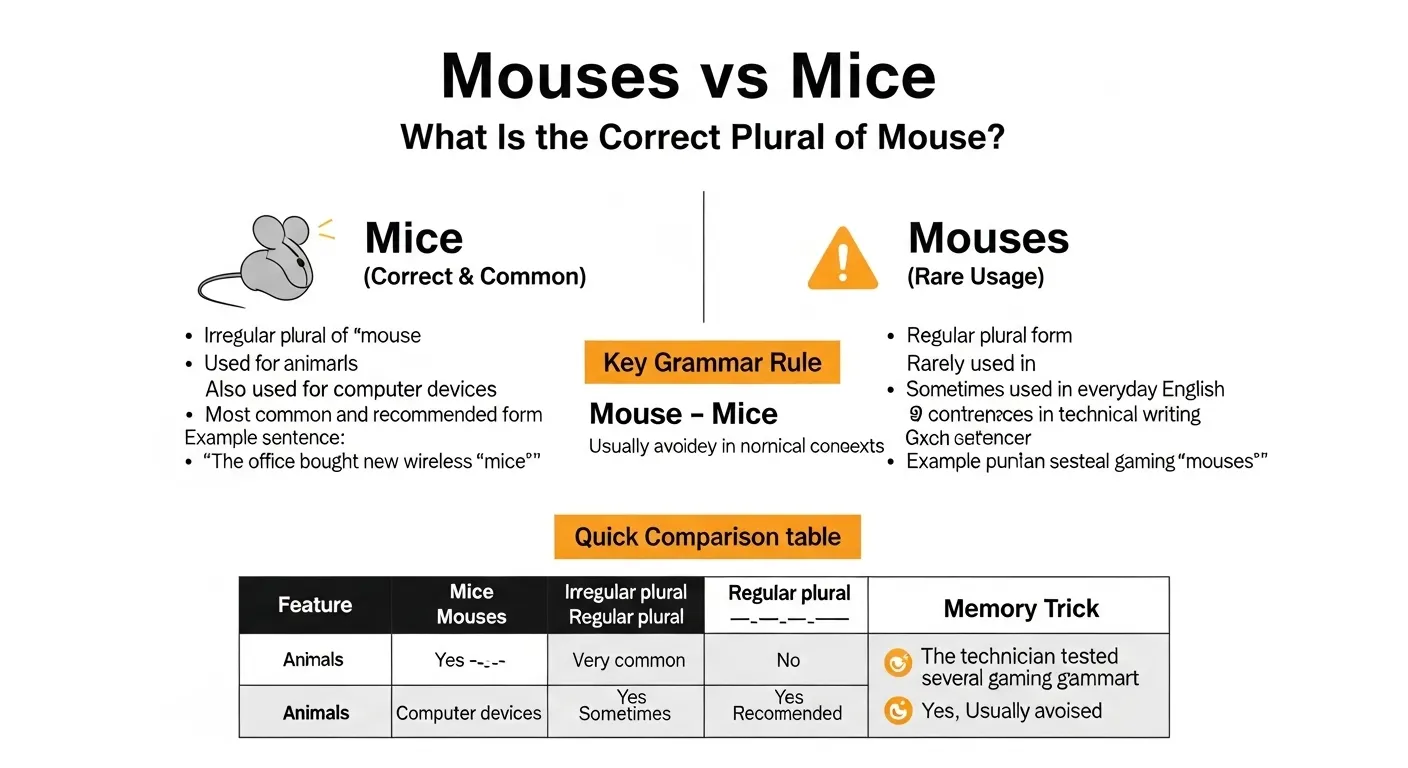
Mouses or mice is a common grammar question in English. Many people wonder which plural form of mouse is correct.
The confusion happens because English has both regular and irregular plural rules.In normal grammar, most nouns become plural by adding “s” or “es.” For example:
• Book → Books
• Car → Cars
• Box → Boxes
However, some words follow older language patterns. These words change their vowel sound instead of adding “s.” The word mouse belongs to this group.
Another reason for confusion is that mouse has two meanings. It can describe a small animal. It can also describe a computer device used to control a cursor.
Because of these two meanings, people often ask If the plural should be mouses or mice.
This guide explains the correct plural form, grammar rules, word history, examples, common mistakes, and usage trends. By the end, you will understand clearly when to use mice and when mouses might appear.
Mouses or Mice: Quick Answer ⚡
The correct plural of mouse is usually mice.
However, mouses may appear in rare technical situations.
Basic rule:
• Mouse → Mice (correct plural for the animal)
• Mouse → Mice (most common plural for computer devices)
• Mouses (rare, sometimes used in technical writing)
Examples
Correct:
• The kitchen has several mice.
• The office bought new wireless mice.
Rare example:
• The lab tested multiple computer mouses.
In everyday English, mice is the correct and preferred plural.
Definition of Mouses or Mice 📘
The phrase mouses or mice refers to the plural forms of the word mouse.
Mouse as an Animal
A mouse is a small rodent with a pointed nose, round ears, and a long tail.
Example:
“The cat chased a mouse across the floor.”
Plural form:
“There are several mice in the barn.”
Mice are common animals found in houses, farms, and fields.
Mouse as a Computer Device
A computer mouse is a device used to control a cursor on a computer screen.
It allows users to:
• Click icons
• Open programs
• Scroll pages
• Select text
Example:
“She moved the cursor using her mouse.”
Plural form:
“The company ordered new wireless mice.”
Although some technical writers use mouses, most people still prefer mice.
The Origin of Mouses and Mice 🌍
The unusual plural mice comes from the history of the English language.
Old English Grammar
English developed from Germanic languages. In Old English, many nouns formed plurals by changing their vowel sound.
This pattern is called vowel mutation or umlaut.
Examples:
| Singular | Plural |
| Mouse | Mice |
| Goose | Geese |
| Tooth | Teeth |
| Foot | Feet |
| Man | Men |
Instead of adding “s,” these words changed their vowel sound.
Over time, most English nouns switched to the “-s” plural rule. However, a few old forms remained. The plural mice survived as the correct form.
Why “Mouses” Appeared Later
When computers were invented, the device was named mouse because its cord looked like a tail.
As computers became common, people needed a plural form for the device.
Some writers used mice because it followed traditional grammar. Others used mouses because technology terms often use regular plurals.
Today, both forms exist, but mice is still the most common choice.
Mouses or Mice: Grammar Comparison 📊
Understanding the difference helps writers choose the correct form.
| Word | Part of Speech | Meaning | Usage |
| Mouse | Singular noun | One animal or device | Standard form |
| Mice | Irregular plural | Multiple animals or devices | Most common |
| Mouses | Rare plural | Sometimes used for computer devices | Technical contexts |
The safest option in writing is mice.
When to Use Mouses or Mice 🎯
Choosing the correct word depends on the context.
Use Mice in Most Situations
Use mice when talking about animals or computer devices.
Examples:
• The farmer found several mice in the storage shed.
• The school bought new computer mice.
• Our office replaced all the old wireless mice.
In everyday language, mice is always correct.
Use Mouses in Rare Technical Contexts
Some technical manuals or engineers use mouses to refer specifically to computer devices.
Example:
• The technician compared several optical mouses.
However, even in technology discussions, mice is still widely used.
Because of this, many style guides recommend using mice instead of mouses.
Common Mistakes with Mice or Mouses ⚠️
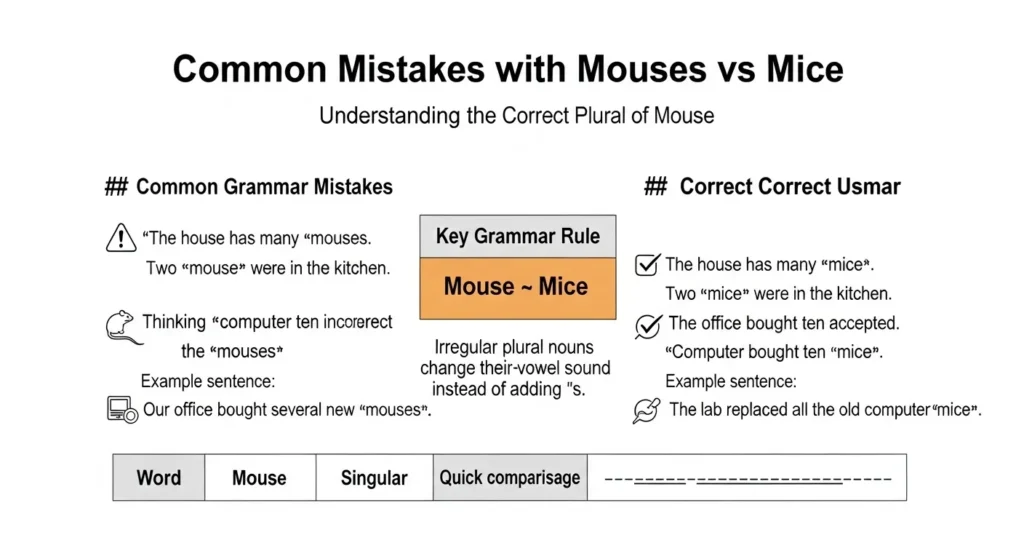
Many English learners make predictable grammar mistakes.
Mistake 1: Using “Mouses” for Animals
Incorrect:
❌ The house has many mouses.
Correct:
✅ The house has many mice.
The plural for animals is always mice.
Mistake 2: Forgetting the Irregular Plural
Incorrect:
❌ Two mouse were hiding in the garage.
Correct:
✅ Two mice were hiding in the garage.
Mistake 3: Thinking “Mice” Only Refers to Animals
Incorrect belief:
❌ Computer mice is wrong.
Reality:
✅ Computer mice is correct and widely accepted.
Mistake 4: Overusing the Rare Form
Incorrect:
❌ Our office bought ten mouses.
Better:
✅ Our office bought ten mice.
Mistake 5: Mixing Singular and Plural Forms
Incorrect:
❌ One of the mice is broken mouse.
Correct:
✅ One of the mice is broken.
Mouses vs Mice in Everyday Examples 💬
Seeing real-life examples makes the rule easier to remember.
Animal Example
“The farmer set traps because there were mice in the barn.”
Home Example
“I heard noises in the wall. There might be mice inside.”
Technology Example
“Our office replaced the old wired mice with wireless ones.”
Classroom Example
“The computer lab uses ergonomic mice for students.”
Technical Example
“The engineer tested different gaming mouses.”
Google Trends & Usage Data for Mouses or Mice 📈
The phrase mouses or mice is frequently searched online. Many people look for grammar help or language explanations.
Popular Search Questions
Common searches include:
• Is it mouses or mice?
• Computer mouse plural
• Why is mouse plural mice?
Can we say mouses?
These questions show that many learners want to understand irregular plural nouns.
Countries Searching the Phrase
| Country | Search Interest |
| United States | High |
| United Kingdom | High |
| Canada | Medium |
| India | Medium |
| Australia | Medium |
Most searches come from students, writers, and English learners.
Keyword Variations
| Search Phrase | Meaning |
| Mouses or mice | Grammar question |
| Plural of mouse | Language rule |
| Computer mouse plural | Technology usage |
| Mouse plural form | Grammar explanation |
These variations show how people search for simple grammar answers.
Comparison Table: Mouses vs Mice 📊
This table makes the difference easier to remember.
| Feature | Mice | Mouses |
| Grammar type | Irregular plural | Regular plural |
| Common usage | Very common | Rare |
| Used for animals | Yes | No |
| Used for computer devices | Yes | Sometimes |
| Recommended for writing | Yes | Usually avoided |
Key takeaway:
Use “mice” in almost all situations.
Memory Trick for Mouses or Mice 🧠
Simple memory tricks can help remember the correct plural.
Trick 1
Mouse → Mice
Think of other vowel-changing words:
• Goose → Geese
• Tooth → Teeth
• Foot → Feet
Trick 2
Remember this phrase:
“One mouse, many mice.”
This simple pattern helps avoid mistakes.
FAQs
1. What is the correct plural of mouse?
The correct plural form is mice.
2. Is “mouses” a real word?
Yes, but it is rare and mainly used in technical contexts.
3. Can computer devices be called mice?
Yes. Most people say computer mice.
4. Why does mouse become mice?
The word comes from Old English vowel change rules.
5. Is “mouses” wrong?
It is not always wrong, but mice is more common and recommended.
6. Do dictionaries accept “mouses”?
Some dictionaries include it, but they still list mice as the main plural form.
7. Should writers use “mice” or “mouses”?
Writers should usually choose mice because it is standard English.
Conclusion
The phrase mouses or mice refers to the plural forms of the word mouse. In standard English, the correct plural is mice.
This irregular form comes from historical grammar patterns in Old English where vowel sounds changed to create plural nouns.
Both animals and computer devices are commonly described using mice as the plural form. Although mouses sometimes appears in technical writing, it is far less common and rarely used in everyday language.
Understanding the difference helps writers avoid grammar mistakes and communicate more clearly. When in doubt, choosing mice is the safest option.With practice, remembering the rule becomes easy: one mouse, many mice.
Discover More Articals!
Amid or Amidst: What Is the Real Difference?
Resignate or Resonate: How Should You Use It?
Feel or Feal: Which Spelling Is Correct?

thinkaora.com is my English grammar comparison website where I simplify confusing words, spelling differences, and usage rules through clear explanations and examples. My goal is to help learners, writers, and students understand English easily and use correct grammar with confidence.