
“Lent” is correct; “lended” is incorrect in standard English usage.
Many people feel unsure when talking about borrowing and giving things temporarily. They wonder if “lended” is acceptable because it sounds logical.
This confusion happens because English has many irregular verbs that do not follow normal past-tense rules.
Writers, students, and professionals often search for this topic to avoid grammar mistakes. Using the wrong form can make writing look less natural or less polished.
This guide clears the confusion by giving simple rules, real examples, and clear comparisons.
By the end, you will know exactly when to use “lent,” why “lended” is wrong, and how to avoid common errors.
Lent or Lended: Quick Answer
The correct past tense and past participle of lend is lent. The form lended is not accepted in standard English.
Examples:
- ✅ I lent him my book yesterday.
- ✅ She has lent me money before.
- ❌ I lended him my book. (Incorrect)
English contains irregular verbs. These verbs do not simply add “-ed” to form the past tense. “Lend” changes to “lent,” just like “send” becomes “sent.”
Quick rule:
- Present: lend
- Past: lent
- Past participle: lent
If you remember one thing, remember this: always use “lent,” never “lended.”
The Origin of Lent or Lended
The verb “lend” comes from Old English “lǣnan,” which meant to grant or allow temporary use.
Over time, English evolved, but many verbs kept irregular forms. These forms stayed because people used them often in speech.
Irregular verbs often come from Germanic roots. They change vowels or endings instead of adding “-ed.” Examples include:
- send → sent
- build → built
- spend → spent
- lend → lent
“Lended” appeared occasionally in older or nonstandard speech. However, it never became accepted in formal grammar. Dictionaries and style guides recognize only “lent.”
Why do people still say “lended”? Because learners expect a regular pattern. Many verbs form the past tense by adding “ed,” so writers guess that “lended” follows the same rule. Language history explains why that assumption fails.
Understanding origin helps memory. Think of “lend” as part of a family of verbs that shift sound rather than add endings.
British English vs American English Spelling
One important point: both British and American English use lent. There is no regional spelling difference in this case. The correct form stays the same across major English varieties.
Many words change spelling between regions, but this verb does not.
Examples:
- UK style: He lent his coat during winter.
- US style: He lent his jacket during winter.
The verb form remains identical. Only surrounding vocabulary may change.
Comparison Table
| Feature | British English | American English | Correct Form |
| Past tense of lend | lent | lent | lent |
| Past participle | lent | lent | lent |
| Use of “lended” | incorrect | incorrect | avoid |
| Formal writing | lent | lent | yes |
This consistency makes the rule simple. No matter where your audience lives, choose “lent.”
Which Spelling Should You Use?
Your audience matters in many language decisions, but not here. The answer stays the same.
For US readers
Always use “lent.” American dictionaries list only this form.
For UK or Commonwealth readers
Use “lent.” British usage follows the same rule.
For global audiences
Use “lent.” It is clear, standard, and widely understood.
If you want your writing to sound professional worldwide, avoid experimenting with “lended.” Even in informal messages, readers may notice the error.
Professional tip: If unsure, replace the sentence with present tense to check the base verb. Then convert it to “lent” for past tense.
Example:
- Present: I lend her notes.
- Past: I lent her notes.
Common Mistakes with Lent or Lended

Many writers repeat the same errors. Learning these patterns helps avoid them.
1. Adding “-ed” automatically
People assume every verb follows a regular rule.
- ❌ He lended me money.
- ✅ He lent me money.
2. Confusing with similar verbs
Some verbs look similar but behave differently.
- bend → bent
- send → sent
- lend → lent
Remember the pattern: replace “-end” with “-ent.”
3. Mixing past and present forms
Sometimes writers use “lend” when they mean past tense.
- ❌ Yesterday I lend him my car.
- ✅ Yesterday I lent him my car.
4. Overcorrecting in perfect tenses
Past participle also uses “lent.”
- ❌ I have lended support.
- ✅ I have lent support.
5. Influence from spoken language
Informal speech or regional habits may include “lended.” Avoid copying this in writing.
Lent or Lended in Everyday Examples
Seeing real situations helps learning.
Emails
- “I lent you the files last week. Please confirm you received them.”
News writing
- “The bank lent funds to support local businesses.”
Social media
- “I lent my headphones to a friend and forgot to ask for them back.”
Formal reports
- “The organization lent resources to community projects.”
Casual conversation
- “She lent me her charger.”
These examples show the same rule in every context. Tone may change, but the verb form does not.
Lent or Lended: Google Trends & Usage Data
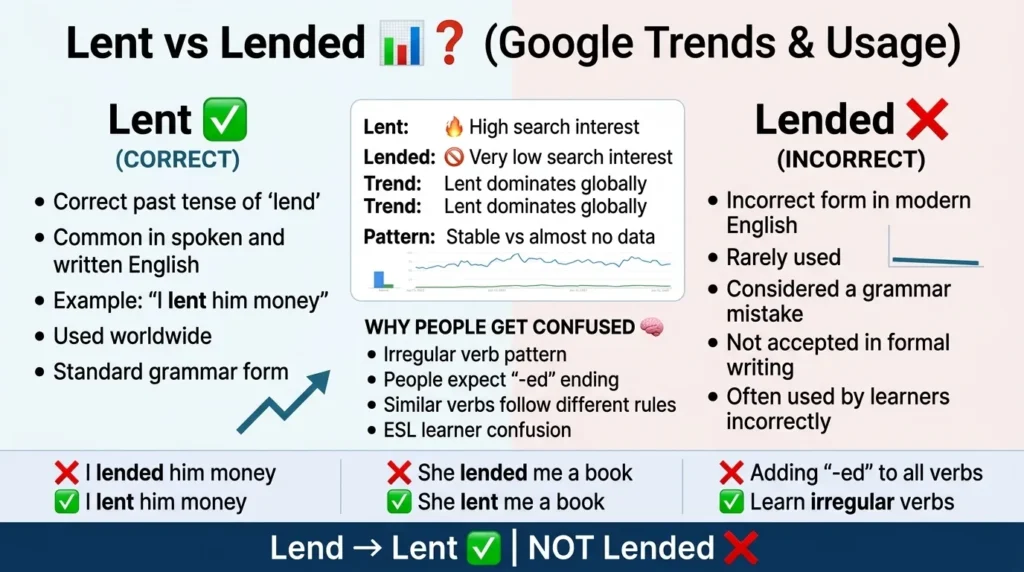
Usage data shows a strong preference for “lent.” Searches for “lent or lended” usually come from learners checking grammar correctness.
Popular regions searching this topic:
- South Asia (students learning English)
- United States (grammar checks during writing)
- United Kingdom and Australia (education context)
Why do people search this phrase?
- Writing essays or academic work.
- Creating professional content.
- Checking before publishing online.
- Learning irregular verb patterns.
Language analysis tools show that “lent” appears far more often in books, news articles, and professional writing. “Lended” mostly appears in error examples or discussions explaining mistakes.
Comparison Table: Keyword Variations
| Form | Grammar Role | Correct or Incorrect | Example Sentence |
| lend | base verb | correct | I lend books to friends. |
| lends | present tense (third person) | correct | She lends help often. |
| lent | past tense | correct | He lent me money. |
| lent | past participle | correct | They have lent support. |
| lended | nonstandard form | incorrect | Avoid using. |
🔍 Lent or Lended vs Leant: Common Confusions Explained
Many learners search phrases like lent or lended, lended vs lent, and even leant vs lent because these forms sound similar.
✔️ Is “lended” a word?
A common question is: is lended a word?
👉 In standard English, the answer is no.
It may appear in informal speech, but it is not grammatically correct.
Correct form:
- lend → lent
Incorrect form:
- lend → ❌ lended
✔️ What about “leant or lent”?
This creates another confusion:
- lent → past tense of lend (correct verb form)
- leant → past tense of lean (different verb)
Example:
- He lent me money. ✅
- She leant against the wall. ✅
So:
- lent vs leant → different meanings
- lent vs lended → one correct, one incorrect
✔️ Easy Pattern to Remember
Many verbs follow the same pattern:
- send → sent
- spend → spent
- lend → lent
This helps answer queries like:
- lend lent or lended
- lend vs lent
- lent irregular verb
📌 Final Tip:
If you are unsure between lended or lent, always choose lent.
FAQs
1. Is “lended” ever correct?
No. Standard English uses only “lent.” Style guides and dictionaries support this rule.
2. Why does “lended” sound logical?
Many verbs add “-ed” for past tense. This creates confusion with irregular verbs like “lend.”
3. Can I use “lended” in informal writing?
It is better to avoid it. Even casual readers may notice the mistake.
4. What is the past participle of “lend”?
The past participle is “lent.”
Example: “She has lent me her notes.”
5. How do I remember the correct form?
Link it with similar verbs:
- send → sent
- spend → spent
- lend → lent
6. Does pronunciation change between regions?
No. Both major English varieties pronounce and spell the past tense as “lent.”
7. Is “lent” related to the religious season?
Yes, but it is a different meaning. Context shows If the word refers to borrowing or a religious period.
🧠 How to Use Lent Correctly (Spelling, Tense, and Usage)
Many users also search:
- how do you spell lent
- lent past tense
- lend vs lent
- lent as a verb
✔️ Correct Forms of “Lend”
Here is the full structure:
- Present: lend
- Past: lent
- Past participle: lent
This answers queries like:
- past tense of lend (lent past tense)
- lend and lent difference
- lent present form (lend is present)
✔️ Example Sentences
- Present: I lend books to friends
- Past: I lent him money yesterday
- Perfect: I have lent help before
✔️ Spelling and Usage Tips
People often search:
- spell lent
- lent spelling
- is it lent or lended
👉 Always remember:
- “lent” is the correct spelling
- “lended” is incorrect
✔️ Final Grammar Insight
- lent verb → used for past actions
- lent as a verb always refers to giving something temporarily
📌 Simple rule:
If the action already happened → use lent
Conclusion
Understanding the difference between “lent” and “lended” is simple once you know the core rule. English contains many irregular verbs, and “lend” belongs to this group.
Instead of adding “ed,” it changes to “lent” in both past tense and past participle forms. This rule applies across regions, writing styles, and contexts.
No matter if you write emails, reports, or social posts, choosing “lent” ensures clarity and correctness.
Many learners make mistakes because they expect a regular pattern, but memorizing common irregular forms solves this problem quickly.
Practice by using short sentences and real examples from daily life. Over time, the correct form will feel natural. Clear grammar builds trust with readers and improves communication.
When in doubt, remember the simple pattern shared by similar verbs like “send” and “spend.” Consistent usage will make your writing stronger, clearer, and more professional.
Discovers More Posts!
Focused vs Focussed: Easy Guide for English Learners 🌟
Bit or Bitten: Which One Is Correct?
Xero or QuickBooks: Which Accounting Software Is Better?

thinkaora.com is my English grammar comparison website where I simplify confusing words, spelling differences, and usage rules through clear explanations and examples. My goal is to help learners, writers, and students understand English easily and use correct grammar with confidence.