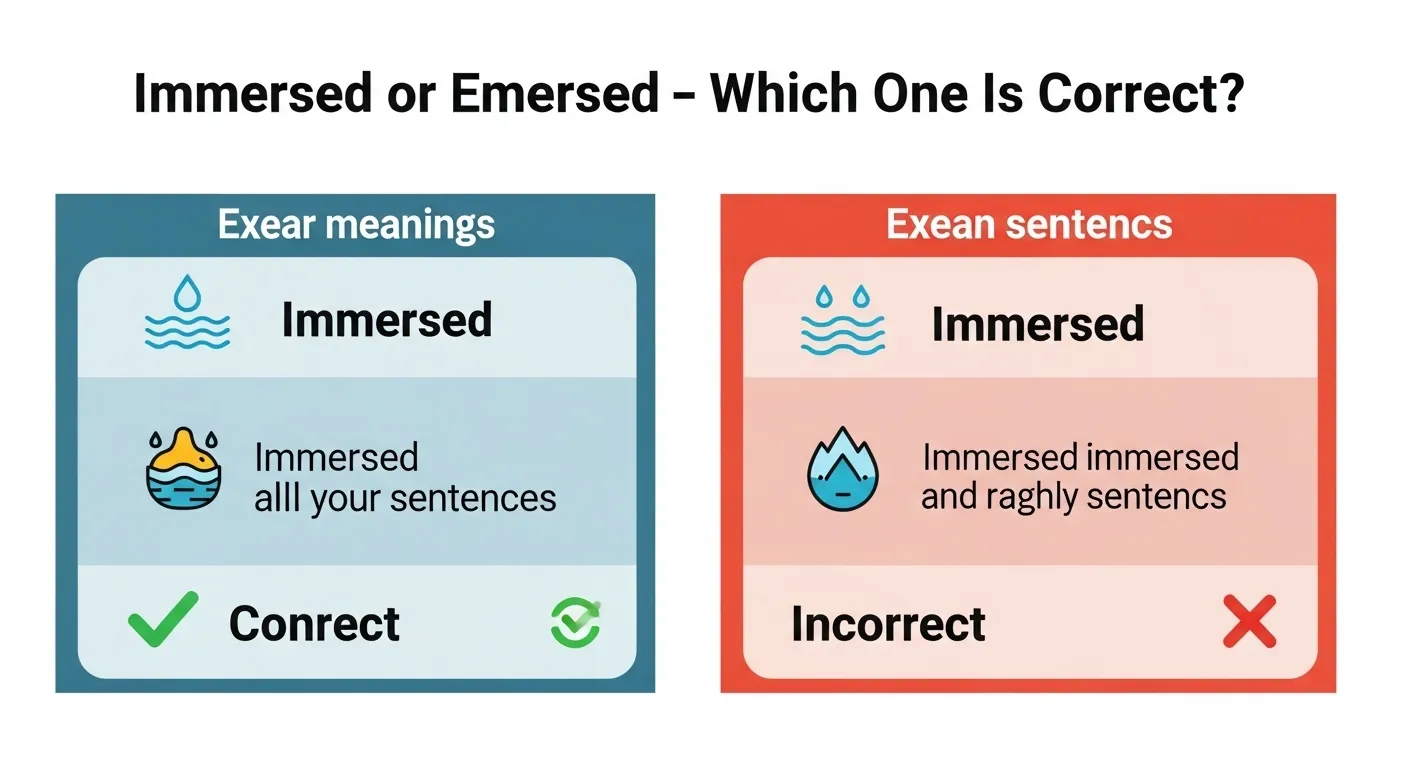
Immersed means fully covered or deeply involved, while emersed means rising out of water or coming into view.
Many writers confuse these two similar looking words because they share the same Latin root and almost identical spelling.
Students, bloggers, and professionals often search this topic to avoid mistakes in writing, science descriptions, or everyday communication.
The confusion increases because one word is very common, while the other appears mostly in technical or scientific contexts. This guide explains both terms in clear language.
You will learn meanings, examples, and real world comparisons so you can choose the correct word with confidence every time.
Immersed or Emersed: Quick Answer
The main difference is simple:
- Immersed = fully covered in liquid or deeply involved in something.
- Emersed = emerging or rising out of liquid, usually water.
Examples
- She was immersed in the ocean waves.
- He felt immersed in his work all day.
- The plant leaves became emersed after the water level dropped.
- The rock slowly emersed from the river.
In daily language, “immersed” is far more common. “Emersed” appears mostly in science, biology, or environmental discussions.
The Origin of Immersed or Emersed
Both words come from Latin. Their meanings come from prefixes that change direction.
Origin of “Immersed”
- From Latin “immergere.”
- “im” means “into.”
- “mergere” means “to dip” or “to plunge.”
So, “immersed” literally means “plunged into.” Over time, the word gained extra meanings. It now describes deep focus or strong emotional involvement.
Example:
- She was immersed in reading.
Origin of “Emersed”
- From Latin “emergere.”
- “e” or “ex” means “out of.”
- “mergere” again means “to dip.”
So, “emersed” means “coming out of water” or “rising from liquid.” Scientists often use it to describe plants or objects that rise above water surfaces.
Example:
- Emersed aquatic plants grow above the water line.
Why the Spellings Look Similar
Both words share the root “merge.” The prefixes change the direction:
| Prefix | Meaning | Result |
| im | into | immersed |
| e/ex | out of | emersed |
This small difference creates opposite meanings. That is why writers must choose carefully.
British English vs American English Spelling
Unlike many word pairs, “immersed” and “emersed” do not change spelling based on region. Both forms stay the same in British and American usage.
However, frequency differs. One term appears widely across everyday writing. The other stays limited to scientific contexts.
Comparison Table
| Aspect | British English | American English |
| Immersed spelling | immersed | immersed |
| Emersed spelling | emersed | emersed |
| Common in daily writing | Yes | Yes |
| Scientific usage | Yes | Yes |
| Everyday speech use for emersed | Rare | Rare |
Example sentences:
- UK usage: He felt immersed in history during the museum visit.
- US usage: She remained immersed in the project for weeks.
Both regions use the same spelling rules.
Which Spelling Should You Use?
Your audience matters when choosing between immersed and emersed.
For US readers
- Use immersed in most cases.
- Readers expect it in both literal and figurative contexts.
- Use emersed only in technical writing.
For UK or Commonwealth readers
- Same spelling rules apply.
- Immersed remains common.
- Emersed still appears mainly in scientific descriptions.
global audiences
- Choose immersed for clarity unless you describe objects emerging from water.
- Avoid using emersed casually because many readers may not recognize it.
Simple rule
- Into liquid or deep involvement → immersed.
- Coming out of liquid → emersed.
Common Mistakes with Immersed or Emersed
Writers often confuse these words because they look similar.
Mistake 1: Using emersed instead of immersed
Incorrect:
- She was emersed in a novel.
Correct:
- She was immersed in a novel.
Explanation: Emotional or mental involvement uses immersed.
Mistake 2: Thinking both words mean the same
They are opposites.
- Immersed = inside or covered.
- Emersed = emerging or above.
Mistake 3: Avoiding emersed entirely
Some writers ignore the word because it sounds unfamiliar. But it is correct in scientific contexts.
Example:
- Emersed aquatic plants grow partially above water.
Mistake 4: Confusing with “emerged”
“Emersed” and “emerged” are not identical.
- Emerged = came into view or became known.
- Emersed = physically rising from water.
Mistake 5: Using immersed only literally
Immersed also has metaphorical meanings:
- immersed in culture
- immersed in learning
Immersed or Emersed in Everyday Examples
Understanding real life usage helps you remember the difference.
Emails
- I was immersed in meetings all morning.
- The roots stayed submerged while leaves remained emersed.
News writing
- Citizens felt immersed in celebrations during the festival.
- Scientists studied emersed vegetation after flooding.
Social media
- I am fully immersed in this new series.
- Rare photo of emersed coral after low tide.
Academic or formal writing
- Participants were immersed in the learning environment.
- Emersed leaves allow plants to absorb sunlight efficiently.
Casual conversation
- He felt immersed in the game.
- The stone emersed as the water level fell.
Immersed or Emersed: Google Trends & Usage Data
Usage patterns show strong differences between the two words.
Popularity
- “Immersed” is widely searched worldwide.
- It appears in education, psychology, art, technology, and daily speech.
Regional interest
- High usage across North America, Europe, Australia, and South Asia.
- Common in both professional and casual contexts.
Scientific contexts
- “Emersed” appears more in biology, botany, and environmental science.
- Used when describing aquatic plants, geological formations, or water level changes.
Contextual usage
| Context | Immersed | Emersed |
| Daily conversation | Very common | Rare |
| Academic science | Common | Moderate |
| News media | Frequent | Limited |
| Social media | Very frequent | Rare |
| Technical writing | Moderate | Frequent in specific fields |
The data shows that most people mean “immersed” when writing casually.
Comparison Table: Keyword Variations Side by Side
| Feature | Immersed | Emersed |
| Basic meaning | Fully covered or deeply involved | Rising out of liquid |
| Usage frequency | Very high | Low |
| Everyday writing | Yes | Rare |
| Scientific usage | Yes | Yes |
| Emotional meaning | Yes | No |
| Literal water meaning | Yes | Yes |
| Opposite direction | Into | Out of |
FAQs About Immersed or Emersed
1. Are immersed and emersed synonyms?
No. They have opposite meanings. Immersed means inside or deeply involved. Emersed means coming out of water.
2. Which word is more common?
Immersed is far more common in everyday language.
3. Can emersed be used in normal conversation?
Yes, but it sounds technical. Most speakers use it in scientific contexts.
4. Is emersed the same as emerged?
No. Emerged has a broader meaning. Emersed specifically refers to rising from water.
5. Can immersed describe emotions?
Yes. People often say immersed in music, work, or culture.
6. Do British and American writers use different spellings?
No. Both regions use the same spelling for these words.
7. How can I remember the difference?
Think of the prefixes:
- im = into → immersed.
- e = exit or out → emersed.
Conclusion
Immersed and emersed look similar but carry opposite meanings. Immersed describes being fully covered by liquid or deeply involved in an activity or feeling.
Emersed describes something rising out of liquid or appearing above a water surface.
The shared Latin root explains why the words look alike, but the prefixes change direction and meaning.
Most writers use immersed daily because it works in both literal and figurative contexts. Emersed appears mainly in scientific writing, especially in biology or environmental studies.
Choosing the correct word depends on your message. If you describe deep involvement or something underwater, use immersed.
If you describe something coming out of water, use emersed. Remember the simple rule: into versus out. With practice, the difference becomes easy.
Clear word choice improves understanding and helps your writing sound precise and professional across different audiences and situations.
Related More Posts!
Focused vs Focussed: Easy Guide for English Learners 🌟
Does or Do: Meaning, Usage, Rules, and Clear Examples
Either or Neither: Grammar Rules and Common Mistakes

My name is James Whitmore.I am a language research writer. I explore the history and evolution of English words. I write detailed comparisons explaining why spellings change over time and how British and American English diverged. My articles add depth and credibility to grammar comparison topics.