Both “focused” and “focussed” are correct spellings, but their usage depends on the type of English you follow.
Many writers pause when typing this word because they see both versions online, in books, and on social media. The confusion grows when spell check tools suggest different forms.
People search for this topic to avoid mistakes in emails, articles, academic work, and professional writing.
Since English spelling changes across regions, small differences like double letters can create doubt.
This guide clears that confusion with simple explanations, real examples, and practical advice.
By the end, you will understand the difference between focused or focussed and feel confident choosing the right spelling every time.
Focused or Focussed: Quick Answer
The short answer is simple:
- Focused is the most common spelling, especially in American English.
- Focussed appears more in British English but is less common today.
Both come from the verb “focus.” When adding “-ed,” some writers double the “s,” while others keep one “s.” Modern usage shows that “focused” dominates in global communication.
Examples:
- She stayed focused during the meeting.
- He remained focussed on the task.
Both sentences are correct. The difference is style and regional preference, not meaning.
Key idea:
- Same meaning
- Same pronunciation
- Different spelling traditions
If you want a safe choice that works almost everywhere, “focused” is widely accepted.
The Origin of Focused or Focussed
To understand the spelling difference, it helps to look at history. The word “focus” comes from Latin, meaning “hearth” or “center.”
Over time, English adopted it as a noun and later as a verb, meaning to concentrate or direct attention.
In older British spelling patterns, verbs ending in a single vowel plus consonant often doubled the consonant before adding “-ed” or “-ing.” This is why some writers formed “focussed.”
Examples of similar patterns:
- travel → travelled
- cancel → cancelled
- model → modelled
American English later simplified many spellings. Writers removed extra letters to create cleaner forms. That change made “focused” more common in the United States.
Language keeps evolving. Today, many British publications also accept “focused.” As a result, the double “s” version is becoming less frequent.
Important point: spelling differences often reflect historical writing habits, not different meanings.
British English vs American English Spelling
English has many spelling variations between regions. These differences developed over time through printing traditions, dictionaries, and education systems.
American English tends to prefer shorter forms. British English sometimes keeps older patterns.
Here is a simple comparison:
| Feature | American English | British English |
| Preferred form | focused | focussed (also focused) |
| Letter doubling | Less common | More common historically |
| Modern trend | focused dominant | focused increasingly common |
| Style guides | Often recommend focused | Mixed acceptance |
Examples:
- American style: The team stayed focused on results.
- British traditional style: The team remained focussed throughout.
Other spelling pairs follow similar patterns:
| American | British |
| traveled | travelled |
| canceled | cancelled |
| labeled | labelled |
These patterns help explain why focused or focussed both exist today.
Which Spelling Should You Use?
Choosing the right spelling depends on your audience and writing goals.
If your audience is American:
Use focused. It is standard and widely expected.
If your audience is British or Commonwealth:
Both forms may appear, but “focused” is still safe and widely accepted.
For global readers:
Use focused. It reduces confusion and matches modern usage trends.
For formal writing:
Consistency matters more than choice. Pick one spelling and use it throughout your document.
For casual writing:
Either spelling works, as long as it looks natural to your audience.
Practical tip:
If you are unsure, choose focused because it fits most situations worldwide.
Common Mistakes with Focused or Focussed
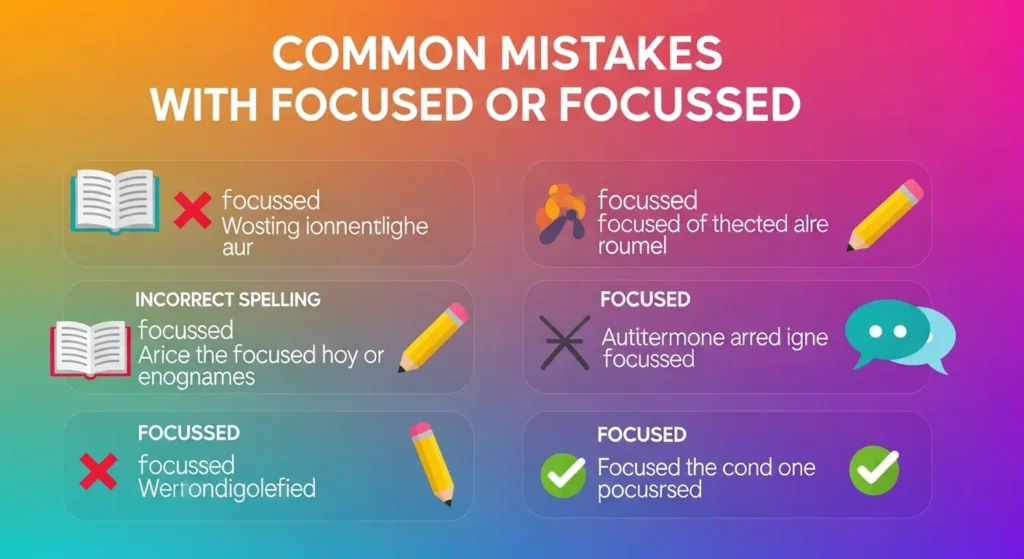
Many writers make small errors when using these spellings. Here are common problems and how to fix them.
1. Mixing both spellings in one document
Incorrect:
- She stayed focused during class but later seemed focussed.
Correct:
- Use one version consistently.
2. Thinking one spelling is wrong
Both are correct; they simply follow different traditions.
3. Confusing pronunciation
Both spellings sound the same. There is no pronunciation difference.
4. Overcorrecting spelling rules
Some people assume double letters must always be added. English does not follow one fixed rule for all words.
5. Copying inconsistent sources
Online articles may use different styles. Always check your own writing for consistency.
Simple rule:
Choose your preferred style once and stay with it.
Focused or Focussed in Everyday Examples
Seeing real examples helps you understand how both forms work in daily communication.
Emails
- Please stay focused on the main objective.
- The team remained focussed on client needs.
News writing
- The government is focused on economic growth.
- The campaign stayed focussed on education reforms.
Social media posts
- Stay focused and trust the process.
- She looks completely focussed during training.
Academic writing
- The study focused on language development in children.
- Researchers focussed on behavioral patterns.
Professional documents
- Our strategy is focused on long-term success.
Most modern business writing prefers “focused” because it appears cleaner and more universal.
Focused or Focussed: Google Trends & Usage Data
Usage patterns vary across regions.
- United States: “Focused” strongly dominates.
- Canada and Australia: “Focused” is more common, though “focussed” appears occasionally.
- United Kingdom: Both forms exist, but “focused” is increasing in popularity.
Global communication, digital publishing, and shared style guides influence these trends. As writers interact across borders, simplified spellings gain popularity.
Another factor is technology. Many default spell-check tools suggest “focused.” This shapes writing habits and reinforces the single “s” version.
Context also matters:
- Academic and technical writing: focused appears more often.
- Older British publications: focussed may still appear.
- Online communication: focused is dominant.
Comparison Table: Focused or Focussed Side by Side
| Feature | Focused | Focussed |
| Meaning | Same | Same |
| Pronunciation | Same | Same |
| American usage | Very common | Rare |
| British usage | Common | Less common but accepted |
| Global preference | High | Lower |
| Modern trend | Increasing | Decreasing |
FAQs About Focused or Focussed
1. Is focused or focussed more correct?
Both are correct. “Focused” is more widely used today.
2. Do they mean different things?
No. They have identical meanings.
3. Which spelling appears in professional writing?
Most professional writing uses “focused.”
4. Can I use focussed in modern writing?
Yes, especially if you follow traditional British spelling.
5. Will readers notice the difference?
Some may notice, but most will understand both forms.
6. Should I change spelling based on region?
Yes. Matching your audience’s style improves clarity.
7. Is focused becoming the standard form?
Many language trends show increasing use of “focused” globally.
Conclusion
The debate around focused or focussed shows how English evolves across regions and time. Both spellings share the same meaning and pronunciation, so the choice depends mainly on writing style and audience expectations.
American English strongly favors “focused,” while British English historically used both forms, with “focussed” appearing more often in older texts.
Modern usage trends show a shift toward the single “s” version, especially in digital communication and international writing.
Consistency remains the most important rule. Switching between spellings in one piece can distract readers and reduce clarity.
Writers should think about their audience, context, and preferred language style before choosing.
For most global communication, “focused” works as a safe and widely recognized option. Understanding this small spelling difference helps writers avoid hesitation and produce clearer, more confident writing.
Language changes over time, and spelling variations like focused or focussed remind us that flexibility and awareness are key to effective communication.
Related More Posts!
Addendums or Addenda: Which One Is Correct?

My name is James Whitmore.I am a language research writer. I explore the history and evolution of English words. I write detailed comparisons explaining why spellings change over time and how British and American English diverged. My articles add depth and credibility to grammar comparison topics.