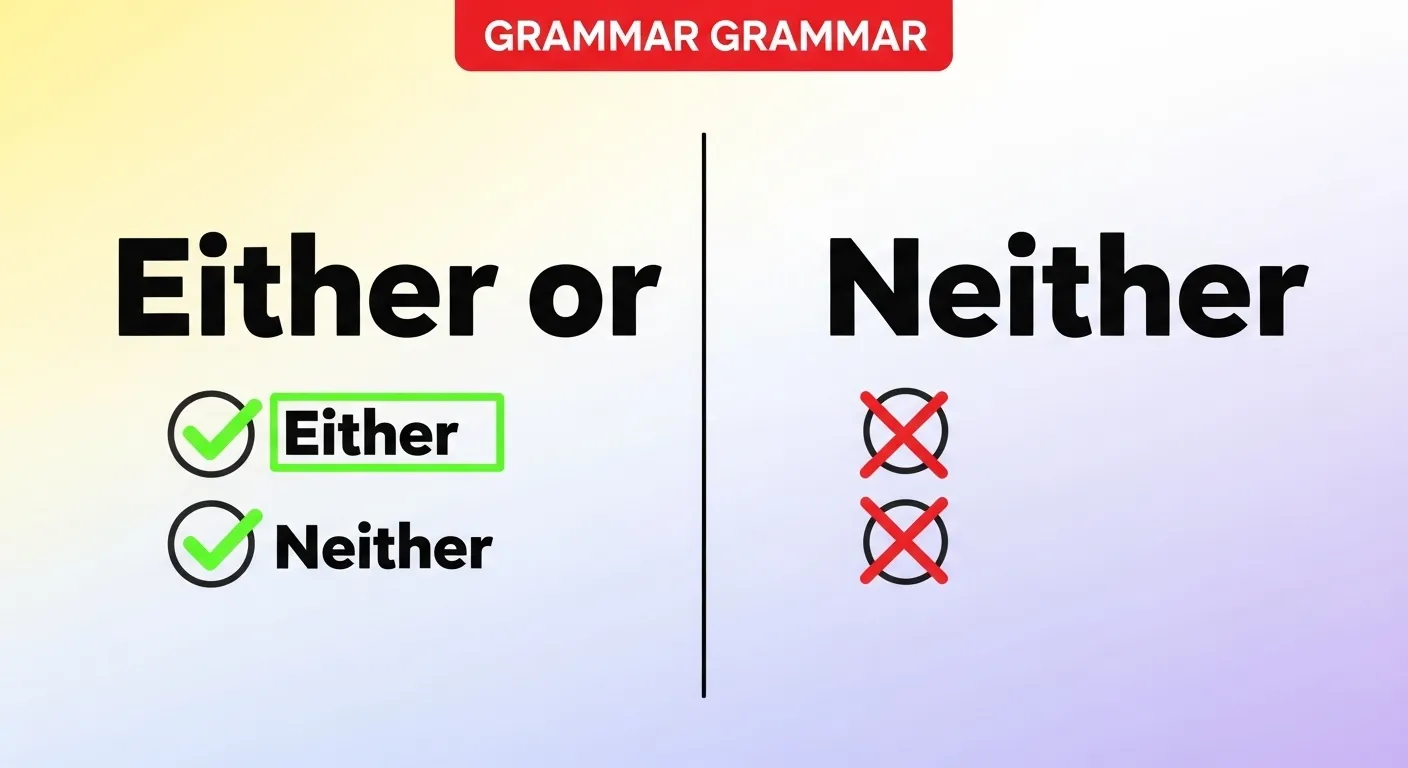
Either means one of two options, while neither means not one and not the other.
Many English learners search for “either or neither” because these words look simple but cause confusion in real sentences.
People often struggle with verb agreement, sentence structure, and choosing the right word in negative statements.
Writers also mix them when giving choices or expressing disagreement. This guide solves that confusion with clear rules, short examples, and easy explanations.
You will learn how to use both words correctly in daily writing, emails and formal communication. By the end, you will feel confident using either and neither without hesitation.
Either or Neither: Quick Answer
Either refers to one option from two choices.
Neither means zero from two choices.
Simple examples:
- You can choose either tea or coffee.
- Either answer is correct.
- Neither option works for me.
- Neither student finished the task.
Easy rule:
- Use either for positive choice between two.
- Use neither for negative meaning involving two items.
Sentence patterns:
- Either + singular noun
- Either road leads to the city.
- Either road leads to the city.
- Neither + singular noun
- Neither book is interesting.
- Neither book is interesting.
- Either…or (choice structure)
- Either you call me or send a message.
- Either you call me or send a message.
- Neither…nor (double negative structure)
- Neither Ali nor Ahmed arrived.
- Neither Ali nor Ahmed arrived.
Remember: both words usually relate to two items or options.
The Origin of Either or Neither
The words either and neither come from Old English. Understanding their history helps explain their structure.
Origin of “Either”
The word developed from Old English “ǣgther,” meaning “each of two” or “both.” Over time, the meaning shifted to “one or the other.” The pronunciation also changed through Middle English stages.
Originally, either sometimes meant both options together. Later, English speakers narrowed the meaning to selecting one option.
Origin of “Neither”
Neither formed from the combination of “ne” (not) and “either.” So its early meaning was “not either.” This explains why neither carries a negative sense.
Why spelling differences exist
English changed through centuries. Pronunciation shifted, but spelling often stayed stable. That is why either and neither look similar but carry opposite meanings.
Language evolution caused changes in usage patterns. Modern English now uses these words mainly in grammar structures involving two choices.
British English vs American English Spelling
There is no major spelling difference between British and American English for either or neither. The main difference appears in pronunciation and style preference.
Pronunciation differences:
| Word | British pronunciation | American pronunciation |
| Either | /ˈaɪðə/ or /ˈiːðə/ | /ˈiːðər/ or /ˈaɪðər/ |
| Neither | /ˈnaɪðə/ or /ˈniːðə/ | /ˈniːðər/ or /ˈnaɪðər/ |
Some speakers say “ee-ther,” others say “eye-ther.” Both are correct.
Usage differences:
- British speakers sometimes prefer plural verbs in certain structures.
- American English often prefers singular verb agreement when either or neither acts as a singular subject.
Example:
- Neither team is ready. (Common in US)
- Neither team are ready. (Accepted in UK contexts)
Which Spelling Should You Use?
Since spelling remains the same worldwide, your focus should be on grammar style and audience.
For US audiences:
Use singular verb agreement after either or neither when used as pronouns.
- Either option is fine.
- Neither answer is correct.
For UK or Commonwealth audiences:
Both singular and plural verb agreement may appear, depending on context.
- Neither player is ready.
- Neither player are ready. (less formal but seen in British usage)
For global audiences:
Choose simple and clear grammar:
- Use singular verbs after either and neither.
- Avoid complex constructions.
Clear writing works best for international readers.
Common Mistakes with Either or Neither
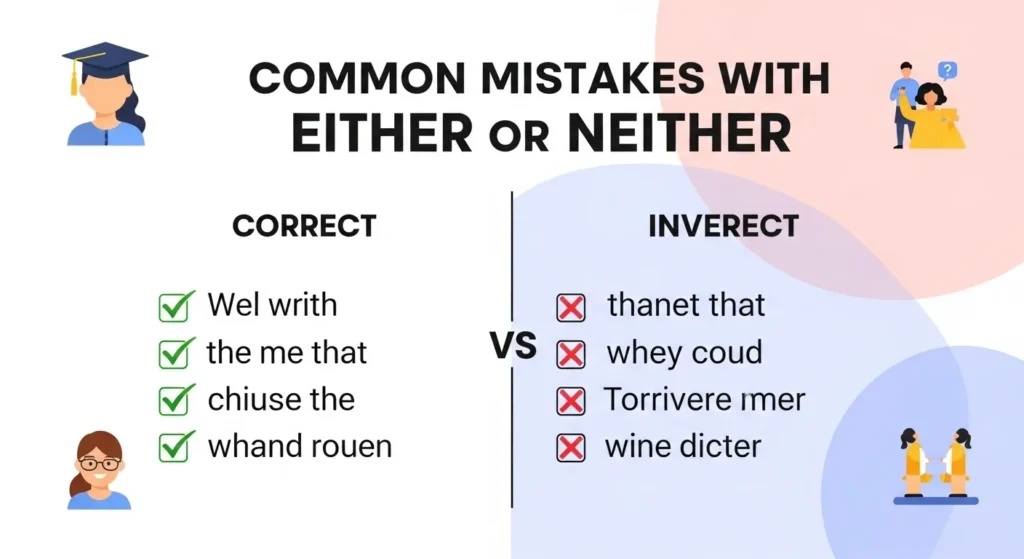
Many learners make similar errors. Here are frequent mistakes and easy corrections.
1. Double negatives
Incorrect:
- I don’t like neither option.
Correct:
- I like neither option.
- I don’t like either option.
2. Wrong verb agreement
Incorrect:
- Neither of the students are here. (less formal)
Better:
- Neither of the students is here.
3. Using either in negative sentences incorrectly
Incorrect:
- I don’t want neither.
Correct:
- I don’t want either.
4. Confusing either and both
Incorrect:
- Either students passed. (if both passed)
Correct:
- Both students passed.
5. Mixing structures
Incorrect:
- Either you come nor stay.
Correct:
- Either you come or stay.
- Neither you nor I agree.
6. Forgetting parallel structure
Make sure both sides match:
- Either study hard or rest well. ✔
- Either study hard or resting. ✘
Either or Neither in Everyday Examples
Emails
- You can send either file format.
- Neither attachment opened correctly.
News writing
- Either candidate may win the election.
- Neither side accepted the proposal.
Social media posts
- Either way, I am happy.
- Neither option looks good today.
Workplace communication
- Either manager can approve the request.
- Neither report meets the standard.
Academic writing
- Either method produces similar results.
- Neither theory explains the outcome fully.
Friendly conversation
- Either movie sounds fun.
- Neither restaurant is open.
Using these words correctly improves clarity and professionalism.
Either or Neither: Google Trends & Usage Data
Usage data shows both words remain common across English-speaking regions.
Popularity by country:
- United States: High usage in daily communication and academic writing.
- United Kingdom: Frequent use in formal writing and journalism.
- India and Pakistan: High search interest due to English learning needs.
- Australia and Canada: Balanced usage similar to British traditions.
Context of usage:
- Grammar learning searches
- Writing improvement guides
- Academic English questions
- Professional communication tips
People search these words because they appear often in exams, emails, and spoken English.
Search patterns show spikes during academic seasons when students review grammar rules.
Comparison Table: Keyword Variations
| Structure | Meaning | Example |
| Either | One of two options | Either road works |
| Neither | Not one or the other | Neither answer works |
| Either…or | Choice between two | Either tea or coffee |
| Neither…nor | Negative choice | Neither rain nor snow |
| Either of | One from a group of two | Either of them is ready |
| Neither of | None from a group of two | Neither of us agrees |
FAQs
1. Is either singular or plural?
Either is usually singular. Use singular verbs in formal English.
2. Is neither always negative?
Yes. Neither already includes a negative meaning. Avoid adding another negative.
3. Can I use either in negative sentences?
Yes. Example: I don’t like either option.
4. Can neither refer to more than two items?
Traditionally, neither refers to two items. Some modern usage extends it, but formal writing keeps the two-item rule.
5. Which comes after either?
Use “or” after either when giving choices.
Example: Either call me or send a message.
6. Which comes after neither?
Use “nor.”
Example: Neither tea nor coffee is available.
7. Can either start a sentence?
Yes.
Example: Either option will solve the problem.
Conclusion
Either and neither are small words with strong grammar power. They help express choice, agreement, and rejection clearly. Either shows selection between two options. Neither shows absence or rejection of both choices.
Understanding the difference removes many common writing errors. Always remember simple rules: either goes with or, neither goes with nor. Use singular verbs for clear and standard grammar.
Avoid double negatives because neither already carries a negative meaning. In daily communication, these words make sentences shorter and clearer.
Writers, students, and professionals benefit from mastering them because they appear in, conversations, and academic texts. Practice with real examples to build confidence.
Focus on clarity rather than complexity. When used correctly, either and neither improve precision and make your writing sound more natural and polished.
Mastering these two words strengthens overall English grammar skills and helps you communicate ideas with confidence in any situation.
Related More Posts!
Lie or Lye: Meaning, Differences and Complete Grammar Guide✨
Hybrid or Gas: Which Car Should You Choose?
Bachelors or Bachelor’s: Meaning, Usage, and Clear Examples

thinkaora.com is my English grammar comparison website where I simplify confusing words, spelling differences, and usage rules through clear explanations and examples. My goal is to help learners, writers, and students understand English easily and use correct grammar with confidence.