Affect is usually a verb meaning to influence something. Effect is usually a noun meaning a result or outcome. Many writers confuse these words because they sound similar and look alike.
The mistake appears often in academic writing, emails, and professional communication. Using the wrong word can change the meaning of a sentence.
Students, bloggers, and professionals often search for this topic to improve grammar accuracy.
This guide explains the difference, examples, common mistakes, and practical advice. By the end, you will know exactly when to use effect or affect with confidence.
Effect or Affect: Quick Answer
- Affect → Usually a verb. Means “to influence” or “to change.”
- Effect → Usually a noun. Means “result” or “outcome.”
Examples:
- “Lack of sleep can affect your health.”
- “The medicine had a positive effect.”
Simple memory tip:
- Affect = Action (both start with A).
- Effect = End result.
The Origin of Effect or Affect
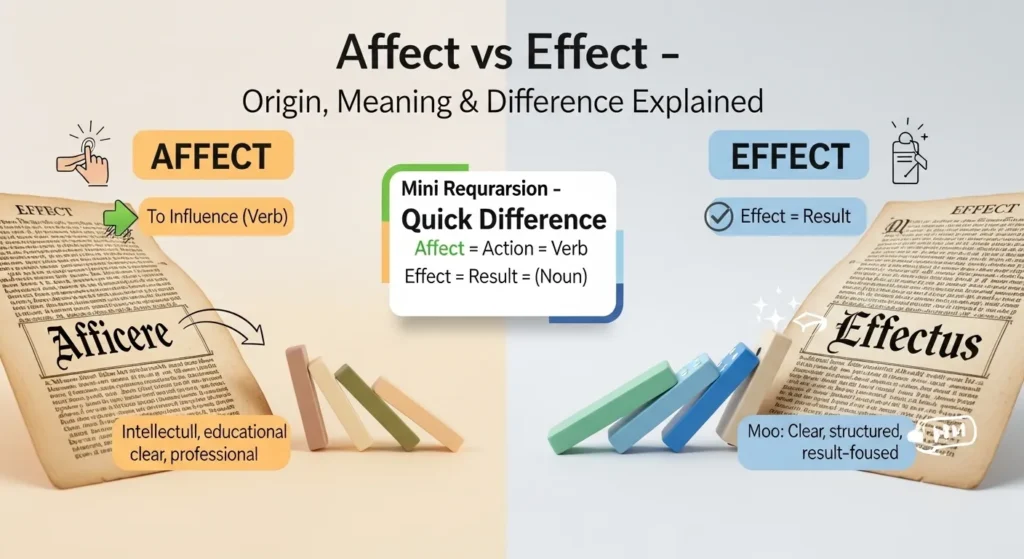
Both words come from Latin.
- Affect comes from afficere, meaning “to influence” or “to act upon.”
- Effect comes from effectus, meaning “result” or “execution.”
Old French brought these words into English. Over time, grammar rules separated their roles:
- Affect became mainly a verb.
- Effect became mainly a noun.
This historical development explains their different meanings today.
British English vs American English Usage
There is no spelling difference between British and American English for these words. The difference lies in grammar and function.
| Feature | Affect | Effect |
| Part of Speech | Usually verb | Usually noun |
| Meaning | Influence or change | Result or outcome |
| British Usage | Same as American | Same as American |
| American Usage | Same rules | Same rules |
Examples:
- British: “Weather affects travel.”
- American: “Weather affects travel.”
Which Word Should You Use?
Choose based on sentence role.
Use affect when:
- Showing influence or impact.
- Describing an action.
Examples:
- Stress affects performance.
- Noise affects concentration.
Use effect when:
- Talking about results.
- Describing outcomes.
Examples:
- The effect was immediate.
- The policy had a strong effect.
Advanced note:
- Effect can be a verb meaning “to bring about.” Example: “The new law will effect change.” This usage is formal and less common.
Common Mistakes with Effect or Affect
- Using effect as a verb incorrectly.
- Incorrect: “This will effect your mood.”
- Correct: “This will affect your mood.”
- Incorrect: “This will effect your mood.”
- Mixing noun and verb roles.
- Forgetting the memory tip.
- Overthinking context.
- Confusing pronunciation with meaning.
Correct examples:
- “The weather affects traffic.”
- “The effect of rain was severe.”
Effect or Affect in Everyday Examples
Emails:
- “This change may affect deadlines.”
- “The effect of the update is positive.”
News writing:
- “Economic changes affect markets.”
- “The effect on prices is noticeable.”
Social media:
- “Music affects mood.”
- “The effect was amazing.”
Formal writing:
- Affect describes influence.
- Effect describes results.
Effect or Affect: Google Trends & Usage Data
Search patterns show that many learners struggle with this pair. Grammar questions about effect vs affect remain popular worldwide.
Key observations:
- Students search during academic seasons.
- Professionals search while editing reports.
- Content creators check usage before publishing.
Insight:
Confusion happens because pronunciation is similar. Clear memory rules help avoid mistakes.
Comparison Table: Effect vs Affect
| Feature | Affect | Effect |
| Main Role | Verb | Noun |
| Meaning | Influence | Result |
| Memory Tip | Action | End result |
| Example | affect performance | positive effect |
| Advanced Usage | Rare noun form | Rare verb form |
| Common Contexts | Psychology, health, behavior | Science, results, outcomes |
FAQs About Effect or Affect
1. Which comes first, affect or effect?
Affect is the action. Effect is the result.
2. Can effect be a verb?
Yes, but it means “to bring about.” It is less common.
3. Can affect be a noun?
Yes, in psychology it refers to emotional expression, but this is technical usage.
4. How can I remember the difference?
Affect = Action. Effect = End result.
5. Why do people confuse them?
They look and sound similar.
6. Is pronunciation different?
Often slightly different, but many speakers say them similarly.
7. Which is used more in daily writing?
Both appear frequently, but affect as a verb and effect as a noun are most common.
Conclusion
Understanding the difference between effect and affect helps writers avoid common grammar errors.
Affect usually works as a verb that shows influence or change. Effect usually works as a noun that describes results or outcomes.
Remember the simple rule: affect is the action, effect is the end result. Context is important, especially in academic, professional, or formal writing.
Using the correct word improves clarity and credibility. Many learners struggle because the words look and sound alike. Practice with examples and apply the memory tip regularly.
In emails, reports, articles, or everyday conversations, choosing the right word ensures clear communication. With practice, the difference becomes easy and automatic.
Related More Posts!
Visiter or Visitor: Which One Is Correct?With In 30 Seconds
Between or Among: What’s the Difference?

thinkaora.com is my English grammar comparison website where I simplify confusing words, spelling differences, and usage rules through clear explanations and examples. My goal is to help learners, writers, and students understand English easily and use correct grammar with confidence.