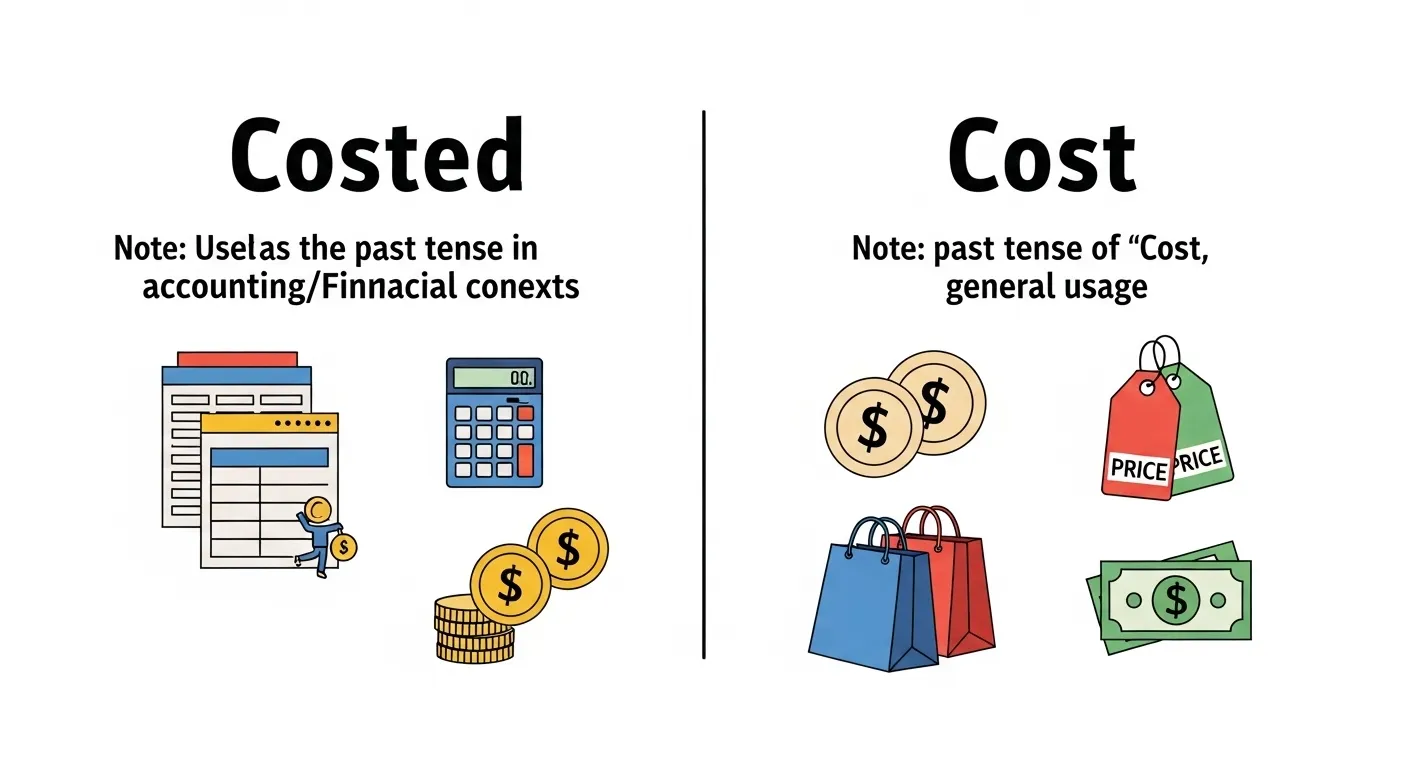
“Cost” is correct for most situations, while “costed” is used only when calculating or estimating expenses.
Cost is the correct form in most situations, while costed is used in specific accounting or planning contexts.
Many English speakers get confused between these two forms because both appear to be past tense versions of “cost.”
Understanding when to use each word can save you from writing errors in emails, reports, or professional documents.
This guide explains the differences, origins, and proper usage of “cost” and “costed,” providing clear examples, tables, and tips for writers in different English speaking regions.
Costed or Cost: Quick Answer
The word “cost” is generally used as both the present and past tense of the verb when referring to the price of something:
- Present: “The book costs $20.”
- Past: “The book cost $20 yesterday.”
“Costed” is used mostly in business, finance, or project planning, meaning the act of estimating or calculating costs:
- “The team costed the new project before submission.”
- “All expenses have been costed for next year’s budget.”
Rule of thumb: If you are simply talking about how much something was or is, use cost. If you are talking about calculating or estimating, costed is correct.
The Origin of Costed or Cost
The word cost comes from the Old French word coste (meaning price) and from Latin constare, meaning “to stand firm” or “to have a fixed value.”
- Over centuries, cost became the standard verb for expressing the price of items.
- Costed emerged later in English, especially in accounting and business contexts, to indicate a completed calculation or estimation.
Historically, English has allowed some verbs to remain the same in present and past forms (like “cut,” “hit,” “cost”), while others adopt a regular past tense by adding ed.
“Cost” belongs to the irregular verbs group, which is why the past tense is usually the same.
British English vs American English Spelling
Both British and American English mostly use cost as the past tense of the verb “to cost.” However, costed appears more often in business English and is used similarly in both regions.
| Region | Standard Usage | Example | Notes |
| UK | Cost | “The laptop cost £500 last week.” | Common in everyday English. |
| UK | Costed | “The project has been costed by the finance team.” | Mainly in accounting/business contexts. |
| US | Cost | “The meal cost $25 yesterday.” | Widely used in all contexts. |
| US | Costed | “We costed the new software implementation last month.” | Limited to professional/business writing. |
Key point: Both forms exist in UK and US English, but general writing almost always prefers cost for past tense and costed for calculated or budgeted amounts.
Which Spelling Should You Use?
For General Writing:
Use cost in all everyday contexts: shopping, news, emails, or social posts.
For Business, Accounting, or Project Management:
Use costed when referring to calculations or detailed financial planning.
Global Advice:
- US audience: Use cost in most situations; costed in formal financial documents.
- UK/Commonwealth audience: Same rules; costed appears slightly more often in professional contexts.
- International English: Stick with cost for clarity unless you are reporting precise cost calculations.
Common Mistakes with Costed or Cost
Many writers incorrectly use costed as the past tense in casual sentences:
- ❌ “The dinner was costed $50.” → Correct: “The dinner cost $50.”
- ❌ “The shoes costed $80 yesterday.” → Correct: “The shoes cost $80 yesterday.”
Other common mistakes:
- Using costed in storytelling or descriptive writing: “The car costed him a fortune.” ❌
- Confusing costed with counted or priced in general English: “All items were costed at the store.” ❌ (better: “All items cost $10 each”)
Tip: Remember cost = past/present for prices; costed = calculation or estimate.
Costed or Cost in Everyday Examples
Emails:
- Correct: “The marketing campaign cost $2,000 last quarter.”
- Correct in finance: “The campaign has been costed carefully by the team.”
News Articles:
- “The repairs cost the city $1 million.”
- “The new stadium project has been costed at $500 million.”
Social Media:
- “This coffee cost $5, but it was worth it!” ✅
- “We costed our vacation budget to avoid overspending.” ✅
Formal Writing/Reports:
- “All proposed projects have been costed and reviewed by management.”
- “The equipment cost $10,000 last year.”
Costed or Cost: Google Trends & Usage Data
Based on usage trends:
- “Cost” appears in over 95% of search queries related to pricing.
- “Costed” shows up mostly in accounting, financial planning, and project management contexts.
- Top countries searching for costed: UK, Australia, and Canada.
- Top countries searching for cost: US, India, UK, Canada.
Interpretation: Everyday English almost exclusively uses cost, while costed is professional/jargon specific.
Comparison Table: Cost vs Costed
| Word | Use | Example | Frequency |
| Cost | Past/present tense for price | “The laptop cost $500.” | Very high |
| Costed | Calculated or estimated price | “The project has been costed by finance.” | Low :medium |
| Notes | General English | Use in all casual and professional sentences | High |
| Notes | Business English | Use in financial/project documents only | Medium |
FAQs About Costed or Cost
1. Is “costed” correct English?
Yes, but only for business or financial contexts where costs are calculated.
2. Can I say “The meal costed $20”?
No, correct usage is: “The meal cost $20.”
3. Is “cost” both past and present tense?
Yes, for regular price references, “cost” remains the same in past and present.
4. When should I use “costed” instead of “cost”?
Use it when referring to estimated or calculated expenses: “The campaign has been costed carefully.”
5. Do Americans and British use “costed” differently?
Slightly. Both use “costed” in accounting, but in everyday writing, Americans rarely use it.
6. Can “costed” appear in news writing?
Yes, but only in financial or project cost reporting. General news prefers cost.
7. How do I remember the difference?
Think: cost = price paid, costed = calculation made.
Conclusion
In summary, cost is your go to word for almost all situations when referring to the price of an item, If past, present, or future.
It is simple, widely recognized, and safe to use in emails, articles, reports, and social media. Costed should be reserved for professional contexts where costs have been carefully calculated or budgets.
Using the right word ensures clarity, avoids embarrassing errors, and maintains professionalism. Remember, if you are talking about how much something was or is, stick with cost.
If you are referring to the act of calculating or estimating costs, use costed. Following these rules keeps your writing clear, accurate, and universally understood, If in the UK, US, or global English speaking audience.
Related More Posts!
Wholistically or Holistically: Which One Is Correct?📚

My name is James Whitmore.I am a language research writer. I explore the history and evolution of English words. I write detailed comparisons explaining why spellings change over time and how British and American English diverged. My articles add depth and credibility to grammar comparison topics.