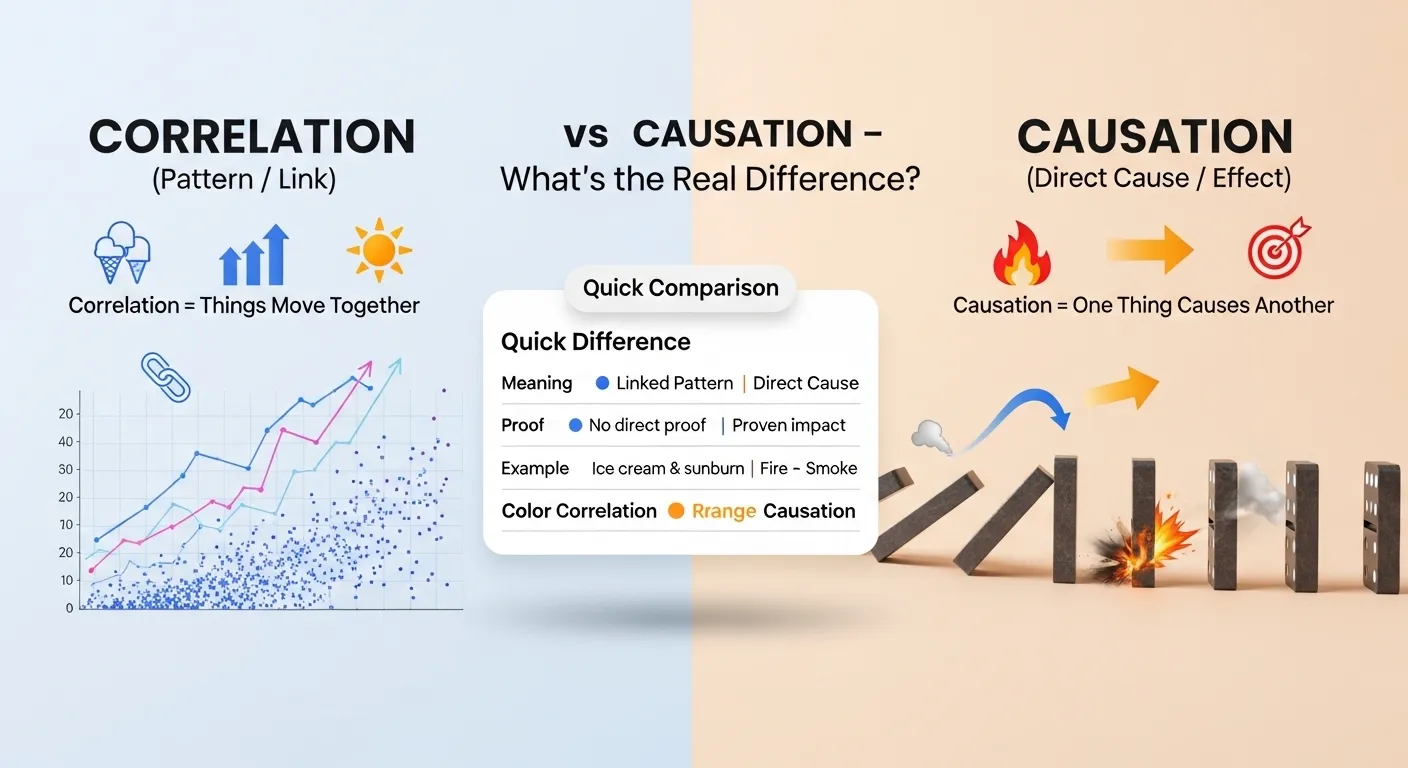
Correlation or causation? Correlation means two things move together, while causation means one thing directly causes the other.
Many people search this phrase when reading news, research reports, or social media claims. They see headlines like “Coffee causes longer life” or “Ice cream increases crime.”
This creates confusion. Are these facts connected, or is it just coincidence? This article clears that confusion in simple words.
You will learn the definition, quick difference, history, spelling rules, common mistakes, real life examples, trend data, and expert advice. After reading, you will easily spot the difference between connection and cause.
📘 Definition of Correlation or Causation 📖
Correlation means two variables move in the same or opposite direction. They are related, but one does not directly create the other.
Causation means one variable directly produces a change in another variable.
In simple words:
- 📊 Correlation = Things happen together.
- 🎯 Causation = One thing makes another happen.
Simple Example:
- Ice cream sales and sunburn cases both rise in summer. That is correlation.
- Fire causes smoke. That is causation.
The key difference is direct cause versus shared pattern.
⚡ Correlation or Causation: Quick Answer ✅
If two things happen at the same time, that is correlation.
If one thing directly creates the other, that is causation.
Real Life Examples 🌍
- More study time → Higher grades → Likely causation.
- More sunglasses sold → More beach visits → Correlation (summer is the real reason).
📊 Quick Comparison Table
| Feature | Correlation | Causation |
| Meaning | Two things linked | One causes the other |
| Direct Effect | No proof of cause | Direct impact |
| Example | Rain & umbrella use | Rain causes wet ground |
| Strength | Can be weak or strong | Clear cause effect |
Correlation shows a relationship. Causation shows responsibility.
📖 The Origin of Correlation or Causation 🕰️
📊 Correlation
The word “correlation” comes from Latin correlatio, meaning “mutual relationship.” It became common in statistics during the 19th century. Scientists used it to measure relationships between numbers.
🎯 Causation
The word “causation” comes from Latin causa, meaning “reason” or “cause.” Philosophers like Aristotle discussed cause and effect thousands of years ago.
📝 Spelling Note
There is no spelling difference for correlation or causation across English speaking countries.
🇺🇸🇬🇧 British English vs American English Spelling ✍️
Some English words change spelling, such as:
- Color (US) / Colour (UK)
- Analyze (US) / Analyse (UK)
But:
- Correlation = Same spelling
- Causation = Same spelling
📊 Spelling Comparison Table
| Word | American English | British English |
| Correlation | Correlation | Correlation |
| Causation | Causation | Causation |
Spelling stays consistent worldwide.
🌍 Which Spelling Should You Use? 🤷
You can use the same spelling everywhere.
Audience Focus:
- 🇺🇸 Academic writing in US → Same spelling
- 🇬🇧 Research papers in UK → Same spelling
- 🌎 Global audience → Same spelling
Instead of spelling, focus on clarity. Explain clearly if you mean connection or cause.
❌ Common Mistakes with Correlation or Causation ⚠️
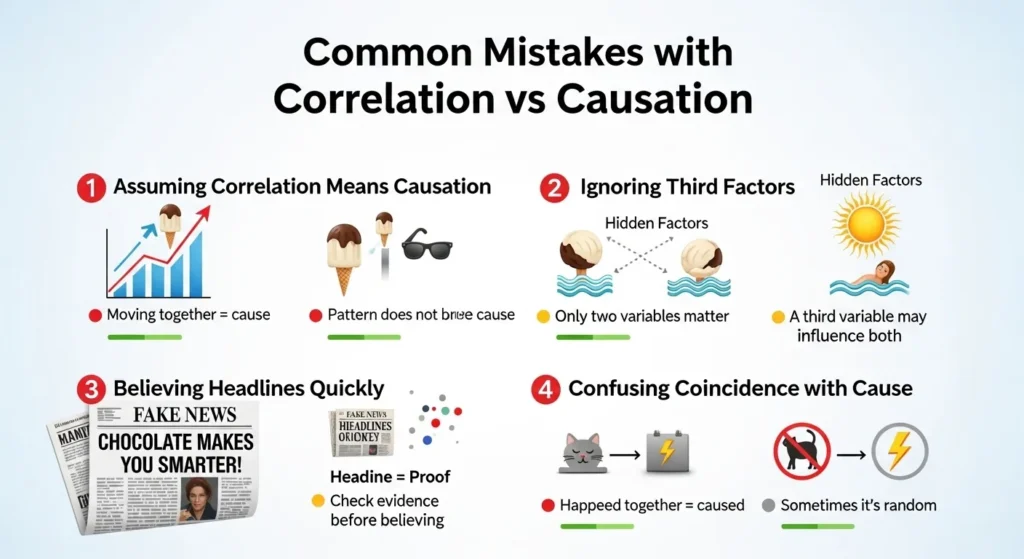
1. Assuming correlation means causation
❌ Just because two things move together does not mean one causes the other.
2. Ignoring third factors
A hidden variable may influence both.
Example:
Ice cream sales and drowning cases rise in summer. Summer heat is the real factor.
3. Believing headlines quickly
News headlines often show correlation but suggest causation.
4. Confusing coincidence with cause
Two events happening together can be random.
💬 Correlation or Causation in Everyday Examples
“The data shows a correlation between training hours and sales growth.”
📰 News
“Study finds correlation between sleep and productivity.”
📱 Social Media
“Eating chocolate makes you smarter!” (Often correlation, not proven causation.)
📄 Academic Writing
“The experiment confirms a causal relationship between variables.”
These terms are common in research, business reports, and data analysis.
📈 Correlation or Causation: Google Trends & Usage Data 🌎
Search interest increases during:
- 📚 Exam seasons (students study statistics)
- 🎓 Research projects
- 📰 Viral news debates
Countries with high search interest:
- United States
- India
- United Kingdom
- Canada
Students, researchers, and professionals search this phrase often when analyzing data or reading scientific claims.
📊 Detailed Side by Side Comparison
| Factor | Correlation | Causation |
| Relationship | Shows link | Shows cause |
| Proof Needed | Statistical pattern | Strong evidence |
| Experiment Required | Not always | Often required |
| Example | Height & shoe size | Smoking causes lung damage |
| Risk of Error | High misinterpretation | Lower if proven |
Correlation is about pattern.
Causation is about impact.
✅ Advantages of Understanding Correlation 📊
- Helps identify patterns
- Useful in research
- Easy to measure
- Helps form hypotheses
❌ Limits
- Does not prove cause
- Can mislead
✅ Advantages of Understanding Causation 🎯
- Shows true impact
- Helps decision making
- Supports strong conclusions
- Useful in science and medicine
❌ Limits
- Harder to prove
- Requires controlled testing
❓ FAQs About Correlation or Causation 🤔
1. Does correlation always mean causation?
No. They are different.
2. Can causation exist without correlation?
Usually causation shows correlation, but not all correlations show causation.
3. Why do people confuse them?
Because patterns look like cause.
4. How do researchers prove causation?
Through experiments and controlled studies.
5. What is a third variable?
A hidden factor affecting both variables.
6. Is correlation useful?
Yes. It helps find relationships.
7. Which is stronger in research?
Causation is stronger because it proves effect.
🏁 Conclusion 🎓
Correlation or causation is an important concept in statistics, research, and daily news. Correlation means two things move together.
Causation means one thing directly creates the other. Many people confuse these ideas because patterns look convincing.
For example, ice cream sales and sunburn cases rise together, but heat is the real cause. Understanding this difference helps you think critically.
It protects you from misleading headlines and false claims. Spelling does not change across English speaking countries, so the focus should be on meaning.
Always ask: Is this just a pattern, or is there proof of cause? When you understand this difference, you become a smarter reader and decision maker.
Discover More Articals!
Between or Among: What’s the Difference?
Sympathy or Empathy: What’s the Difference?With In 30 Minutes

thinkaora.com is my English grammar comparison website where I simplify confusing words, spelling differences, and usage rules through clear explanations and examples. My goal is to help learners, writers, and students understand English easily and use correct grammar with confidence.