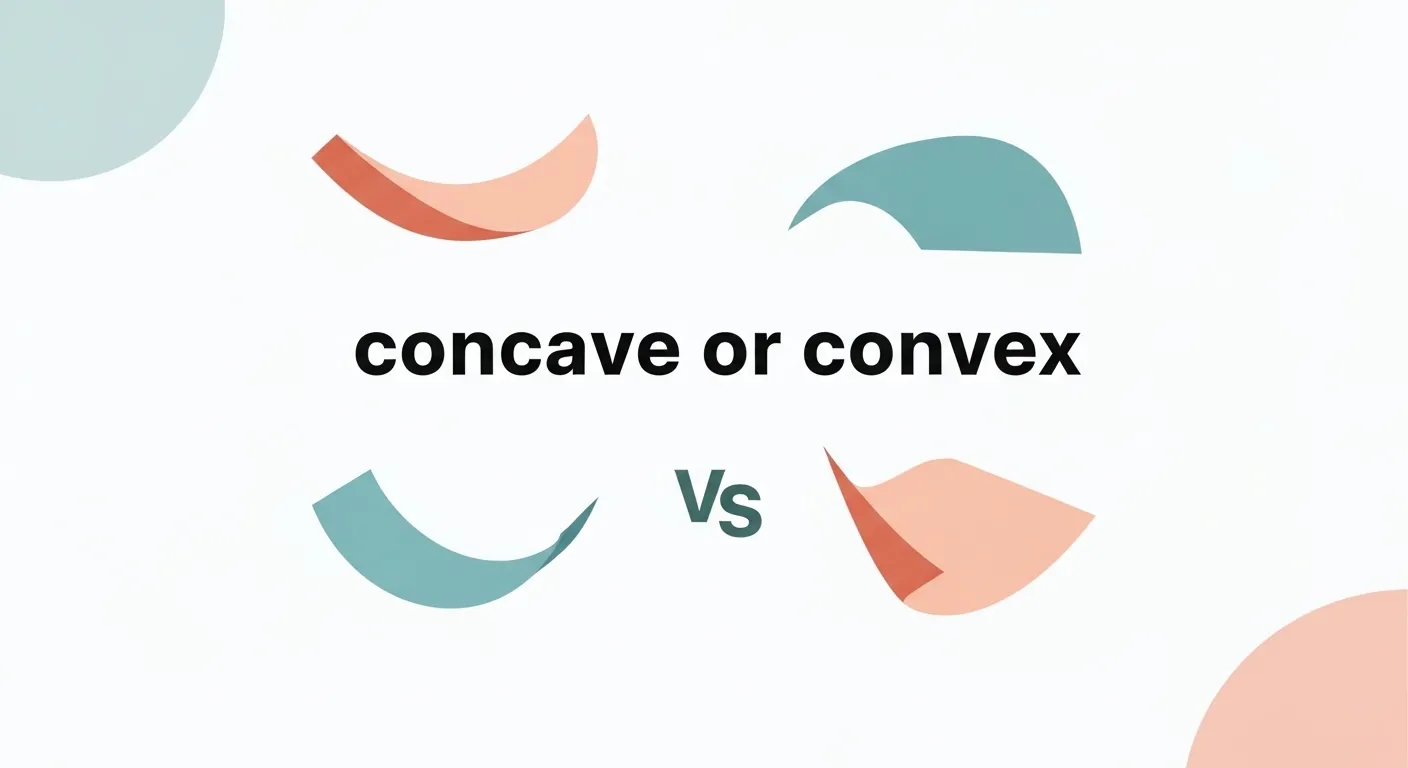
Concave curves inward, while convex curves outward. Many people search for concave or convex because these words look similar but describe opposite shapes.
Students, writers, designers, and even drivers see these terms in math, physics, mirrors, lenses, architecture, and daily objects.
The confusion usually happens when trying to remember which shape bends inward and which bulges outward.
Some also struggle when describing lenses, mirrors, or graphs correctly. This guide explains the difference in simple language with clear examples.
You will learn the meanings, origins, spelling usage, real world examples, and common mistakes.
By the end, you will feel confident using concave and convex correctly in both casual and professional situations.
Concave or Convex: Quick Answer
Concave and convex describe shapes or surfaces.
- Concave means curved inward like the inside of a bowl.
- Convex means curved outward like the outside of a ball.
Easy examples:
- A spoon’s inside surface is concave.
- A spoon’s back side is convex.
- A cave entrance can look concave.
- A dome roof is often convex.
Memory tip:
- Concave = cave → goes inward.
- Convex = bulges outward.
These terms appear in geometry, optics, lenses, mirrors, architecture, and even economics charts.
The Origin of Concave or Convex
Understanding the origin helps you remember meaning easily.
Concave
The word concave comes from Latin:
- “concavus” meaning hollow or vaulted.
- It describes something curved inward.
Early mathematicians used this word to describe shapes that dip inside. Scientists later applied it to mirrors and lenses.
Convex
Convex comes from Latin:
- “convexus” meaning vaulted or arched.
- It refers to surfaces that curve outward.
In classical geometry, convex shapes were defined as shapes where lines between any two points remain inside the shape. This helped mathematicians classify polygons and curves.
Why confusion exists
- Both words start with “con.”
- Both describe curved surfaces.
- They are opposites but sound similar.
Because of this, learners often mix them up, especially in science classes.
British English vs American English Spelling
Unlike many English words, concave and convex do not change spelling between British and American English. However, usage examples may differ based on education systems or contexts.
Both regions use:
- concave
- convex
There is no alternate spelling.
Comparison Table
| Feature | British English | American English |
| Concave spelling | concave | concave |
| Convex spelling | convex | convex |
| Pronunciation | Similar | Similar |
| Usage in math/science | Same meaning | Same meaning |
| Educational examples | Mirrors, lenses | Mirrors, lenses |
The consistency makes learning easier. Once you understand meaning, you can use the same spelling everywhere.
Which Spelling Should You Use?
Since there are no spelling variations, your focus should be on choosing the correct word based on meaning.
If your audience is in the United States
Use:
- concave for inward curves.
- convex for outward curves.
American textbooks often include lens and mirror examples.
If your audience is in the UK or Commonwealth
Use the same spellings. Science and math terminology remains identical.
For global audiences
Choose based on shape description:
- inward curve → concave
- outward curve → convex
Clear visuals or examples help international readers understand quickly.
Common Mistakes with Concave or Convex
Many learners make similar errors. Here are the most frequent ones.
1. Mixing up inward and outward
Incorrect:
- Calling a dome concave.
Correct:
- Dome = convex.
2. Forgetting memory cues
Remember:
- Cave = inward → concave.
3. Confusion in mirrors
- Concave mirrors can focus light.
- Convex mirrors spread light and show wider views.
4. Using both words together incorrectly
Incorrect:
- “The surface is concave and convex” without explanation.
Correct:
- “The spoon has a concave inside and convex outside.”
5. Misunderstanding graphs
In mathematics:
- Concave up or concave down describes curve direction.
- Convex often refers to outward shape or optimization concepts.
Quick correction table
| Mistake | Correct Version |
| Dome is concave | Dome is convex |
| Bowl exterior is concave | Bowl exterior is convex |
| Cave wall convex | Cave wall concave |
Concave or Convex in Everyday Examples
These terms appear in many daily contexts.
Emails
- “The lens uses a convex shape to widen viewing angle.”
- “The design needs a concave curve for better grip.”
News writing
- Automotive mirrors often use convex glass to improve side visibility.
- Satellite dishes use concave shapes to focus signals.
Social media
- “My makeup mirror is concave for close detail.”
- “Convex mirrors help parking safety.”
Formal writing
- Engineering reports describe concave structures for strength.
- Mathematical papers discuss convex functions and sets.
Everyday objects
- Spoon: concave inside, convex outside.
- Camera lenses: convex shapes bend light.
- Stadium roofs: often convex.
Concave or Convex: Google Trends & Usage Data
Interest in these words rises during academic seasons. Students often search during math and physics exams. Engineering and design fields also increase searches.
Popular regions
- United States
- United Kingdom
- India
- Pakistan
- Canada
- Australia
Contexts of use
- Geometry lessons.
- Physics optics topics.
- Photography and lenses.
- Architecture design.
- Economics and optimization.
Online learning platforms contribute to increased searches as students look for simple explanations.
Comparison Table: Concave vs Convex
| Feature | Concave | Convex |
| Curve direction | Inward | Outward |
| Memory tip | Cave shape | Bulging shape |
| Mirror behavior | Focuses light | Spreads light |
| Spoon example | Inside surface | Outside surface |
| Lens type | Can diverge light | Often converges light |
| Visual appearance | Hollow | Rounded |
FAQs About Concave or Convex
1. How can I quickly remember concave and convex?
Think of a cave. A cave curves inward. That means concave is inward.
2. Are concave and convex opposites?
Yes. They describe opposite types of curves or surfaces.
3. Do these words change spelling in different English regions?
No. The spelling stays the same worldwide.
4. Where are concave mirrors used?
They are used in makeup mirrors, telescopes, and headlights because they focus light.
5. Why are side mirrors convex?
Convex mirrors show a wider field of view. This helps drivers see more area.
6. Can shapes be both concave and convex?
Some objects have both surfaces. A spoon is a simple example.
7. Are concave and convex only math terms?
No. They appear in physics, design, architecture, and everyday objects.
Conclusion
Understanding concave or convex becomes simple when you focus on direction. Concave means curved inward like the inside of a bowl. Convex means curved outward like the surface of a sphere.
Both terms come from Latin roots that describe hollow and arched shapes. Their spelling remains the same worldwide, which removes confusion across regions.
Most mistakes happen when people forget which direction each word describes, but memory tricks like cave equals inward help solve this quickly.
These terms appear in many real life situations, from mirrors and lenses to architecture and graphs.
Clear examples help you choose the correct word every time. When writing or speaking, imagine the shape physically.
Visualizing the curve makes the choice easy and natural. Practice using simple comparisons like spoons, domes, and bowls.
Over time, recognizing inward versus outward curves will become automatic.
With this knowledge, you can describe shapes accurately in both casual and technical communication.
Related More Posts!
Sympathy or Empathy: What’s the Difference?With In 30 Minutes
Between or Among: What’s the Difference?

thinkaora.com is my English grammar comparison website where I simplify confusing words, spelling differences, and usage rules through clear explanations and examples. My goal is to help learners, writers, and students understand English easily and use correct grammar with confidence.