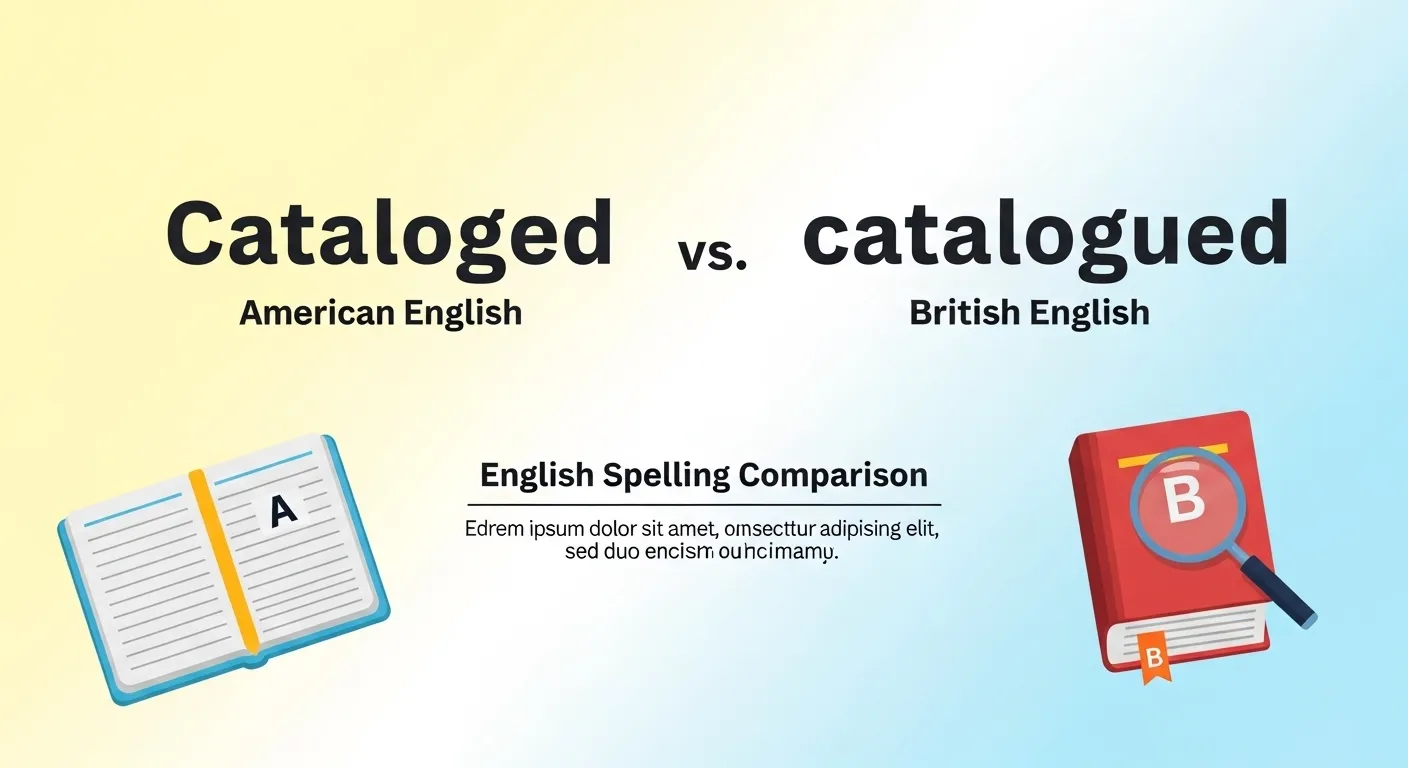
Cataloged and catalogued are both correct spellings; cataloged is used in American English, while catalogued is used in British English and many Commonwealth regions.
Many writers pause when choosing between these two forms because they look different but sound the same.
Students, bloggers, researchers, and professionals often search for this topic when editing documents, writing articles, or preparing academic work.
The confusion comes from spelling traditions that changed over time and from different language standards used across countries.
Understanding the difference helps you write clearly and maintain consistency in your work. This guide explains the meaning,common mistakes, and practical advice so you can choose the right form with confidence.
Cataloged or Catalogued – Quick Answer
The quick answer is simple:
- Cataloged → American English spelling
- Catalogued → British English spelling
Both words are the past tense and past participle of the verb “catalog” or “catalogue,” which means to make a list or record items in an organized way.
Examples:
- The librarian cataloged new books yesterday. (US style)
- The museum catalogued ancient artifacts carefully. (UK style)
Both sentences have the same meaning. The difference lies only in spelling tradition.
Key points:
- Pronunciation stays the same.
- Meaning does not change.
- Choice depends on regional language preference or style guidelines.
The Origin of Cataloged or Catalogued
The word comes from the Greek word katalogos, which meant a list or register. It entered Latin as catalogus and later moved into French as catalogue. English borrowed the term during the Middle English period.
Early English writing favored the spelling catalogue, influenced by French. Over time, language simplified in different regions.
American writers often removed silent letters to make spelling shorter and easier. This change led to forms like:
- colour → color
- organise → organize
- catalogue → catalog
When verbs formed past tense endings, these regional preferences continued:
- catalog + ed = cataloged (American form)
- catalogue + d = catalogued (British form)
The spelling difference reflects historical evolution rather than any difference in meaning or grammar.
Language naturally changes over centuries, and spelling variations are common across English-speaking regions.
British English vs American English Spelling
English spelling differences between regions developed due to education systems, printing traditions, and cultural identity.
American English often prefers shorter forms, while British English keeps older spellings influenced by French.
Below is a comparison showing how the two forms differ.
| Feature | American English | British English |
| Base word | catalog | catalogue |
| Past tense | cataloged | catalogued |
| Style preference | Shorter spelling | Traditional spelling |
| Common locations | United States | UK, Australia, Canada (often), New Zealand |
| Pronunciation | Same | Same |
More examples of similar patterns:
| American | British |
| dialog | dialogue |
| analog | analogue |
| cataloged | catalogued |
These patterns help writers recognize that the extra “ue” ending usually signals British spelling.
Which Spelling Should You Use?
Choosing the right spelling depends on your audience and context.
1. For American readers
Use cataloged. It matches American dictionaries, academic guidelines, and common publishing standards in the United States.
2. For British or Commonwealth readers
Use catalogued. This includes audiences in the United Kingdom, Australia, and many international institutions that follow British language traditions.
3. For global audiences
Pick one version and stay consistent throughout your writing. Mixing spellings in the same document can confuse readers and make your work look less polished.
4. For academic or professional writing
Follow the style guide required by your institution or publisher. Many organizations specify language standards.
Practical tip:
Check your existing content. If you already use words like “colour,” “organise,” or “centre,” then “catalogued” fits better. If you use “color,” “organize,” or “center,” then “cataloged” is the natural choice.
Common Mistakes with Cataloged or Catalogued
Many writers make small errors when using these words. Here are the most frequent issues and how to avoid them.
Mistake 1: Mixing spellings
Incorrect: The archive cataloged items and later catalogued additional files.
Correct: Choose one style and use it consistently.
Mistake 2: Adding extra letters
Incorrect: cataloggued
Correct: catalogued
Mistake 3: Confusing noun and verb forms
Remember:
- catalog/catalogue → noun or verb base form
- cataloged/catalogued → past tense
Mistake 4: Changing pronunciation
Both spellings sound the same. Do not try to pronounce the “ue.”
Mistake 5: Assuming one form is wrong
Both forms are correct. The difference is regional, not grammatical.
Cataloged or Catalogued in Everyday Examples
Understanding real-life usage helps make the difference clear.
Emails
- “I cataloged the client data and saved it in the database.”
- “We catalogued all submissions before review.”
News Writing
- “The journalist cataloged evidence from multiple sources.”
- “Researchers catalogued rare species during the expedition.”
Social Media
- “I finally cataloged my book collection!”
- “She catalogued her travel photos online.”
Academic Writing
- “The study cataloged historical records from 1900 to 1950.”
- “The library catalogued manuscripts according to classification rules.”
Formal Reports
- “All assets were cataloged for inventory management.”
- “Artifacts were catalogued for museum preservation.”
These examples show that both forms function exactly the same in everyday communication.
Cataloged or Catalogued – Google Trends & Usage Data
Search patterns show clear regional preferences.
- Cataloged appears more frequently in the United States.
- Catalogued appears more often in the United Kingdom and other Commonwealth countries.
American publications, technology companies, and academic journals often use the shorter form. British museums, universities, and publishing houses commonly use the longer form.
Digital writing has also influenced usage. Many international platforms accept both spellings, but writers tend to follow their local education system.
Context also matters:
- Technology and business writing often lean toward American spelling due to global software standards.
- Literature, history, and cultural institutions may keep traditional British forms.
Understanding audience expectations helps maintain clarity and consistency.
Comparison Table: Keyword Variations
| Variation | Region | Usage Context | Meaning |
| catalog | US | General writing | Base form |
| catalogue | UK | General writing | Base form |
| cataloged | US | Past tense | Same meaning |
| catalogued | UK | Past tense | Same meaning |
| cataloging | US | Present participle | Listing items |
| cataloguing | UK | Present participle | Listing items |
FAQs About Cataloged or Catalogued
1. Are cataloged and catalogued both correct?
Yes. Both spellings are correct and carry the same meaning. The difference comes from regional language standards.
2. Which spelling is more common globally?
Cataloged is widely used online due to American influence, but catalogued remains common in British contexts.
3. Do dictionaries accept both forms?
Yes. Major dictionaries list both versions, noting regional preference.
4. Is pronunciation different?
No. Both spellings are pronounced the same way.
5. Can I use both in one article?
It is better to choose one style and stay consistent to avoid confusion.
6. Why does British English keep “ue”?
It reflects older spelling traditions influenced by French language patterns.
7. Which spelling should students use?
Follow your school or regional language standard.
Conclusion
Cataloged and catalogued represent two valid ways to write the past tense of catalog or catalogue. The main difference lies in regional spelling traditions rather than grammar or meaning.
American English prefers the shorter form, cataloged, while British English keeps the traditional catalogued.
Knowing your audience helps you choose the best version. Consistency matters more than the specific form you select.
If your writing follows American patterns like color and organize, then cataloged fits naturally. If your writing uses British forms like colour and organise, catalogued works better.
Language changes over time, and spelling differences reflect history, culture, and evolving standards. Writers often feel unsure because both versions appear in books, websites, and academic texts.
Understanding the origin and regional use removes that uncertainty. By selecting one style and applying it consistently, you create clear and professional communication.
The key takeaway is simple: both spellings are correct, so focus on matching your audience and maintaining uniform spelling throughout your work.
Related More Posts!
Tires or Tyres: Examples and Correct Usage 📝

I am Sophia Martinez.I am an ESL grammar coach. I specialize in teaching English to non native speakers. My content focuses on commonly confused words like affect vs effect, their vs there, and verb tense comparisons. Sophia writes in a friendly, supportive tone designed to build confidence in learners.