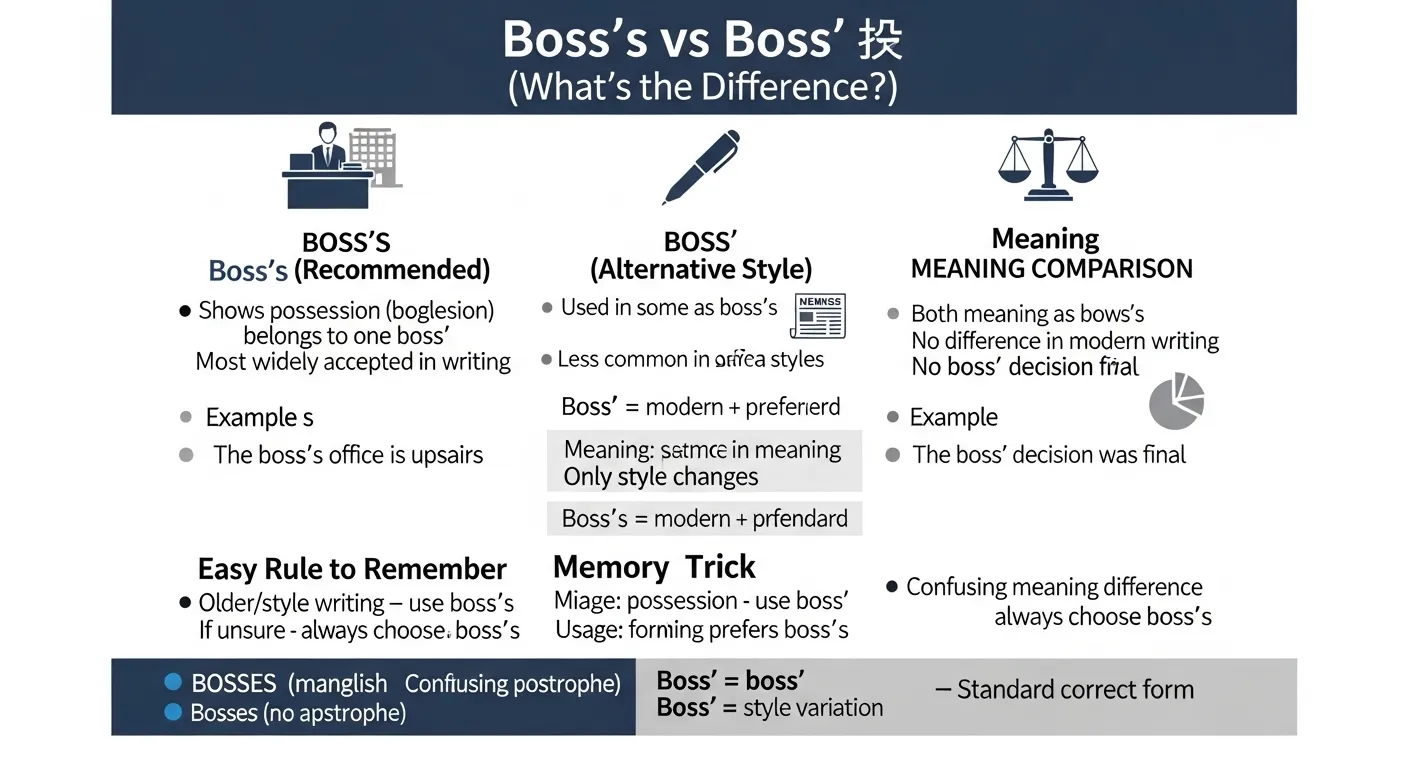
Both “boss’s” and “boss’” are correct, but modern English usually prefers “boss’s.”
Many writers feel confused when a word already ends in -s, like “boss.” Should you add another ’s or just an apostrophe? This question often appears in exams, emails, and professional writing.
People search “boss’s vs boss’” because they are unsure which form is correct and which one sounds more natural.
The confusion comes from different style rules in English, especially between modern usage and traditional style guides.
Understanding this rule is important because possessive forms are used every day. A small punctuation mark can change how professional your writing looks.
This guide explains everything clearly with simple rules, examples, and practical tips so you can choose the right form with confidence.
Boss’s vs Boss’: Quick Answer ⚡✅
👉 Boss’s = modern and most common possessive form
👉 Boss’ = older or style-based form (less common)
👉 Featured Rule
Both “boss’s” and “boss’” are correct. Modern English prefers “boss’s,” while “boss’” appears in traditional or style-specific writing.
📌 Examples:
- ✔ The boss’s office is large.
- ✔ The boss’s decision was final.
- ✔ The boss’ car is outside.
👉 Simple idea:
Add ’s in modern English → boss’s
Boss’s vs Boss’: Definitions with Examples & Top Queries 📖✍️
🟢 Boss’s (Definition)
“Boss’s” shows possession, meaning something belongs to one boss.
📌 Examples:
- ✔ The boss’s meeting starts at 10.
- ✔ I followed the boss’s instructions.
🔵 Boss’ (Definition)
“Boss’” also shows possession, but follows a shorter, traditional rule for words ending in -s.
📌 Examples:
- ✔ The boss’ office is closed.
- ✔ The boss’ decision surprised everyone.
🔍User Queries:
People often search:
- boss’s vs boss’ difference
- which is correct boss’s or boss’
- apostrophe rules for boss
- possessive form of boss
- boss’ meaning in English
- boss’s sentence examples
- grammar rules for words ending in s
- is boss’ correct
- boss’s vs bosses difference
- when to use boss’
👉 These queries show confusion about possessive rules.
The Origin of Boss’s vs Boss’ 📜⏳
The word “boss” comes from Dutch “baas,” meaning master or leader.
In English grammar:
- Possession is shown using ’s
- Older rules suggested adding only ’ after words ending in -s
👉 Over time, English evolved:
- Modern style → boss’s
- Traditional style → boss’
👉 This change happened to make pronunciation clearer.
Boss’s vs Boss’: British vs American English 🌍🇬🇧🇺🇸
👉 Both forms are used in both regions, but preferences differ slightly.
📊 Comparison Table
| Form | British English | American English |
| boss’s | ✔ Preferred | ✔ Strongly preferred |
| boss’ | ✔ Accepted | ✔ Less common |
👉 Modern writing in both regions favors boss’s.
Boss’s vs Boss’: Which One Should You Use? 🎯📝
✔ Use “Boss’s” When:
- Writing modern English
- Emails and professional communication
- Exams and assignments
👉 Example:
- The boss’s approval is needed
✔ Use “Boss’” When:
- Following a specific style guide
- Writing in traditional or classical style
👉 Example:
- The boss’ office was empty
🧠 Memory Trick:
👉 Modern = ’s → boss’s
👉 Old style = ’ → boss’
Smart Rule:
This pattern applies to many words ending in “-s” (e.g., class’s, boss’s), making the rule useful beyond this word.
Common Mistakes with Boss’s vs Boss’ ❌⚠️
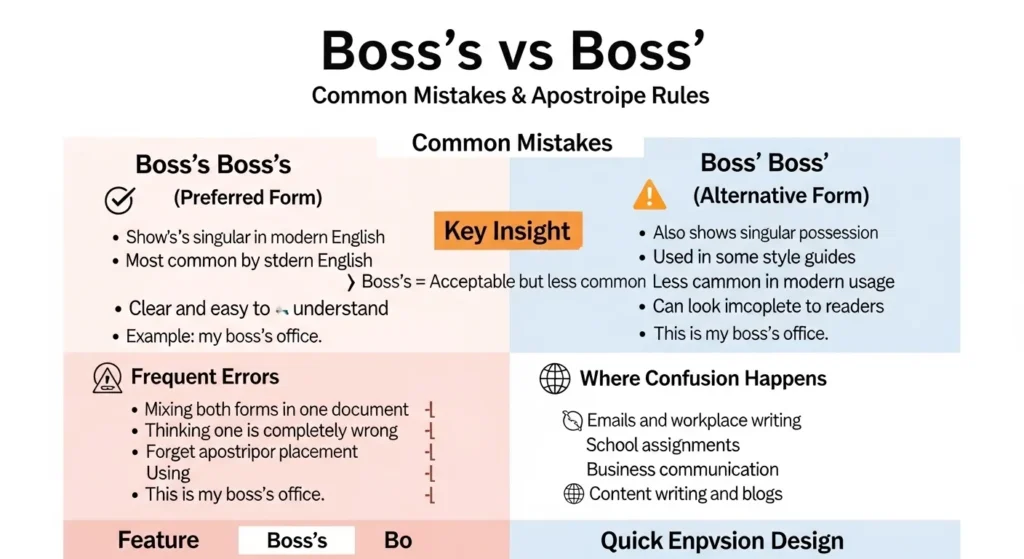
1. Using plural instead of possessive
❌ The bosses car
✔ The boss’s car
2. Forgetting apostrophe
❌ The boss office
✔ The boss’s office
3. Mixing styles
✔ Choose one form and stay consistent
4. Overthinking rules
✔ Modern English → use boss’s
Boss’s vs Boss’ in Everyday Examples 💬📱
🏠 Daily Life:
- The boss’s phone is ringing
- The boss’ office is closed
📱 Social Media:
- Respect your boss’s decisions
- The boss’ message went viral
📚 School Writing:
- The boss’s role is important
- The boss’ authority was questioned
💼 Professional Writing:
- The boss’s approval is required
- The boss’ instructions were followed
Boss’s vs Boss’: Usage Trends & Popularity 📊📈
📌 Key Insight:
- “Boss’s” → dominant in modern English
- “Boss’” → less common, style-based
📊 Trend Summary:
- Online writing → boss’s
- Formal/older style → boss’
👉 Modern English strongly prefers clarity, so boss’s is widely used.
Comparison Table 📋⚖️
| Feature | Boss’s | Boss’ |
| Meaning | Possession | Possession |
| Style | Modern | Traditional |
| Usage | More common | Less common |
| Clarity | Clear pronunciation | Shorter form |
FAQs ❓💡
1. Is “boss’s” correct?
✔ Yes, it is the preferred modern form
2. Is “boss’” correct?
✔ Yes, but less common
3. Which should I use in exams?
✔ Use boss’s
4. Do both mean the same?
✔ Yes
5. Why are there two forms?
✔ Different grammar traditions
6. Which is more common today?
✔ Boss’s
7. Easy rule?
✔ Add ’s for modern writing
Conclusion 🧾📌
The difference between “boss’s” and “boss’” is simple once you understand modern grammar rules.
Both forms are correct and show possession, but they follow different styles. “Boss’s” is the modern and most commonly used form. It is clear, easy to read, and widely accepted in everyday writing, emails, and professional communication.
On the other hand, “boss’” is a shorter, traditional form that appears in certain style guides or older writing. While it is still correct, it is used less often today and may feel less natural in modern contexts.
The best approach is to choose one style and stay consistent. For most situations, especially exams and professional writing, “boss’s” is the safer and better choice. It improves clarity and matches current usage trends.
In simple terms: both are correct, but “boss’s” is the preferred modern option. Use it confidently to make your writing clear, correct, and professional.
Discover More Articals!
Family’s or Families: Which One Is Correct? (2026)
Freshman vs Freshmen: What’s the Difference?
Layed or Laid: Which One Is Correct? (2026)

I am Sophia Martinez.I am an ESL grammar coach. I specialize in teaching English to non native speakers. My content focuses on commonly confused words like affect vs effect, their vs there, and verb tense comparisons. Sophia writes in a friendly, supportive tone designed to build confidence in learners.