“Amid” and “amidst” mean the same thing; both mean “in the middle of” or “surrounded by.”
Many writers search this query because they see both words in books, news, and online posts. The confusion comes from style, region, and tone.
Some people think one is modern and the other is old. Others believe one is British and the other American.
This creates doubt while writing emails, articles, or academic content. The good news is that the difference is small and easy to learn.
This guide explains meanings, origins, usage tips, common mistakes, and real examples. By the end, you will know which word fits your audience, your tone, and your writing goals.
Amid or Amidst: Quick Answer
Both amid and amidst mean “in the middle of,” “among,” or “surrounded by.” The meaning does not change. Only style and tone differ.
👉 Amid feels slightly more modern and simple.
👉 Amidst sounds more formal or traditional.
Simple Examples
- She smiled amid the crowd.
- He stayed calm amid chaos.
- The house stood amidst tall trees.
- The team celebrated amidst loud cheers.
Both sentences above are correct. You can replace one with the other without changing the meaning.
When to Choose Each
- Use amid for clear, modern writing.
- Use amidst for a poetic or formal tone.
Think of it like choosing between short and slightly longer forms. The core idea stays the same.
The Origin of Amid or Amidst
Understanding the history helps remove confusion. Both words come from Old English roots. The older form was “on middan,” which meant “in the middle.” Over time, language evolved and shortened the phrase.
How “amid” developed
“Amid” became common as a shorter, cleaner form. Writers preferred it because it was easy to say and read. As English changed, many words became shorter and simpler.
How “amidst” appeared
The “-st” ending came later. English speakers often added “-st” to create stronger or more formal sounds. Similar examples include:
- Among → Amongst
- While → Whilst
These forms sound more traditional. They often appear in older literature or formal speech.
Why both survived
Language does not always remove older versions. Instead, different forms stay alive for style reasons. Writers choose based on tone, region, and preference.
So, there is no right or wrong choice. Both words come from the same idea. One simply sounds more classic.
British English vs American English Spelling
Regional habits influence word choice. While both forms appear worldwide, preferences differ.
General patterns
- American writers often prefer shorter forms.
- British and Commonwealth writers sometimes use longer traditional endings.
This does not mean strict rules exist. Many UK writers use “amid,” and many US writers use “amidst.” Still, trends exist.
Examples
- US news headline: “Markets rise amid global tension.”
- UK literary style: “She walked amidst golden fields.”
Comparison Table
| Feature | Amid | Amidst |
| Meaning | In the middle of | In the middle of |
| Tone | Modern, simple | Formal, poetic |
| Length | Shorter | Slightly longer |
| American usage | More common | Less common |
| British usage | Common | Also common |
| Academic writing | Accepted | Accepted |
Both words remain correct in any region. Choose based on style rather than strict grammar rules.
Which Spelling Should You Use?
Choosing depends on your audience and writing purpose.
For US readers
Use amid for clarity. Many American publications prefer shorter forms. It feels direct and modern.
For UK or Commonwealth readers
Both forms work. If your tone is formal or literary, “amidst” may fit well. For news or business writing, “amid” keeps things simple.
For global audiences
Choose amid because it is shorter and easier for readers worldwide. Short words improve readability, especially for online content.
Tone-based decisions
- Professional or journalistic writing → amid
- Poetry or dramatic storytelling → amidst
- Academic work → either form, but stay consistent
Consistency matters. Avoid switching between forms within the same piece.
Common Mistakes with Amid or Amidst
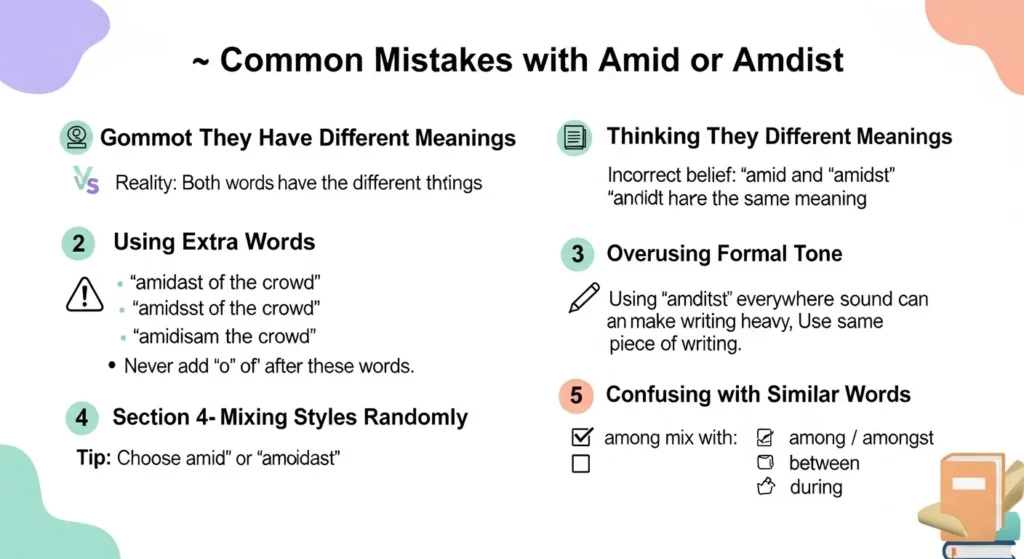
Many errors come from misunderstanding meaning or placement.
1. Thinking they have different meanings
❌ Incorrect belief: “amid” and “amidst” mean different things.
✅ Reality: Both carry the same meaning.
2. Using extra words
❌ “amidst of the crowd”
✅ “amid the crowd”
✅ “amidst the crowd”
Never add “of” after these words.
3. Overusing formal tone
Some writers choose “amidst” everywhere because it sounds fancy. This can make writing feel heavy. Use it only when tone requires it.
4. Mixing styles randomly
Switching between “amid” and “amidst” without reason confuses readers. Pick one form and stay consistent.
5. Confusing with similar words
Do not mix with:
- among / amongst
- between
- during
Each has a slightly different usage context.
Amid or Amidst in Everyday Examples
Learning through real-life usage makes understanding easier.
Emails
- “We completed the project amid tight deadlines.”
- “The team stayed focused amidst unexpected changes.”
Professional emails usually prefer shorter words.
News Writing
Journalists often use concise language.
- “Stocks fell amid economic uncertainty.”
- “Leaders met amid rising tensions.”
Social Media Posts
Simple language works best.
- “Finding peace amid chaos.”
- “Smiling amidst the noise of life.”
Both appear online, but shorter forms feel more modern.
Academic or Formal Writing
- “The experiment continued amidst strict observation.”
- “Policies changed amid public pressure.”
Formal tone may welcome either version.
Creative Writing
- “She stood amidst the storm.”
- “Flowers grew amid ruins.”
Writers often choose based on rhythm and sound.
Amid or Amidst: Google Trends & Usage Data
Usage patterns change over time. Modern writing trends favor simplicity and clarity. Because of this, “amid” often appears more frequently in news and digital content.
Popularity by region
- United States: “amid” dominates due to preference for shorter forms.
- United Kingdom: both appear regularly, though literary writing may include “amidst.”
- Global online content: “amid” grows due to readability and search behavior.
Context-based usage
- Journalism and headlines prefer shorter words.
- Poetry and historical writing may use longer traditional forms.
- Business communication favors clarity, so shorter options appear more.
Digital writing encourages concise language. This increases the visibility of shorter forms.
Comparison Table: Keyword Variations Side by Side
| Variation | Meaning | Tone | Common Regions | Best Use Cases |
| Amid | In the middle of | Modern, clear | US, global | News, blogs, business writing |
| Amidst | In the middle of | Formal, classic | UK, literature | Creative writing, formal tone |
FAQs About Amid or Amidst
1. Are “amid” and “amidst” interchangeable?
Yes. They carry the same meaning. The difference lies in tone and style preference.
2. Is one more correct than the other?
No. Both are grammatically correct. Choice depends on audience and writing style.
3. Which sounds more modern?
“Amid” sounds simpler and more modern because it is shorter.
4. Which sounds more formal?
“Amidst” feels slightly more formal or literary due to the added ending.
5. Can I use them in academic writing?
Yes. Both are acceptable. Just remain consistent within your text.
6. Do native speakers notice a difference?
Some notice tone differences, but most understand both instantly.
7. Should beginners choose one over the other?
Beginners may find “amid” easier because it is shorter and widely used.
Conclusion
Choosing between amid and amidst is easier than many people think. Both words share the same meaning. They describe being surrounded by something or existing in the middle of a situation. The real difference lies in tone and style.
“Amid” feels modern, clear, and direct. It works well in news articles, emails, business writing, and online content.
“Amidst” sounds more formal and traditional. It fits poetry, storytelling, and dramatic writing where rhythm matters.
Regional habits may influence your decision, but no strict rule limits usage. Writers in any country can use either form.
The key is consistency. Pick the word that matches your audience and keep using it throughout your piece. Short sentences and clear wording improve readability.
Many modern writers prefer shorter forms because readers scan content quickly. Still, longer traditional forms add personality and style when used carefully.
Understanding the origin and usage helps remove doubt. Instead of worrying about correctness, focus on clarity and tone. When your writing feels natural and easy to read, both words will serve you well.
Related more posts!
Lie or Lye: Meaning, Differences and Complete Grammar Guide✨

thinkaora.com is my English grammar comparison website where I simplify confusing words, spelling differences, and usage rules through clear explanations and examples. My goal is to help learners, writers, and students understand English easily and use correct grammar with confidence.