The correct spelling is “reckless”, not “wreckless.” Many people search for “wreckless or reckless” because the words sound similar, and they want to avoid embarrassing mistakes in writing.
The confusion often appears in emails, essays, social media posts, and official documents. Understanding the difference is important because spelling it wrong can make you look unprofessional.
In this article, we will explain the correct spelling, the history of the word, differences between British and American usage, common mistakes and give clear guidance on which version to use in everyday writing.
Wreckless or Reckless: Quick Answer
Quick Answer: The correct spelling is reckless.
- Reckless (adjective) means careless or without thinking about danger or consequences.
- Wreckless is incorrect and rarely used; it is a misspelling.
Examples:
- Correct: “Driving at high speed in the rain is reckless.”
- Incorrect: “He was acting wreckless on the road.”
Tip: If you are unsure, remember that “reck” comes from an old word meaning “care,” so “reckless” literally means “without care.”
The Origin of Wreckless or Reckless
The word reckless has a long history in English. It originates from the Middle English word “rekles”, which means “careless” or “thoughtless.” The root “reck” comes from Old English “raec”, meaning “regard” or “care.”
Over time, the word evolved into reckless in modern English. The misspelling wreckless likely emerged because the words “wreck” and “reck” sound alike, especially when spoken. Some people associate “wreckless” with the idea of causing a “wreck,” but this is incorrect.
So, reckless is the historically and grammatically correct word. Understanding its origin helps prevent common mistakes and clarifies why “wreckless” is never right in formal writing.
British English vs American English Spelling
Unlike some words that have different British and American spellings, reckless is spelled the same way in both versions of English. There is no “wreckless” form in either British or American English.
| Word | British English | American English | Meaning |
| Reckless | ✅ | ✅ | Careless, without thought |
| Wreckless | ❌ | ❌ | Incorrect spelling |
Example Sentences : UK:
- “The driver’s reckless behavior caused an accident.”
Example Sentences : US:
- “It is reckless to text while driving.”
Key Point: There is no spelling variation for “reckless.” Both UK and US writers should use the same correct form.
Which Spelling Should You Use?
Always use reckless. There is no context where wreckless is correct. Here’s advice for different audiences:
- US Writers: Use reckless in emails, schoolwork, and professional documents.
- UK & Commonwealth Writers: Use reckless; avoid “wreckless” entirely.
- Global Audiences: If you are writing for international readers, reckless is universally understood and correct.
Pro Tip: Spellcheckers in Microsoft Word, Google Docs, and Grammarly will flag wreckless as incorrect. Always trust them.
Common Mistakes with Wreckless or Reckless
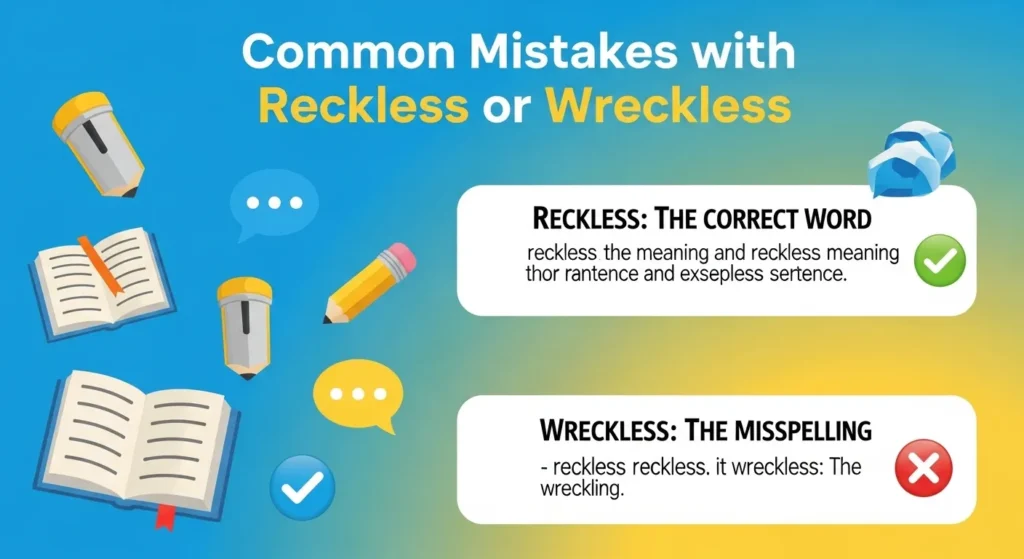
Many people accidentally write wreckless because of pronunciation or association with the word “wreck.” Let’s look at frequent errors:
- Incorrect: “He was wreckless on the road.”
Correct: “He was reckless on the road.” - Incorrect: “Driving so fast is completely wreckless.”
Correct: “Driving so fast is completely reckless.” - Incorrect: “Don’t be wreckless with your money.”
Correct: “Don’t be reckless with your money.”
Tip: If you can replace the word with careless, thoughtless, or irresponsible, then reckless is correct.
Wreckless or Reckless in Everyday Examples
Here are practical examples of reckless in different contexts:
Emails:
- “Please avoid reckless behavior while using company vehicles.”
News Articles:
- “The storm caused reckless driving conditions on the highways.”
Social Media:
- “Stop acting reckless just to get attention.”
Formal Writing:
- “The committee condemned the reckless spending of funds.”
Tip: You can safely use reckless in both casual and formal writing. Avoid “wreckless” to stay professional.
Wreckless or Reckless: Google Trends & Usage Data
Although “wreckless” appears occasionally in online searches, “reckless” dominates globally. Data shows:
- Highest usage: United States, UK, Canada, Australia
- Occasional errors: Users type “wreckless” when unsure of spelling
- Social Media: “Reckless” is overwhelmingly more common in tweets, posts, and captions
Observation: Search engines and writing tools often suggest reckless when “wreckless” is typed, showing the correct form is widely recognized.
Keyword Variations Comparison Table
| Variation | Correct? | Notes |
| Reckless | ✅ | Standard, historically correct, universal |
| Wreckless | ❌ | Common mistake, never correct |
| Recklessly | ✅ | Adverb form, e.g., “He drove recklessly.” |
| Wrecklessly | ❌ | Incorrect, avoid |
| Careless | ✅ | Synonym of reckless, simpler alternative |
FAQs: Wreckless or Reckless
1. Is “wreckless” a real word?
No, “wreckless” is not a real word in English. The correct form is reckless.
2. Can “reckless” be used in formal writing?
Yes, “reckless” is appropriate for both formal and informal contexts.
3. Why do people write “wreckless”?
Because it sounds similar to “reckless” and is associated with the word “wreck.”
4. Are there other forms of reckless?
Yes, adverbs and nouns: recklessly (adverb), recklessness (noun).
5. Is “reckless” spelled the same in UK and US English?
Yes, there is no difference; both use “reckless.”
6. What are synonyms for reckless?
Careless, rash, thoughtless, irresponsible, heedless.
7. How can I remember the correct spelling?
Remember “reck” = care, so reckless = without care.
Conclusion
Understanding the difference between wreckless and reckless is crucial for clear and professional writing. Reckless is the correct spelling, used worldwide in both British and American English.
The misspelling wreckless often appears because of pronunciation or confusion with the word “wreck,” but it is always incorrect.
Using reckless ensures your writing looks polished and credible,If in emails, social media posts, news articles, or academic work.
Remember, reckless describes someone who acts without care or consideration for consequences.
Using it correctly prevents misunderstandings and enhances clarity. Always double-check spelling to maintain accuracy and professionalism in all types of communication.
Related More Posts!
Licences or Licenses: Grammar Rules Explained

I am Sophia Martinez.I am an ESL grammar coach. I specialize in teaching English to non native speakers. My content focuses on commonly confused words like affect vs effect, their vs there, and verb tense comparisons. Sophia writes in a friendly, supportive tone designed to build confidence in learners.