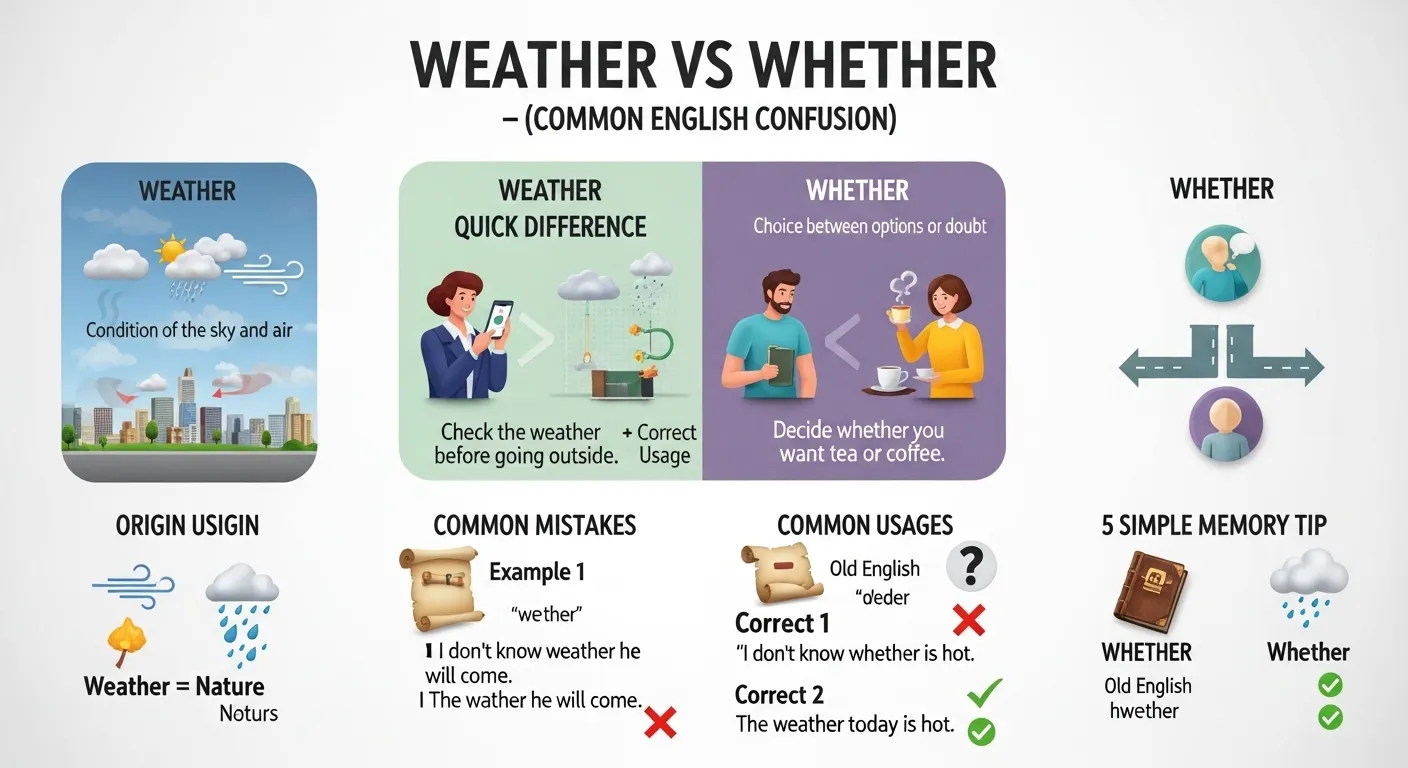
Weather = climate or outdoor conditions; whether = choice between options or doubt. Many learners mix these two words because they sound the same but mean very different things.
People often search this topic when writing emails and feel unsure about which spelling fits their sentence. A small mistake can change the meaning completely and make writing look less clear.
This guide removes that confusion step by step. You will learn the difference in meaning and common errors.
You will also see real life examples and simple tips so you can choose the correct word quickly and write with confidence every day.
Weather or Whether: Quick Answer
These two words are homophones. They sound alike but carry different meanings.
Weather
- Meaning: the condition of the sky and air.
- It relates to rain, sun, wind, clouds, heat, or cold.
- Examples:
- The weather is sunny today.
- Bad weather delayed our trip.
- I check the weather before leaving home.
- The weather is sunny today.
Whether
- Meaning: used when talking about choice, doubt, or two possibilities.
- Often connects options.
- Examples:
- I do not know whether he will come.
- Decide whether you want tea or coffee.
- She asked whether the meeting was today.
- I do not know whether he will come.
Simple tip:
If you can replace the word with “climate,” use weather.
If you talk about options or uncertainty, use whether.
The Origin of Weather or Whether
Language history helps explain why these words confuse many writers.
Origin of “Weather”
The word comes from Old English weder. It described air conditions and seasonal changes. Early Germanic languages used similar words to describe storms, wind, and natural forces.
Over time, the spelling became stable in modern English. Its meaning stayed close to nature and the environment.
Origin of “Whether”
This word comes from Old English hwæther, meaning “which of two.” It was used when choosing between options or expressing uncertainty.
The spelling changed as English evolved, but the core meaning stayed linked to decisions and alternatives.
Why the Confusion Exists
- Both words sound the same in modern pronunciation.
- English has many homophones.
- Learners rely on sound instead of meaning when writing.
- Spell check tools may not catch the mistake because both are real words.
Understanding the roots shows that one word belongs to nature and the other to choice.
British English vs American English Spelling
Unlike many other word pairs, these two forms do not change between British and American varieties. The spelling remains the same across regions. However, usage style and sentence structure can vary slightly.
Key Points
- Both British and American English use weather for climate.
- Both use whether for choices or doubt.
- No regional spelling differences exist.
Comparison Table
| Feature | British English | American English | Example |
| Climate meaning | weather | weather | The weather is cold. |
| Choice meaning | whether | whether | I wonder whether she knows. |
| Formal writing | Same usage | Same usage | Reports, emails, essays |
| Spoken language | Same meaning | Same meaning | Everyday speech |
Because spelling does not change, the focus should be on understanding meaning rather than regional rules.
Which Spelling Should You Use?
Choosing the correct form depends on the sentence meaning and audience.
For US Readers
Use the standard meanings. American writing favors clear, direct sentences. Check context. Ask: Are you talking about climate or a decision?
For UK and Commonwealth Readers
The same rules apply. Many writers from Pakistan, India, Australia, and the UK follow British standards, but the distinction between these two words remains identical.
For Global Communication
When writing online or for international readers:
- Keep sentences short.
- Avoid complex phrasing that hides meaning.
- Use clear context clues.
Quick decision guide:
- Nature, sky, temperature → weather
- Choice, options, uncertainty → whether
Common Mistakes with Weather or Whether
Many errors happen because of pronunciation similarity.
Mistake 1: Using climate word for decisions
❌ I don’t know weather he will call.
✅ I don’t know whether he will call.
Mistake 2: Using decision word for climate
❌ The whether today is hot.
✅ The weather today is hot.
Mistake 3: Writing quickly without checking context
People type fast and rely on sound memory. Always reread the sentence and ask what you mean.
Mistake 4: Confusing in questions
❌ Tell me weather you agree.
✅ Tell me whether you agree.
Mistake 5: Overthinking grammar rules
The difference is simple. One relates to nature. One relates to options.
Weather or Whether in Everyday Examples
Seeing real life examples helps build memory.
Emails
- Please check the weather before traveling.
- Let me know whether you can attend the meeting.
News Headlines
- Severe weather warning issued today.
- Experts debate whether policy changes will help.
Social Media Posts
- Love this warm weather today.
- Not sure whether I should watch a movie or sleep.
Formal Writing
- The report studies how weather affects crops.
- The study examines whether training improves results.
Casual Conversation
- The weather feels cold this morning.
- I wonder whether he finished the work.
Weather or Whether: Google Trends & Usage Data
Search behavior shows how often people confuse these words. Many users type both forms together because they want a quick comparison.
Popular Regions
- United States
- United Kingdom
- India
- Pakistan
- Australia
In education focused regions, searches increase during exam seasons. Students want quick grammar help.
Context of Searches
- School assignments
- Professional writing
- Language learning
- Editing emails
Why Interest Stays High
- Homophones remain a common learning challenge.
- English learners want simple rules.
- Short guides help people fix mistakes fast.
Comparison Table: Keyword Variations Side by Side
| Word | Meaning | Use Case | Example Sentence |
| weather | climate conditions | nature, temperature | The weather is rainy. |
| whether | choice or doubt | decisions, options | Decide whether to go. |
| weather forecast | prediction of climate | news, travel | Check the weather forecast. |
| whether or not | emphasis on choice | formal writing | Tell me whether or not you agree. |
| severe weather | extreme conditions | safety alerts | Severe weather warning issued. |
| whether clause | grammar structure | formal grammar | I asked whether he arrived. |
FAQs
1. Why do people confuse these words?
They sound the same. English has many homophones. Writers rely on sound instead of meaning.
2. Is one word more formal than the other?
No. Each word fits a different meaning. Both appear in formal and casual writing.
3. Can I replace one with the other?
No. Switching them changes meaning and may make the sentence incorrect.
4. How can I remember the difference fast?
Think of weather with “wea ” like wind and air. Think of whether with “choice.”
5. Are there regional spelling changes?
No. Both British and American English use the same spelling.
6. Does grammar software always catch mistakes?
Not always. Since both words are correct spellings, software may miss the error.
7. Is one used more often?
Usage depends on context. News uses climate terms often. Academic writing uses choice related structures frequently.
Conclusion
Learning the difference between these two words is simple once you focus on meaning instead of sound. One refers to the natural world. It describes temperature, rain, wind, and sky conditions.
The other introduces choices, alternatives, or uncertainty between options. Many writers confuse them because pronunciation is identical, but understanding context solves the problem quickly.
Always read your sentence and ask a clear question: Am I talking about climate, or am I talking about a decision?
This small check prevents most mistakes. Practice by writing short sentences each day. Use real examples from emails, conversations, and news headlines to build confidence.
Over time, choosing the correct form becomes automatic. Clear writing helps readers understand your message faster and shows strong language skills. Keep sentences simple.
Focus on meaning. With these tips, you can avoid confusion and communicate clearly in both casual and professional situations.
Related More Posts!
Laptop or Labtop: Which Spelling Is Correct and Why It Matters?
Ton or Tonne: Which One Is Correct and When to Use Each?
Sympathy or Empathy: What’s the Difference?With In 30 Minutes

thinkaora.com is my English grammar comparison website where I simplify confusing words, spelling differences, and usage rules through clear explanations and examples. My goal is to help learners, writers, and students understand English easily and use correct grammar with confidence.