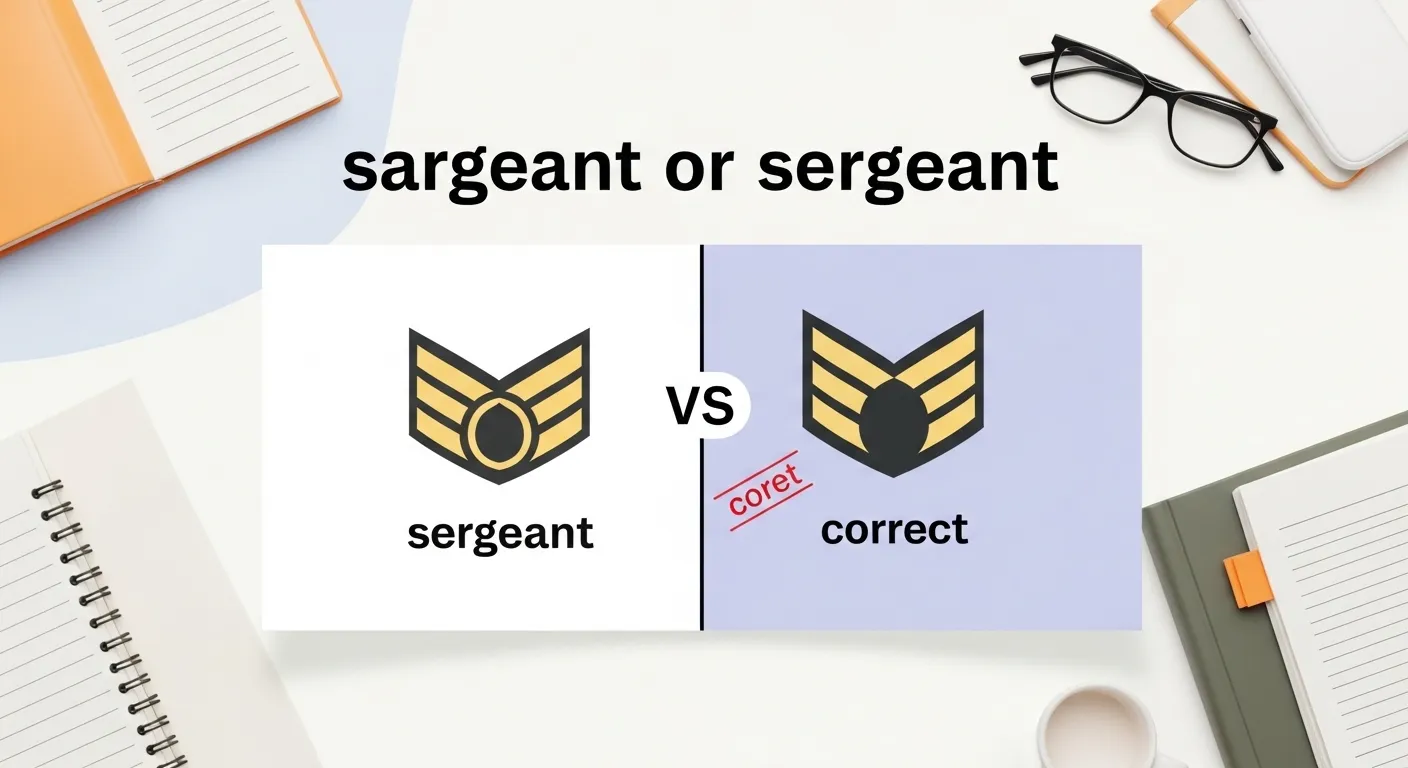
The correct and widely accepted spelling is “sergeant,” while “sargeant” is usually a misspelling or a rare surname variation.
Many people search for sargeant or sergeant because the pronunciation sounds confusing and English spelling does not always match how words sound.
Writers often hesitate when typing military ranks, police titles, or historical references because both versions look similar.
This confusion appears in emails, articles, social media posts, and official documents. Understanding the difference helps avoid mistakes and improves clarity.
This guide explains the meaning, history, and real life examples so you can confidently choose the right spelling every time.
Sargeant or Sergeant: Quick Answer
The correct spelling in standard English is sergeant.
“Sargeant” is usually incorrect unless it is part of a personal name or surname.
Simple explanation:
- ✅ Sergeant = correct spelling for military rank, police title, or official position.
- ❌ Sargeant = common misspelling caused by pronunciation confusion.
Examples:
- Correct: The police sergeant led the investigation.
- Correct: She was promoted to army sergeant.
- Incorrect: The police sargeant arrived early.
Many people write “sargeant” because the word sounds like “sar-jent.” However, English spelling keeps the traditional form “sergeant.”
The Origin of Sargeant or Sergeant
Understanding the history of a word often explains its spelling.
The word sergeant comes from Old French “sergent,” which means servant or officer. This term itself came from the Latin word “serviens,” meaning one who serves.
Historical development:
- Latin: serviens : servant or helper.
- Old French: sergent : military or official servant.
- Middle English: sergeaunt or serjant : early variations.
- Modern English: sergeant : standardized spelling.
Over centuries, English absorbed many French words after the Norman Conquest. Spellings were influenced by scribes, pronunciation changes, and regional habits. Even though pronunciation evolved, traditional spelling remained.
“Sargeant” likely appeared because English speakers wrote the word based on sound rather than historical spelling rules.
Some surnames still use “Sargeant,” which makes the confusion stronger. But for job titles or ranks, the accepted form is “sergeant.”
British English vs American English Spelling
Many English words have different spellings between British and American forms. Examples include “colour/color” or “centre/center.” However, in this case, both British and American English use the same spelling: sergeant.
The confusion does not come from regional spelling differences but from pronunciation.
Key points:
- British English: Sergeant ✔
- American English: Sergeant ✔
- Commonwealth countries: Sergeant ✔
The pronunciation often sounds like “sar-jent,” which leads some writers to add an extra “a.”
Comparison Table
| Feature | Sergeant | Sargeant |
| Standard spelling | Yes | No |
| Used in UK | Yes | Rare |
| Used in US | Yes | Rare |
| Military rank spelling | Correct | Incorrect |
| Police title spelling | Correct | Incorrect |
| Common usage | Very common | Mostly error or surname |
Unlike other spelling debates, there is no accepted regional difference here. “Sergeant” remains consistent across English-speaking countries.
Which Spelling Should You Use?
Choosing the correct spelling depends on context and audience expectations.
For United States readers
Use sergeant. All official military and law enforcement documents use this spelling.
Example:
- Staff Sergeant
- Police Sergeant
For United Kingdom or Commonwealth readers
Again, use sergeant. The spelling is standardized across these regions.
For global audiences
If your writing is intended for an international audience, always choose sergeant. It avoids confusion and maintains professionalism.
Exception: Personal names
If someone’s surname is spelled “Sargeant,” respect that spelling because names follow personal preference.
Example:
- Mr. John Sargeant (correct if that is the person’s name)
In summary, use “sergeant” in professional writing, educational material, journalism, and formal communication.
Common Mistakes with Sargeant or Sergeant
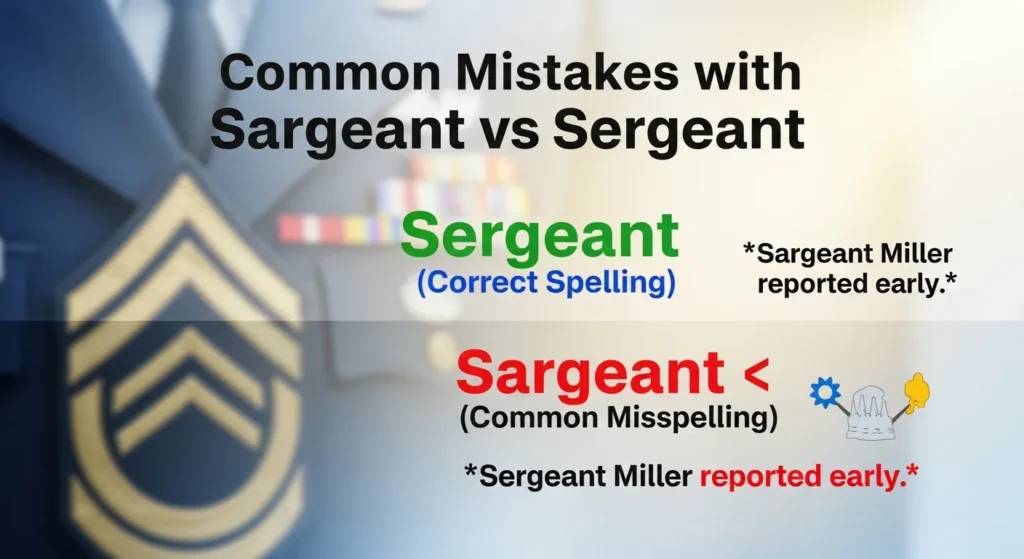
Writers often make predictable errors when dealing with this word.
1. Spelling based on sound
People hear “sar-jent” and assume it should be spelled with an “a.”
Correction:
- ❌ sargeant
- ✅ sergeant
2. Mixing rank with surname spelling
Seeing “Sargeant” as a family name leads some writers to assume it is correct everywhere.
Correction:
- Titles use sergeant.
- Names follow personal spelling.
3. Auto-correct confusion
Some typing tools may not flag “sargeant” if treated as a proper noun.
Tip: Always double-check professional titles.
4. Incorrect plural forms
- Correct: sergeants
- Incorrect: sargeants
5. Capitalization errors
Capitalize when used as a title before a name.
- Sergeant Miller arrived early.
- The sergeant gave instructions.
Understanding these mistakes helps prevent repeated errors.
Sargeant or Sergeant in Everyday Examples
Seeing words in real situations makes them easier to remember.
Emails
- Correct: Please contact Sergeant Adams for details.
- Incorrect: Please contact Sargeant Adams.
News writing
- Correct: The police sergeant confirmed the report.
- Correct: Army sergeants received awards.
Social media
- “My brother became a sergeant today!”
- “Congratulations to our new sergeant.”
Formal writing
- The sergeant supervised the training session.
- A senior sergeant led the unit.
Informal conversations
Even in casual writing, using the correct spelling builds credibility and clarity.
Sargeant or Sergeant: Google Trends & Usage Data
Search behavior shows that many people type both versions into search engines.
Why people search both forms:
- Pronunciation confusion.
- Exposure to surnames spelled “Sargeant.”
- Typing errors or autocorrect mistakes.
- Learning English as a second language.
Popular regions searching this topic:
- United States
- United Kingdom
- Canada
- Australia
- India and Pakistan
In most online texts, news sources, academic publications, and official websites use “sergeant.” The alternative spelling appears mostly in user-generated content or personal names.
Usage data indicates that “sergeant” dominates professional and educational contexts.
Keyword comparison table
| Variation | Meaning | Correct for rank | Frequency |
| Sergeant | Military/police rank | Yes | Very high |
| Sargeant | Alternate spelling or surname | No | Low |
| Sgt. | Abbreviation | Yes | Common |
| Staff Sergeant | Specific rank | Yes | High |
FAQs about Sargeant or Sergeant
1. Is “sargeant” ever correct?
Only when used as a personal surname or brand name. For ranks or titles, use “sergeant.”
2. Why does “sergeant” sound different from how it looks?
English pronunciation changed over time, but spelling stayed close to its French origin.
3. Do British and American English use different spellings?
No. Both use “sergeant.”
4. What is the abbreviation for sergeant?
“Sgt.” is the common abbreviation.
Example: Sgt. Williams.
5. How do I remember the correct spelling?
Think of “serve” because a sergeant serves or leads others.
6. Is sergeant used outside the military?
Yes. Police departments and some organizations use the title.
7. What is the plural form?
Sergeants.
Conclusion
Understanding the difference between sargeant or sergeant becomes simple once you know the history and standard usage. The correct spelling for military and police ranks is always “sergeant.”
Although “sargeant” may appear in personal names or occasional informal writing, it is not accepted as the standard spelling for official titles.
The confusion mainly comes from pronunciation because the spoken form does not match the written form perfectly.
English contains many words with silent or unexpected letters, and “sergeant” is one example where historical spelling remains unchanged.
Choosing the right spelling helps maintain professionalism and avoids misunderstanding, especially in formal communication, education, and public writing.
By remembering the origin, recognizing common mistakes, and seeing real-life examples, you can confidently use “sergeant” in emails, articles, social media, and official documents.
When in doubt, follow the widely accepted standard and use “sergeant” for clarity and correctness across all English speaking audiences.
Related More Posts!
Tires or Tyres: Examples and Correct Usage 📝

My name is James Whitmore.I am a language research writer. I explore the history and evolution of English words. I write detailed comparisons explaining why spellings change over time and how British and American English diverged. My articles add depth and credibility to grammar comparison topics.