“Regards” is usually used as a polite closing in emails, while “regard” is often used as a noun or verb inside sentences.
Many people search for “regard or regards” because they feel unsure when ending emails or writing formal messages. The confusion comes from grammar rules, professional etiquette, and similar meanings.
Some writers worry about sounding too formal or too casual. Others wonder if both words mean the same thing.
This guide explains the difference in simple language. You will learn when to use each form, common mistakes, real-life examples, and helpful tips.
After reading, you will feel confident using the right word in emails, writing, and daily communication.
Regard or Regards: Quick Answer
Regard and regards are related but used differently.
👉 Regard (singular)
- Used as a noun or verb inside sentences.
- Means respect, attention, or consideration.
Examples:
- I regard her as a strong leader.
- He showed high regard for his teacher.
👉 Regards (plural)
- Often used as a polite email closing.
- Can also mean greetings or good wishes.
Examples:
- Kind regards,
- Please give my regards to your family.
Quick tip:
Use regard within sentences. Use regards when closing emails or sending greetings.
The Origin of Regard or Regards
The word “regard” comes from Old French regarder. It meant “to look at” or “to observe.”
Over time, English speakers expanded its meaning. It began to include ideas like respect, care, and attention.
During the Middle English period, writers used “regard” to describe how someone viewed another person. It also meant thinking carefully about something.
Later, the plural form “regards” developed. People used it to send greetings or express polite wishes.
In earlier letters, writers often ended messages with formal phrases. Examples included “with my highest regards” or “with sincere regards.”
Over time, these phrases became shorter. Today, many emails end with simple closings like “Regards” or “Best regards.”
The difference between singular and plural forms is not about spelling change. It is about meaning and function.
One form acts as a general word for respect or consideration. The other works as a polite expression used in communication.
British English vs American English Spelling
Both British and American English use regard and regards in the same way. There is no spelling change between regions. However, usage style can vary slightly.
In professional settings, people in both regions use “Kind regards” or “Best regards” as common email closings. Some workplaces prefer shorter closings like “Regards.” Others choose more friendly options.
Below is a simple comparison:
| Feature | British English | American English |
| Spelling | Regard / Regards | Regard / Regards |
| Email closing style | Kind regards, Best regards | Best regards, Regards |
| Formal tone preference | Slightly more traditional | Often shorter and direct |
| Business communication | Polite and structured | Clear and concise |
Key takeaway:
The spelling stays the same. Only style preferences may differ depending on culture or workplace habits.
Which Spelling Should You Use?
Choosing between “regard” and “regards” depends on context and audience.
👉 for your audience is in the US
- “Best regards” is very common.
- Short closings like “Regards” work well in business emails.
👉your audience is in the UK or Commonwealth countries
- “Kind regards” sounds polite and professional.
- It feels warm but still formal.
👉 global communication
- “Best regards” is safe and widely accepted.
- Avoid very casual endings unless you know the reader well.
👉 Inside sentences
Always use “regard” based on grammar rules.
Examples:
- She holds him in high regard.
- Please regard this as official notice.
Think about tone. Formal messages often use longer closing phrases. Friendly messages may use shorter ones.
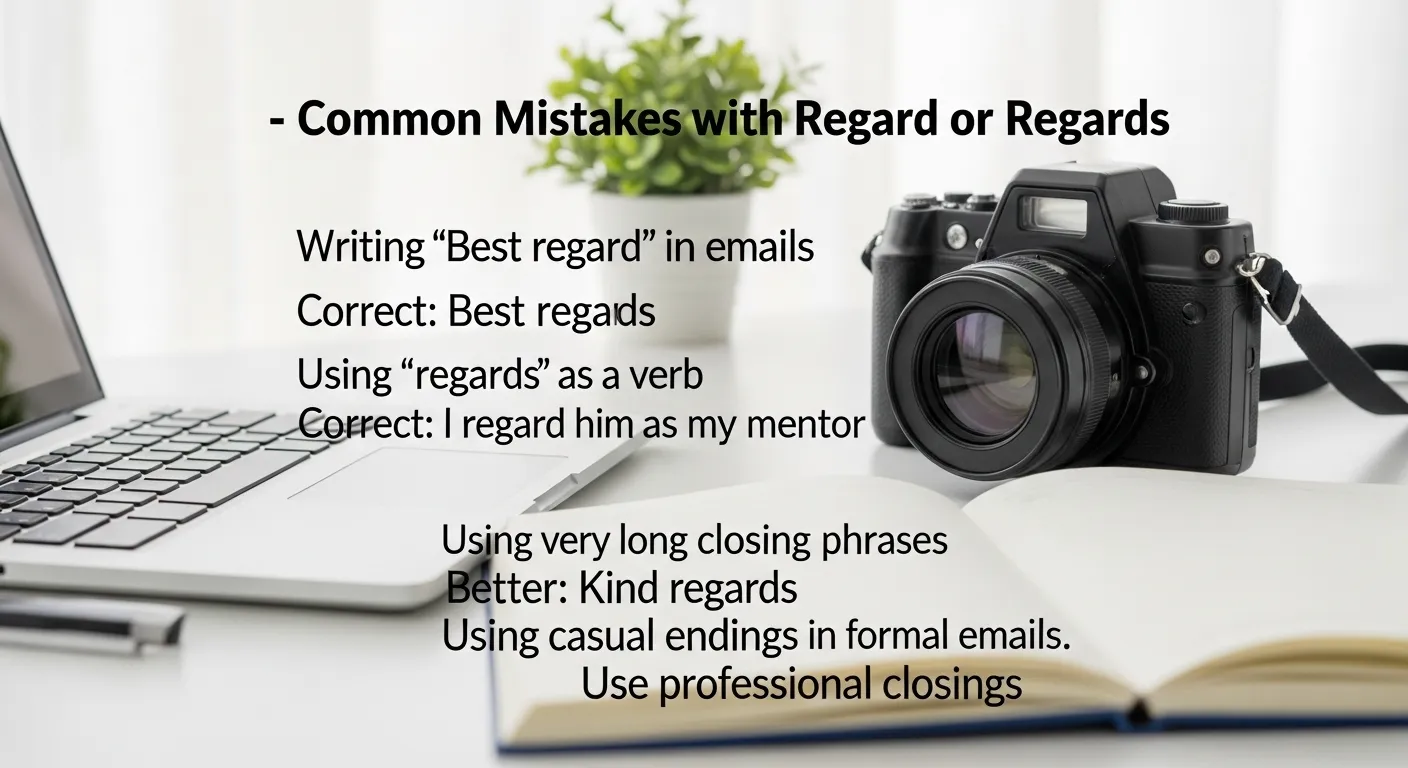
Common Mistakes with Regard or Regards
Many writers mix these words because they sound similar. Here are common errors and simple fixes:
❌ Writing “Best regard” at the end of an email
✔ Correct: “Best regards”
Reason: The closing phrase traditionally uses the plural form.
❌ Using “regards” inside a sentence incorrectly
Example: “I regards him as my mentor.”
✔ Correct: “I regard him as my mentor.”
Reason: The verb form must match grammar rules.
❌ Adding too many words
Example: “With my very highest warm regards sincerely”
✔ Better: “Kind regards”
Keep closing phrases short and clear.
❌ Using a closing that does not match tone
Formal email → Avoid casual closings like “See ya.”
Professional communication needs polite wording.
Regard or Regards in Everyday Examples
Understanding real-life usage helps you remember easily.
Emails
Formal email:
- Dear Mr. Khan,
- Thank you for your support.
- Kind regards,
- Ahmed
Business email:
- Please review the attached file.
- Best regards,
- Sara
Friendly professional email:
- Let me know your thoughts.
- Regards,
- Ali
News Writing
- The minister expressed regard for international cooperation.
- The organization showed high regard for safety standards.
Social Media
- Sending my regards to everyone attending the event.
- Many fans regard this movie as a classic.
Formal Writing
- The court holds the law in high regard.
- Researchers regard this method as effective.
Regard or Regards: Google Trends & Usage Data
Usage patterns show how people prefer these words in different contexts.
👉 Email closings
Search interest often rises around phrases like “Best regards” or “Kind regards.” Many people want professional email guidance.
👉 Professional communication
Business users frequently search for polite closing lines. This shows a strong focus on workplace etiquette.
👉 Country patterns
- United States: “Best regards” is highly popular.
- United Kingdom: “Kind regards” appears often.
- Global workplaces: Both phrases are widely accepted.
👉 Context differences
- “Regard” appears more in grammar questions or writing guides.
- “Regards” appears more in email templates and business writing searches.
These patterns show that people want clarity on tone and correctness.
Comparison Table: Regard vs Regards
| Word | Part of Speech | Meaning | Common Use | Example |
| Regard | Noun | Respect or attention | Inside sentences | She has high regard for him. |
| Regard | Verb | To consider or view | Writing or speaking | I regard this as important. |
| Regards | Noun (plural) | Greetings or wishes | Email closings | Best regards, John |
| Regards | Expression | Polite ending | Professional messages | Kind regards |
FAQs About Regard or Regards
1. Is “regards” formal or casual?
It is polite and professional. It works well in business emails.
2. Can I use “regard” at the end of an email?
No. Email closings usually use the plural form “regards.”
3. Which is more professional: “Best regards” or “Kind regards”?
Both are professional. “Best regards” sounds neutral. “Kind regards” feels slightly warmer.
4. Is it okay to write only “Regards”?
Yes. It is simple and professional. Many people use it in quick emails.
5. Does “regard” always mean respect?
Not always. It can also mean consideration or viewing something in a certain way.
6. Should I capitalize “Regards” in email closings?
Yes. When used as a closing line, capitalize it.
7. Can I use “Warm regards” in business emails?
Yes. It sounds friendly but still professional. Use it when you know the reader well.
Conclusion
Understanding the difference between “regard” and “regards” is simple once you focus on function. The singular form usually appears inside sentences. It describes respect, attention, or how someone views something.
The plural form often appears as a polite closing in emails or messages. Both words share the same spelling across regions, which makes learning easier.
The main difference lies in context and tone. For professional communication, “Best regards” or “Kind regards” works well and feels polite.
For everyday writing, use “regard” when describing opinions or respect. Avoid common mistakes like using the wrong form in email endings.
Keep your language clear and consistent. Short and polite phrases help readers understand your message quickly.
With practice, choosing the correct word becomes natural. Clear communication builds trust and shows professionalism.
By following the simple rules in this guide, you can write confidently and leave a positive impression in both formal and casual situations.
Related More Posts!
Laptop or Labtop: Which Spelling Is Correct and Why It Matters?
Hybrid or Gas: Which Car Should You Choose?
Concave or Convex: Meaning, Differences and Easy Examples

I am Sophia Martinez.I am an ESL grammar coach. I specialize in teaching English to non native speakers. My content focuses on commonly confused words like affect vs effect, their vs there, and verb tense comparisons. Sophia writes in a friendly, supportive tone designed to build confidence in learners.