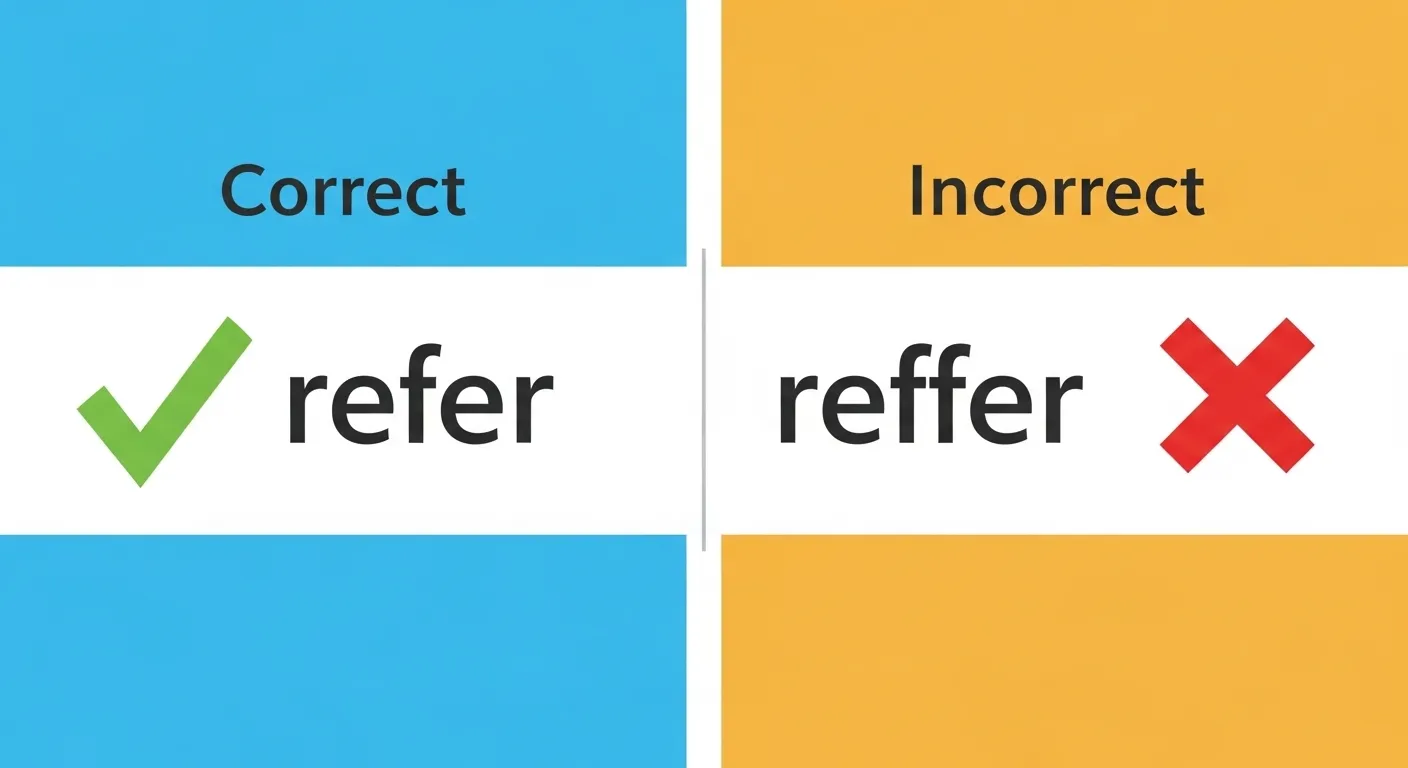
The correct spelling is “refer”, not “reffer.” Many people get confused because the pronunciation makes it tempting to double the “f.” Understanding the right spelling is essential for writing emails, documents, and social media posts correctly.
People often search for “refer or reffer” to clarify this simple yet common English dilemma. Misusing the word can make your writing look unprofessional, especially in academic or business contexts.
In this guide, we will explain the difference, explore its origin, compare British and American usage, and provide everyday examples to ensure you always write it correctly.
Refer or Reffer: Quick Answer
The quick answer is simple: “refer” is correct.
Examples:
- I will refer you to a specialist for further treatment.
- Please refer to the attached document for more details.
- He often refers to historical events in his lectures.
Incorrect:
- I will reffer you to a specialist. ❌
- Please reffer to the document. ❌
The word refer is always spelled with a single “f” and is widely accepted in both British and American English.
The Origin of Refer or Reffer
The word refer comes from the Latin referre, which means “to carry back” or “to report.” In English, it has been used since the late Middle Ages with the same meaning of directing attention or sending someone to another source.
The confusion with “reffer” arises because some English verbs double the consonant when forming different tenses or derivatives, like occur → occurred or prefer → preferred. However, refer follows a slightly different pattern: it doubles the “r” in some tenses (like “referred” or “referring”) but never doubles the “f.”
So, “reffer” is a misspelling and has no historical or grammatical backing.
British English vs American English Spelling
Both British and American English agree on refer as the correct spelling. The differences appear only when forming derived forms like past tense or gerund:
| Form | British English | American English |
| Base | refer | refer |
| Past | referred | referred |
| Present participle | referring | referring |
| Third person singular | refers | refers |
Notice: Never write “reffer” in any version of English.
Tips:
- In British English, consonants are sometimes doubled differently than in American English (e.g., “travelling” vs “traveling”), but refer remains consistent.
- The same rules apply in emails, official documents, and casual writing.
Which Spelling Should You Use?
- United States: Use refer. Correct in all contexts.
- United Kingdom & Commonwealth: Also use refer.
- Global/International English: Stick with refer.
Professional advice: Always spell it refer to avoid errors. “Reffer” is rarely recognized and may be flagged by grammar tools.
Common Mistakes with Refer
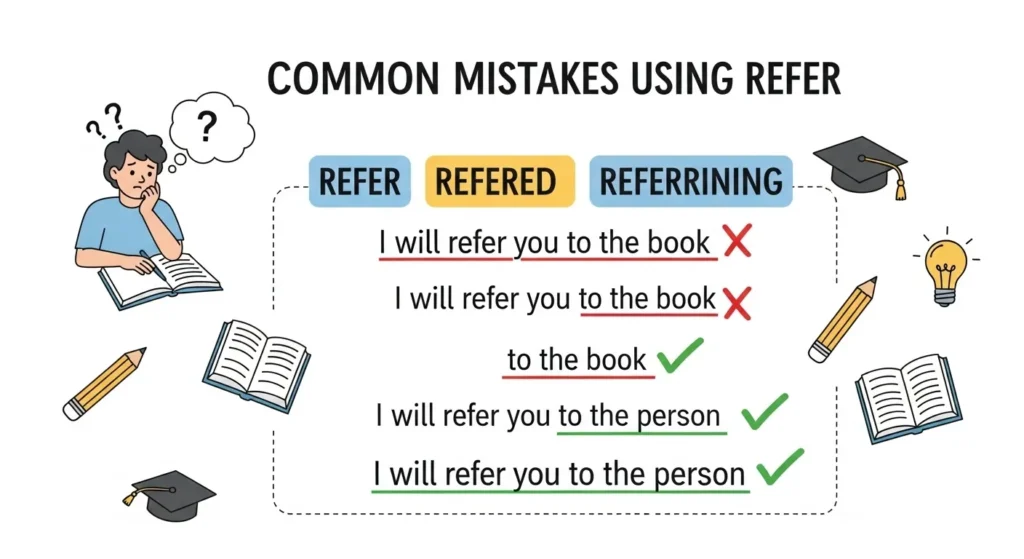
Many writers make mistakes due to pronunciation or assumptions about English doubling rules. Here are the most frequent errors:
Mistakes:
- Reffer → ❌ Incorrect
- Refering → ❌ Should be referring
- Referreded → ❌ Correct form: referred
Corrections:
- Correct: “She will refer the case to her manager.”
- Correct: “He is referring to the report.”
- Correct: “The patient was referred to a specialist.”
Pro Tip: Remember: single “f” in the base form, double “r” in past and gerund forms.
Refer in Everyday Examples
Here’s how you can use refer in different contexts:
1. Emails:
- “Please refer to the attached schedule for details.”
- “Kindly refer your query to the support team.”
2. News Articles:
- “The report refers to the latest climate data.”
- “Experts referred to international guidelines in their recommendations.”
3. Social Media:
- “Always refer to official sources for accurate information.”
- “I referred him to this amazing tutorial!”
4. Academic Writing:
- “As mentioned, Smith (2020) refers to multiple studies on this topic.”
5. Business Writing:
- “The manager referred the client to our services department.”
Key point: “Refer” is versatile and fits formal and informal writing styles.
Refer: Google Trends & Usage Data
Google Trends and other language tools show that people often search for “refer or reffer” because of uncertainty about the spelling. Usage is highest in English-speaking countries:
- United States: High searches for proper usage in work emails and school assignments.
- United Kingdom: Frequent searches among students and writers.
- India & Pakistan: Common searches due to English learning and professional communication.
Trend Analysis:
- Searches for reffer are very low, indicating it is rarely correct or used.
- Correct spelling “refer” dominates almost all content online.
Keyword Variations Comparison Table
| Word Form | Correct Spelling | Incorrect Spelling | Notes |
| Base form | refer | reffer | Always use single “f” |
| Past tense | referred | reffered | Double “r” in past tense |
| Present participle | referring | refering | Double “r” in -ing form |
| Third person | refers | reffers | Single “f,” correct ending is “s” |
FAQs About Refer or Reffer
1. Is “reffer” ever correct?
No. “Reffer” is always incorrect. Use “refer” in all situations.
2. Do I double the “f” in “refer”?
No. Only the “r” doubles in past and -ing forms (referred, referring).
3. Is “refer” British or American English?
It is correct in both British and American English.
4. How do I use “refer” in a sentence?
Example: “Please refer to the instructions before starting.”
5. What is the difference between “refer” and “reference”?
“Refer” is a verb; “reference” is a noun or verb. Example: “Refer to the report” vs “Add it as a reference.”
6. Can “refer” be used in informal writing?
Yes, it is versatile and fits emails, blogs, and social media.
7. How do I remember the correct spelling?
Think: single “f” in base, double “r” in past/gerund. Avoid “reffer” completely.
Conclusion
The correct spelling is refer, and “reffer” is always wrong. This small but common English mistake can affect writing professionalism, clarity, and even searchability. By understanding its origin from Latin, knowing the spelling rules in British and American English, and reviewing common mistakes, writers can confidently use “refer” in emails, academic papers, news articles, and social media posts.
Remember the simple tip: single “f” in the base form, double “r” in past tense or gerund forms. By following this rule, you ensure accuracy and avoid unnecessary errors. Always check your documents if unsure, and rely on “refer” as the universal correct form.
Related More Posts!
Fridays or Friday’s: Which One Is Correct? With In 30 Seconds

My name is James Whitmore.I am a language research writer. I explore the history and evolution of English words. I write detailed comparisons explaining why spellings change over time and how British and American English diverged. My articles add depth and credibility to grammar comparison topics.