Prove is a verb (action), and proof is a noun (thing or result). Many English learners and even native speakers confuse these two words because they look similar and relate to evidence or truth.
People often search this topic when writing emails, academic work, or professional content and want to avoid mistakes.
The confusion grows because both words appear in legal, academic, and everyday language. Some writers also mix grammar roles, which leads to awkward sentences.
This guide removes confusion by explaining meaning, usage, history, examples, and common mistakes.
You will learn clear rules, simple tips, and real life examples so you can confidently choose the correct word every time you write.
Prove or Proof: Quick Answer
Here is the simple rule:
- Prove = verb (an action word). It means to show something is true.
- Proof = noun (a thing or idea). It means evidence or confirmation.
Examples:
- I will prove my point with facts.
- She wants to prove her skills.
- This photo is proof of the event.
- We need more proof before deciding.
Think of it like this:
👉 Prove = action
👉 Proof = result or evidence
More examples:
- Scientists try to prove theories through experiments.
- Data can act as proof of research results.
- Lawyers prove cases using proof like documents and witnesses.
Quick test:
If you can replace the word with “show,” use prove.
If you can replace it with “evidence,” use proof.
The Origin of Prove or Proof
Understanding history helps you remember meaning.
The word prove comes from Old French prover and Latin probare. It meant “to test,” “to examine,” or “to show something is good or true.” Over time, English adopted it as a verb used in law, science, and daily speech.
The word proof developed from similar roots but evolved as a noun. Early English used it to describe testing strength or verifying truth. Later, it became linked with evidence, printing processes, and legal confirmation.
Why do spelling differences exist? English often creates noun and verb pairs from the same root. The language changes endings to show grammar function. This is why:
- prove → action
- proof → object or result
You can see similar patterns:
- speak → speech
- choose → choice
- think → thought
These changes help readers quickly know if a word describes an action or a thing.
Historically, legal systems strengthened the use of these terms. Courts required people to prove claims using proof. That relationship still shapes modern usage.
British English vs American English Spelling
Unlike many English word pairs, prove and proof do not change spelling between British and American English. The meaning stays the same across regions.
However, usage style can vary slightly. British writing sometimes uses more formal phrasing, while American writing may prefer direct sentences.
Examples:
- British style: “The report aims to prove the hypothesis.”
- American style: “The report will prove the claim.”
Comparison Table
| Aspect | British English | American English |
| Spelling of prove | prove | prove |
| Spelling of proof | proof | proof |
| Formal tone | Often more formal | Often more direct |
| Academic use | Common in research writing | Common in research writing |
| Everyday speech | Same meaning | Same meaning |
Conclusion: There is no spelling difference between regions. Focus on grammar role instead.
Which Spelling Should You Use?
Choosing the correct word depends on sentence structure and audience.
For US readers
Use prove when describing action:
- “We must prove the results.”
Use proof for evidence:
- “We need proof before approval.”
American audiences prefer clarity and short sentences. Use simple verb forms.
For UK and Commonwealth readers
The same rules apply. Writers often use more formal phrasing, especially in academic or legal writing.
Example:
- “The study seeks to prove the theory.”
- “The documents provide proof.”
For global audiences
Use clear, simple grammar. Avoid long complex sentences.
Ask yourself:
- Is this an action? → prove
- Is this evidence? → proof
When writing for international readers, clarity matters more than style differences.
Common Mistakes with Prove or Proof
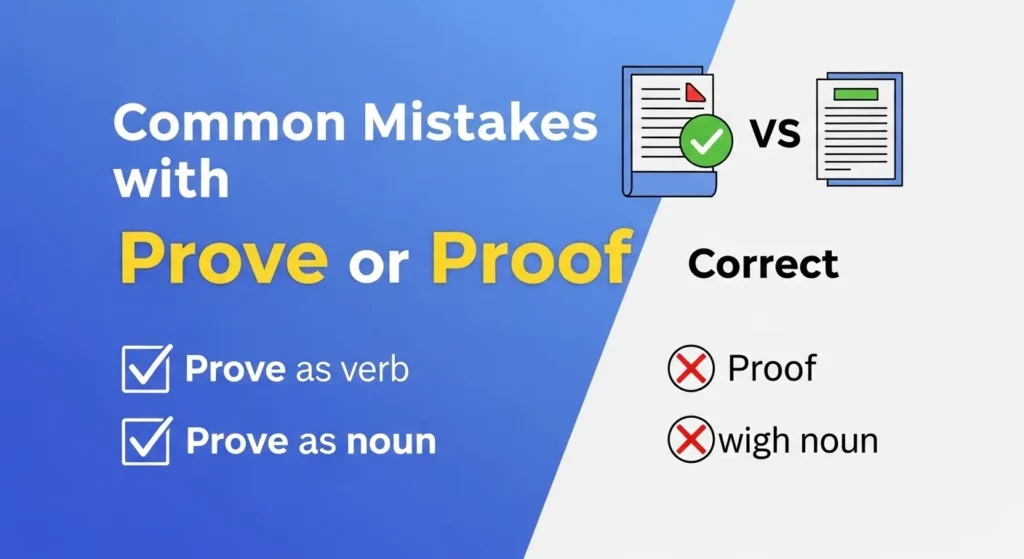
Many writers confuse these words because they share meaning themes. Here are frequent errors:
Mistake 1: Using proof as a verb
❌ I will proof my idea tomorrow.
✅ I will prove my idea tomorrow.
Proof is not used as a verb in this context.
Mistake 2: Using prove as a noun
❌ This photo is strong prove.
✅ This photo is strong proof.
Mistake 3: Confusing proofread with prove
Proofreading means checking text for errors. It comes from printing history.
Example:
- I will proofread the document.
- I will prove my argument.
Mistake 4: Overusing “prove” in opinions
Some claims cannot be proven objectively.
Better:
- “This suggests” instead of “This proves.”
Mistake 5: Grammar tense confusion
- Present: prove
- Past: proved
- Past participle: proven or proved (both acceptable depending on style)
Examples:
- She proved her skills.
- The theory has been proven.
Prove or Proof in Everyday Examples
Seeing real life situations helps understanding.
Emails
- Please provide proof of payment.
- We must prove compliance before approval.
News writing
- The investigation aims to prove responsibility.
- Video footage serves as proof.
Social media
- “I will prove everyone wrong.”
- “This screenshot is proof!”
Academic writing
- Researchers try to prove hypotheses using data.
- Charts act as proof of trends.
Business communication
- Sales numbers prove market demand.
- Contracts provide proof of agreement.
Legal writing
- Lawyers must prove claims beyond doubt.
- Witness testimony can be proof.
Casual conversation
- I can prove it.
- Show me proof.
Prove or Proof: Google Trends & Usage Data
Usage patterns show how people search and use these words worldwide.
Popular contexts
- Education and grammar learning
- Legal discussions
- Academic writing
- Online debates
Popular regions
- United States
- United Kingdom
- India
- Pakistan
- Australia
Search behavior often includes questions like:
- “prove vs proof meaning”
- “when to use proof or prove”
- “prove definition examples”
Online discussions and social media increase usage because people want to support arguments with evidence.
Context trends
- “prove” appears more in action focused sentences.
- “proof” appears more in research, legal, and verification contexts.
Comparison Table: Prove vs Proof
| Feature | Prove | Proof |
| Part of speech | Verb | Noun |
| Meaning | Show something is true | Evidence or confirmation |
| Example | I will prove it | This is proof |
| Grammar role | Action | Object or result |
| Common context | Arguments, research, claims | Evidence, documents |
| Tense forms | prove, proved, proven | Not applicable |
FAQs About Prove or Proof
1. Is prove a noun?
No. Prove is mainly a verb. Use proof as the noun form.
2. Can proof ever be a verb?
In special contexts like printing or baking, “proof” may act as a verb, but in general writing it is a noun.
3. What is the past tense of prove?
The past tense is “proved.” The past participle can be “proven” or “proved.”
4. Is proven correct in formal writing?
Yes. Both proven and proved are accepted, but some traditional styles prefer proved.
5. How can I remember the difference?
Think:
- prove = move (action)
- proof = roof (thing)
6. Which word is used in legal writing?
Both. Lawyers prove claims using proof.
7. Are prove and proof interchangeable?
No. They have different grammar roles and cannot replace each other directly.
Conclusion
Understanding the difference between prove and proof makes writing clearer and more professional. The key idea is simple: prove is an action, while proof is the evidence or result.
Many writers struggle because both words relate to truth and validation, but their grammar roles are different.
Learning the history and structure helps you remember usage easily. There is no spelling difference between British and American English, so focus on function rather than regional style.
In everyday writing, choose prove when describing showing or demonstrating something. Choose proof when referring to evidence, confirmation, or support.
Avoid common mistakes such as using proof as a verb or using prove as a noun. Practice with real examples from emails, and social media to build confidence. When in doubt, ask If the word describes an action or an object.
Following this simple rule will help you write more clearly, avoid confusion, and communicate ideas with accuracy in any professional or casual context.
Related More Posts!
Lie or Lye: Meaning, Differences and Complete Grammar Guide✨
Feel or Feal: Which Spelling Is Correct?
Reinforce or Re-Enforce: Which One Is Correct?

thinkaora.com is my English grammar comparison website where I simplify confusing words, spelling differences, and usage rules through clear explanations and examples. My goal is to help learners, writers, and students understand English easily and use correct grammar with confidence.