Nickel is the correct spelling, not nickle. Many people get confused between these two because they sound the same.
This confusion often happens when writing about the metal used in coins, batteries, or alloys.
People search for “nickel or nickle” to make sure they are using the proper spelling in formal writing, scientific contexts, or everyday communication.
Knowing the correct form helps avoid mistakes in academic papers, business writing, and social media posts.
In this article, we will explore the origins, correct usage, and common mistakes related to nickel vs nickle.
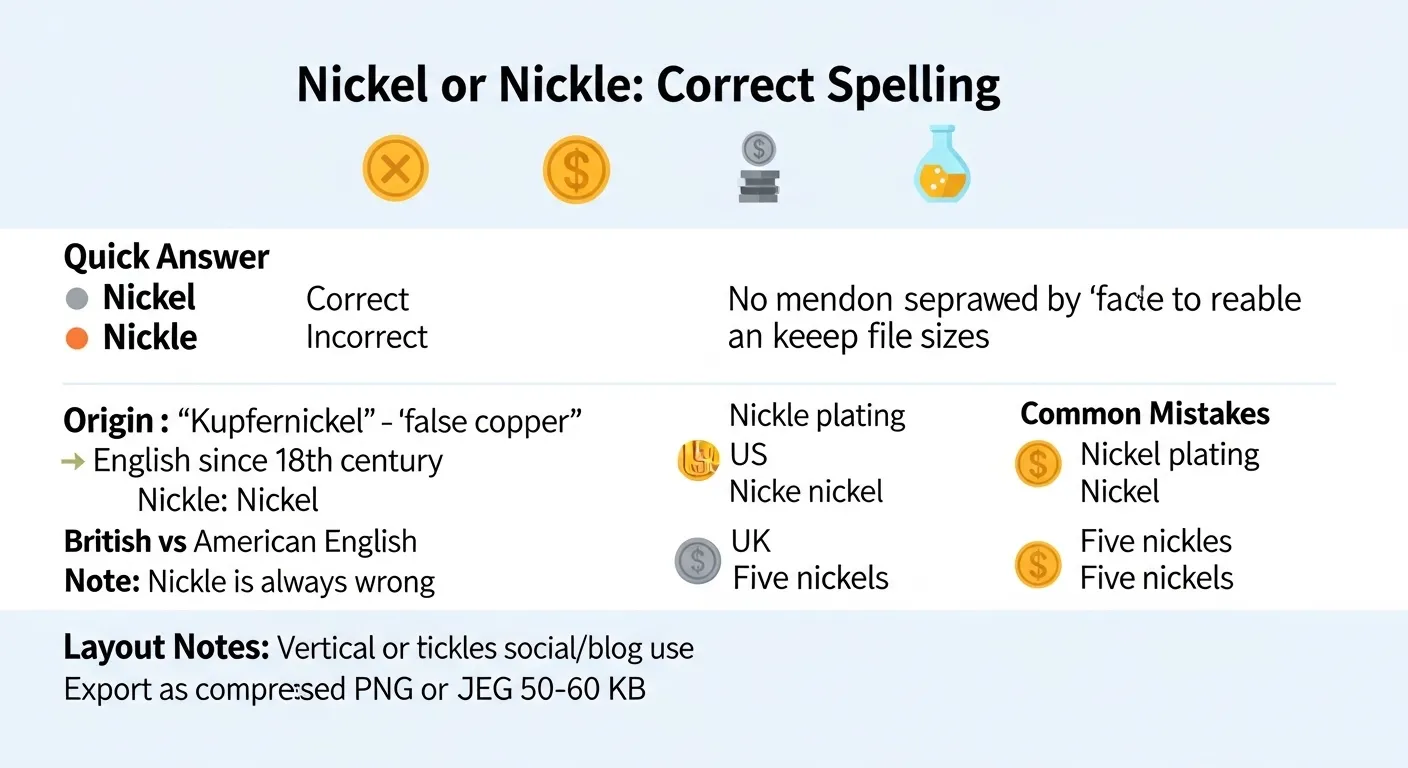
Nickel or Nickle; Quick Answer
The correct spelling is “nickel”. Using “nickle” is considered incorrect in all standard English references.
Examples:
- Correct: The coin is made of nickel.
- Incorrect: The coin is made of nickle.
- Correct: She wore a nickel bracelet.
- Incorrect: She wore a nickle bracelet.
Whenever you are unsure, remember that “nickel” is the official spelling used in dictionaries, scientific texts, and the United States Mint.
The Origin of Nickel
The word nickel comes from the German word “Kupfernickel”, which means “false copper.” Miners called it this because the ore looked like copper but didn’t contain any.
The spelling “nickel” has been in English since the late 18th century, when the metal became widely known.
Why the confusion exists:
- The pronunciation of nickel sounds like it could be spelled “nickle.”
- English often has inconsistent spelling rules, which leads many to assume the “e” should appear before the “l.”
- Early handwritten texts sometimes used “nickle,” making the error spread before dictionaries standardized it.
British English vs American English Spelling
Both British and American English agree that the correct spelling is nickel. Unlike words like “colour” vs “color,” nickle is never the standard form in either variant.
Comparison Table:
| Variant | Correct Spelling | Notes |
| American English | nickel | Used in coins, metals, chemistry, and everyday language. |
| British English | nickel | Same usage; “nickle” is incorrect in all cases. |
| Common Mistake | nickle | Incorrect everywhere, but sometimes appears in informal writing. |
Tip: Always use nickel in professional, educational, and scientific contexts.
Which Spelling Should You Use?
No matter where you are in the world, nickel is the only correct spelling. Here is some audience based advice:
- United States: Always use nickel for coins, alloys, or chemistry.
- United Kingdom and Commonwealth Countries: Stick with nickel in writing and publications.
- Global Communication: Use nickel to avoid confusion in emails, reports, and international content.
Even if you see “nickle” on the internet or social media, it is a misspelling. Following the standard spelling will make your writing appear professional and credible.
Common Mistakes with Nickel
Many people make the following errors:
- Nickle instead of nickel the most common.
- Incorrect: The metal contains nickle.
- Correct: The metal contains nickel.
- Incorrect: The metal contains nickle.
- Using “nickle” in scientific texts or reports.
- Correct usage in chemistry: “Nickel sulfate is soluble in water.”
- Correct usage in chemistry: “Nickel sulfate is soluble in water.”
- Confusing nickel with “nickel plated” objects: the word “nickel” should always remain the same, not “nickle plated.”
- Writing “nickle” in educational papers, causing marking deductions.
- Incorrect plural: avoid writing “nickles” when referring to coins.
- Correct: “I have five nickels.”
- Correct: “I have five nickels.”
Nickel in Everyday Examples
Here are examples of nickel in various contexts:
Emails:
- “Please note that the machine requires a nickel coating for durability.”
News:
- “The central bank announced that nickel prices have risen this month.”
Social Media:
- “Just bought a new phone with a nickel finish. Looks sleek!”
Formal Writing:
- “Nickel is a transition metal used in various industrial applications.”
These examples show that nickel is used consistently across contexts, while “nickle” would be considered an error.
Nickel: Google Trends & Usage Data
Search data indicates that “nickel” is far more popular than “nickle.”
- United States: Searches for “nickel” are common for coin collectors, metalworkers, and students.
- United Kingdom: “Nickel” is used in educational and industrial searches.
- Global: “Nickel” is the standard in chemistry, engineering, and metals.
Observation: “Nickle” only appears occasionally on blogs and social media, mostly as a spelling mistake.
Search Trend Comparison Table:
| Term | Popularity | Notes |
| Nickel | Very high | Correct, widely used. |
| Nickle | Low | Common misspelling, mostly informal. |
Keyword Variations Side by Side
| Correct | Incorrect | Notes |
| Nickel | Nickle | Always use “nickel.” |
| Nickel coin | Nickle coin | Coins are never spelled with “nickle.” |
| Nickel plating | Nickle plating | Metal coatings should be spelled correctly. |
| Nickel alloy | Nickle alloy | Scientific texts follow “nickel.” |
FAQs About Nickel or Nickle
1. Is “nickle” ever correct?
No, “nickle” is always a misspelling. Use nickel.
2. Can I use “nickle” in informal writing?
It’s still incorrect. Even informal writing should use nickel.
3. Why do people spell it as “nickle”?
Because the pronunciation suggests an “e” before the “l.”
4. What is the plural of nickel?
The plural is nickels, as in “I found three nickels on the ground.”
5. Is “nickel” used in chemistry?
Yes, nickel is a chemical element (Ni, atomic number 28).
6. How do I remember the correct spelling?
Think of nickel coin coins are always spelled with nickel.
7. Does British English allow “nickle”?
No, British English also uses nickel exclusively.
Conclusion
In summary, the correct spelling is always nickel, never nickle. This word has a clear origin in German mining terms and has been standardized in English since the 18th century.
Both American and British English agree on this spelling, making it easy to follow for international communication.
Using nickel correctly is essential in coins, metal alloys, chemistry, industrial applications, and everyday writing. Common mistakes, like using “nickle,” can make writing look unprofessional, so always double check.
In practice, If you are writing emails, academic papers, or social media posts, nickel is the spelling that will never be challenged.
By following this guide, you can confidently write about coins, metals, and chemical compounds without error.
Related More Posts!
Tires or Tyres: Examples and Correct Usage 📝

My name is James Whitmore.I am a language research writer. I explore the history and evolution of English words. I write detailed comparisons explaining why spellings change over time and how British and American English diverged. My articles add depth and credibility to grammar comparison topics.