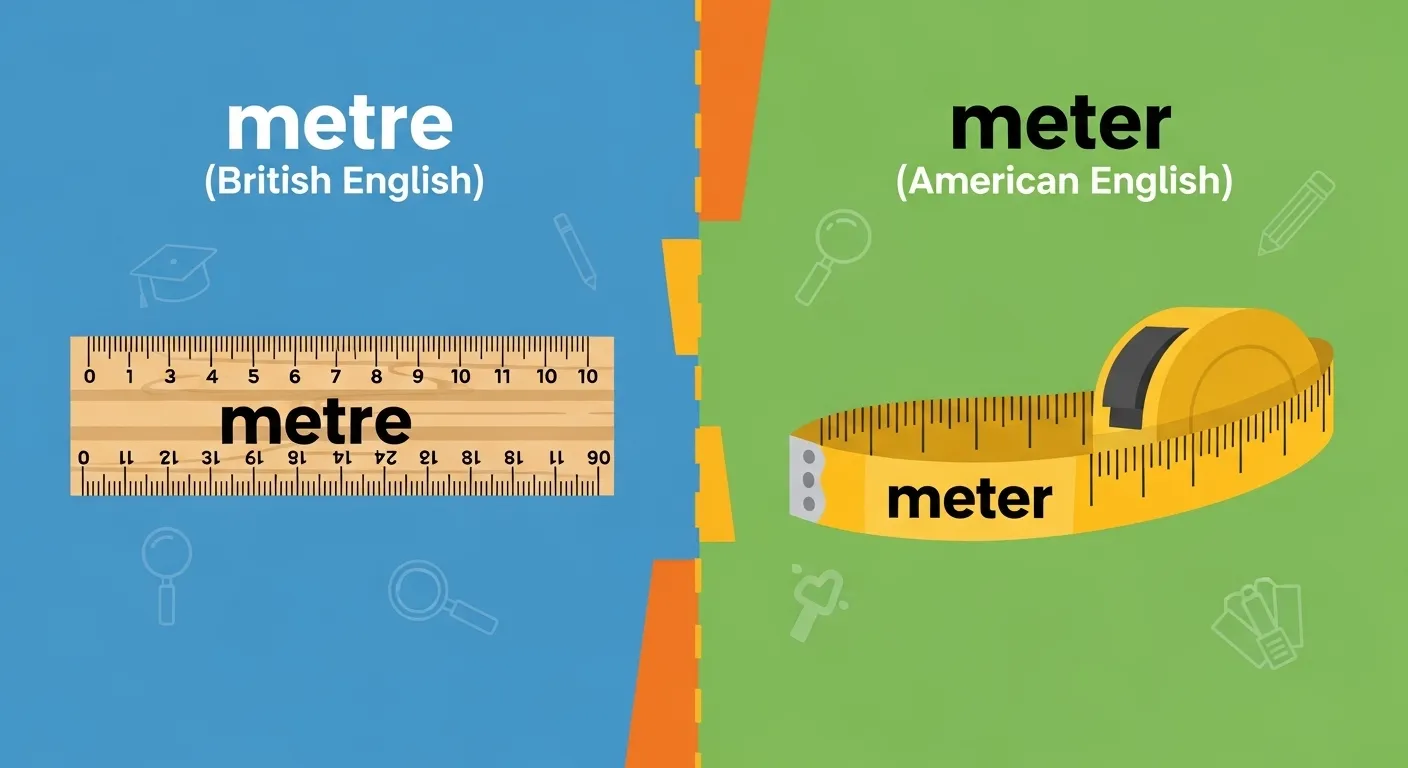
The correct spelling depends on where you are: “metre” is British English, while “meter” is American English.
Many people get confused when writing scientific papers, measurements, or everyday communication because both spellings are used globally.
This confusion leads to mistakes in emails, school assignments, news articles, and even social media posts.
People search for “metre or meter” to understand which spelling fits their audience and context.
Knowing the difference not only improves clarity but also shows attention to detail in writing. In this article, we will explain the differences and common mistakes in simple terms.
Metre or Meter: Quick Answer
Quick Answer:
- Metre: Used in British English for measurement of length.
- Meter: Used in American English for the same measurement.
Examples:
- UK: “The room is 5 metres wide.”
- US: “The room is 5 meters wide.”
Tip: If writing for a UK or Commonwealth audience, use metre. For US audiences, use meter.
The Origin of Metre or Meter
The word “metre/meter” comes from the Greek word “metron,” which means “measure.” It was adopted into French as “mètre” and then spread to English in the 18th century.
- Metre: British English kept the French-inspired spelling with -re at the end.
- Meter: American English simplified it to -er, following general spelling rules in the US.
Historically, standardization of the metric system in France influenced the British spelling. Over time, American English adapted many words to simpler forms, including metre → meter.
Fun Fact: The spelling difference does not change pronunciation; both are pronounced /ˈmiːtər/.
British English vs American English Spelling
The main difference lies in the ending: -re vs -er.
| Feature | British English | American English | Example Sentence |
| Spelling | metre | meter | “The track is 400 metres long.” (UK) |
| Measurement | Length | Length | “The car is 3 meters long.” (US) |
| Other uses | Meter can refer to devices | Meter can also refer to devices | “The water meter is broken.” (US/UK) |
Key Points:
- British English prefers -re for most measurement words (metre, litre, centre).
- American English uses -er for the same words (meter, liter, center).
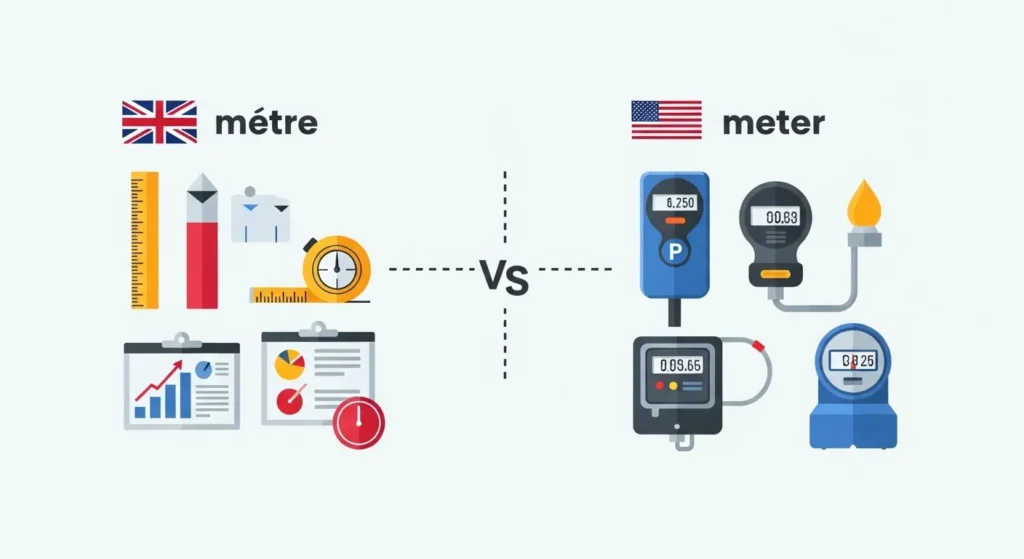
- Devices such as gas meters or parking meters use meter in both UK and US.
Which Spelling Should You Use?
Choosing the right spelling depends on your audience and location:
- United States: Always use meter. Example: “The room measures 5 meters.”
- United Kingdom & Commonwealth: Use metre for measurement. Example: “The bridge is 300 metres long.”
- Global/International: If unsure, follow the audience’s common usage or use metric system conventions in scientific writing.
Tip: When writing formal reports, journals, or textbooks, check the style guide. Many scientific journals accept either spelling as long as it is consistent.
Common Mistakes with Metre or Meter
Here are some frequent errors people make:
- Mixing UK and US spelling in the same text:
- ❌ Wrong: “The track is 400 meters long and 5 metres wide.”
- ✅ Correct: “The track is 400 metres long and 5 metres wide.” (UK consistency)
- ❌ Wrong: “The track is 400 meters long and 5 metres wide.”
- Using “meter” for measurement in UK writing:
- ❌ Wrong: “The room is 3 meters wide.” (UK article)
- ✅ Correct: “The room is 3 metres wide.”
- ❌ Wrong: “The room is 3 meters wide.” (UK article)
- Confusing with devices:
- Always use meter for instruments (parking meter, gas meter) even in UK writing.
- Always use meter for instruments (parking meter, gas meter) even in UK writing.
- Incorrect pluralization:
- Singular: metre/meter
- Plural: metres/meters
- ❌ Wrong: 5 metre
- ✅ Correct: 5 metres
- Singular: metre/meter
Metre or Meter in Everyday Examples
Emails:
- UK: “Please confirm the room is 10 metres long.”
- US: “Please confirm the room is 10 meters long.”
News articles:
- UK newspapers: “The new bridge spans 2,000 metres.”
- US newspapers: “The new bridge spans 2,000 meters.”
Social media:
- UK user: “I ran 5 kilometres today : that’s about 5,000 metres!”
- US user: “I ran 3 miles, about 4,800 meters.”
Formal writing:
- Scientific papers often note: “The sample was 50 metres from the control site (UK spelling).”
Tip: Always check the publication’s style guide before submission.
Metre or Meter: Google Trends & Usage Data
Using Google Trends, we can see:
- UK, Canada, Australia: “metre” is more popular in searches.
- USA: “meter” dominates searches.
- Global audience: Searches vary, but most non-US countries follow UK spelling.
Observations:
- Searches for “metre” spike in science, education, and sports contexts in UK and Commonwealth countries.
- Searches for “meter” spike for US traffic, energy, and device-related topics.
- People often search “metre or meter” to resolve spelling questions, showing global confusion.
Metre vs Meter: Comparison Table
| Feature | Metre | Meter | Notes |
| Spelling | British | American | Depends on audience |
| Measurement | Length | Length | Same meaning |
| Device | Rarely used | Common | Water meter, parking meter |
| Plural | metres | meters | Add ‘s’ for plural |
| Usage example | “The pool is 50 metres long.” | “The pool is 50 meters long.” | Correct context |
FAQs About Metre or Meter
1. Is metre or meter correct in the US?
- Answer: Meter is correct in US English.
2. Can I use metre in American writing?
- Answer: It’s uncommon. Use meter for US audience.
3. Do both mean the same thing?
- Answer: Yes, both measure length. The difference is spelling.
4. What about devices like gas meters?
- Answer: Always use meter, even in UK writing.
5. How do I remember the difference?
- Answer: UK → metre → measurement; US → meter → measurement and devices.
6. What is the plural form?
- Metre → metres; Meter → meters.
7. Is the pronunciation different?
- No, both are pronounced /ˈmiːtər/.
Conclusion
Understanding metre or meter is simple once you know the rules. The choice depends entirely on your audience and context. Metre is the British English spelling used in the UK, Australia, Canada, and other Commonwealth countries. Meter is American English and is used in the US. Both spellings refer to the same unit of measurement, and pronunciation is identical.
Consistency is key. Mixing “metre” and “meter” in the same document can confuse readers and appear unprofessional. Always remember that meter is also used for measuring devices, such as parking meters, gas meters, and electricity meters, regardless of the country.
When writing for international or scientific contexts, choose one spelling and stick to it. For global clarity, consider audience preference or style guides. Using the correct form demonstrates attention to detail, credibility, and professionalism. By following these simple rules, you can confidently write “metre or meter” correctly every time.
Relatad More Posts!
Fridays or Friday’s: Which One Is Correct? With In 30 Seconds

I am Sophia Martinez.I am an ESL grammar coach. I specialize in teaching English to non native speakers. My content focuses on commonly confused words like affect vs effect, their vs there, and verb tense comparisons. Sophia writes in a friendly, supportive tone designed to build confidence in learners.