“Lose” is a verb (action word), while “loss” is a noun (thing or result).
Many English learners and writers mix these two words because they look similar but work in different ways. One small spelling change can alter the meaning of your sentence.
People often search for “lose or loss” when writing emails, essays, social posts, or professional messages.
They want to avoid grammar mistakes and sound clear. This guide removes confusion step by step.
You will learn the meaning and real examples. By the end, you will know exactly when to use each word without second-guessing your writing.
Lose or Loss: Quick Answer
The difference is simple:
- Lose = verb (an action). It means to fail to keep, win, or hold something.
- Loss = noun (a thing or result). It refers to the state or outcome of losing.
Examples:
- I do not want to lose my keys.
- The company reported a financial loss.
- If you lose focus, mistakes happen.
- The team suffered a heavy loss.
A quick memory trick:
👉 Lose = do (an action)
👉 Loss = result (a thing)
Another tip:
- “Lose” often appears with subjects and actions.
- “Loss” usually follows articles like “a,” “the,” or adjectives like “big,” “major,” or “total.”
The Origin of Lose or Loss
Understanding word history makes learning easier.
Origin of “Lose”
“Lose” comes from Old English losian, which meant “to perish,” “to be destroyed,” or “to fail.” Over time, the meaning expanded. Today, it covers many situations:
- Misplacing items
- Failing to win
- Losing opportunities or chances
The pronunciation changed slightly through history, but the spelling stayed close to early forms.
Origin of “Loss”
“Loss” comes from Old English los, meaning destruction, ruin, or absence. It developed into a noun that described the result of losing something valuable. Over centuries, writers used it for emotional, financial, and physical situations.
Why the Spelling Difference Exists
English often changes spelling to show word type:
- Verb form → “lose”
- Noun form → “loss”
The double “s” in “loss” signals a solid noun form. Many English word pairs follow similar patterns, where a verb and noun look alike but differ slightly in spelling.
British English vs American English Spelling
Unlike many English words, “lose” and “loss” do not change spelling between regions. Both British and American English use the same forms. However, usage style and context can vary slightly.
For example:
- British writing may use formal structures more often.
- American writing may prefer simpler, direct phrases.
Still, the core spelling rule stays identical worldwide.
Comparison Table
| Word | Part of Speech | Meaning | British Usage | American Usage |
| Lose | Verb | To fail to keep or win | Same spelling | Same spelling |
| Loss | Noun | Result or state of losing | Same spelling | Same spelling |
Example Sentences
- UK example: The club might lose funding after the report.
- US example: The company announced a major financial loss.
Key takeaway:
No regional spelling difference exists here. Only grammar role matters.
Which Spelling Should You Use?
Choosing between “lose” and “loss” depends on your audience and sentence purpose.
For US Readers
Use clear action verbs. If you describe something happening now, choose “lose.”
Example:
- Businesses may lose customers if service is slow.
Use “loss” when talking about results or outcomes.
- The company faced a large loss last year.
For UK or Commonwealth Readers
The rule is the same. Grammar role determines the correct choice.
- They could lose the match.
- The match ended in a painful loss.
For Global or Mixed Audience
Keep sentences short. Use simple structures:
- Action = lose
- Result = loss
This method avoids confusion across different English styles.
Common Mistakes with Lose or Loss
Many writers make similar errors. Here are frequent mistakes and how to fix them.
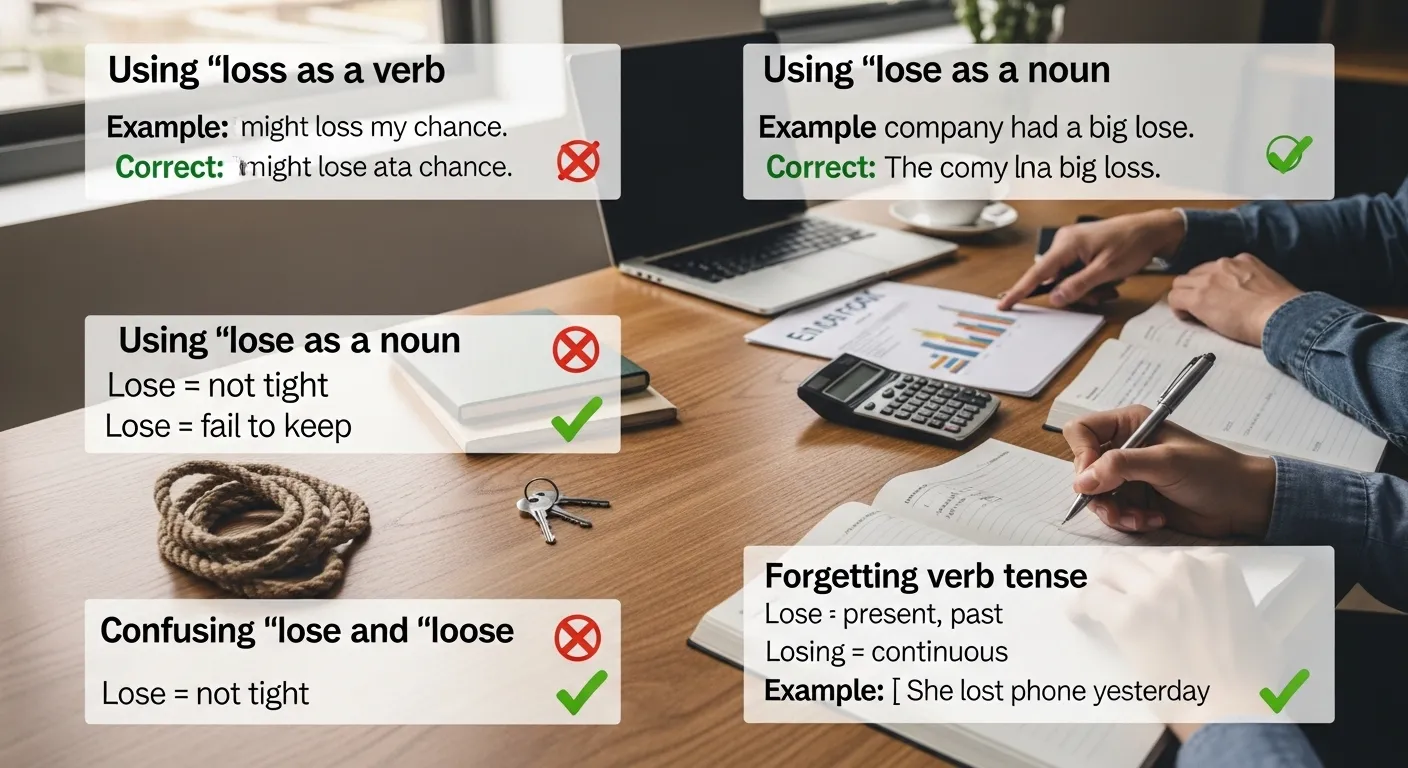
1. Using “loss” as a verb
❌ I will loss my chance.
✅ I will lose my chance.
Remember: “loss” cannot describe an action.
2. Using “lose” as a noun
❌ The company had a big lose.
✅ The company had a big loss.
3. Confusing spelling with pronunciation
Some people write “loose” instead of “lose.” They sound similar but have different meanings.
- Loose = not tight
- Lose = fail to keep
4. Overthinking grammar
If the word follows “a” or “the,” it is usually “loss.”
- A loss
- The loss
5. Forgetting tense
Lose changes with tense:
- lose
- lost
- losing
But “loss” stays the same as a noun.
Lose or Loss in Everyday Examples
Real-life examples help you see how these words work in different contexts.
Emails
- Please back up your files so you do not lose data.
- We regret the loss of your documents during transfer.
News Headlines
- Team may lose star player due to injury.
- Company reports record financial loss.
Social Media
- Do not lose hope during hard times.
- The sudden loss shocked everyone.
Academic or Formal Writing
- Students may lose focus without breaks.
- Memory loss can affect learning ability.
Workplace Communication
- We might lose clients if deadlines are missed.
- The project delay caused a financial loss.
Notice how “lose” shows action, while “loss” shows outcome.
Lose or Loss: Google Trends & Usage Data
Search interest shows that many people confuse these two words. Learners often type both terms together to understand the difference. The keyword appears in educational blogs, grammar guides, and language forums.
Popularity by Region
- United States: High search volume from students and professionals.
- United Kingdom: Similar interest due to academic writing needs.
- India and Pakistan: Strong searches from English learners and content creators.
- Canada and Australia: Steady interest from mixed British-American language influence.
Context of Searches
Users often search when:
- Writing emails or reports
- Studying English grammar
- Preparing for exams
- Creating online content
This shows the importance of clear explanations and quick rules.
Comparison Table: Lose vs Loss
| Feature | Lose | Loss |
| Part of Speech | Verb | Noun |
| Meaning | Action of failing to keep or win | Result of losing |
| Example | Do not lose your phone | The loss hurt deeply |
| Tense Change | Yes (lose, lost, losing) | No |
| Used After “a” or “the”? | Rarely | Often |
| Focus | Action | Result |
FAQs About Lose or Loss
1. Is “lose” or “loss” correct for action?
Use “lose” when describing something happening or an action.
2. Is “loss” always a noun?
Yes. It refers to the result, state, or concept of losing something.
3. Why do people confuse these words?
They look similar and sound close. Many learners rely on sound instead of grammar role.
4. Can “loss” be plural?
Yes. The plural form is “losses.”
Example: The company faced several losses.
5. What is the past tense of “lose”?
The past tense is “lost.”
Example: She lost her keys yesterday.
6. How can I remember the difference quickly?
Think: “Lose” has one “s,” like a simple action. “Loss” has double “s,” showing a solid result.
7. Are these words different in British and American English?
No. Both regions use the same spelling and meaning.
Conclusion
The difference between “lose” and “loss” becomes easy once you focus on grammar role. “Lose” is an action word. It shows something happening now or in the future. “Loss” is a noun. It describes the result or state after something is gone.
This simple rule removes most confusion. Use “lose” when someone performs an action.
Use “loss” when you talk about the outcome. Short sentences help avoid mistakes. Practice with real examples from daily writing.
Check if your sentence needs an action or a thing. Over time, this choice will feel natural. Clear writing improves communication. Small spelling details matter.
When you choose the correct form, your message becomes stronger and easier to understand. Keep the action-versus-result rule in mind, and you will rarely mix these words again.
Related More Posts!
Laptop or Labtop: Which Spelling Is Correct and Why It Matters?
Hybrid or Gas: Which Car Should You Choose?
Concave or Convex: Meaning, Differences and Easy Examples

I am Sophia Martinez.I am an ESL grammar coach. I specialize in teaching English to non native speakers. My content focuses on commonly confused words like affect vs effect, their vs there, and verb tense comparisons. Sophia writes in a friendly, supportive tone designed to build confidence in learners.