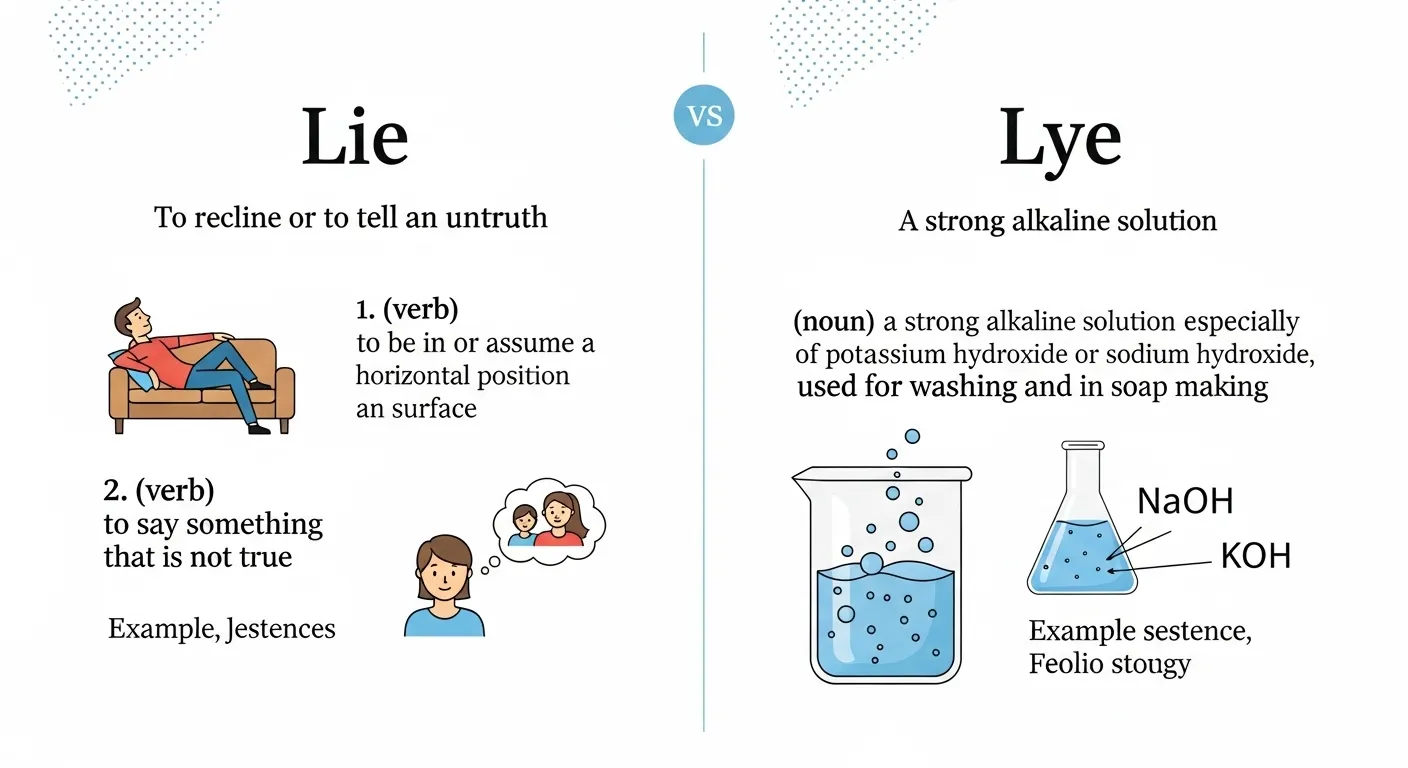
Lie is a verb or noun related to resting or telling something untrue, while lye is a strong chemical used for cleaning and soap making.
Many writers stop when they see lie or lye because both words sound the same but have very different meanings. This confusion happens in daily writing and even professional messages.
Since English has many homophones, readers often mix them up by spelling or context. Understanding the difference helps you avoid mistakes and improves clarity in communication.
This guide explains meanings, spelling patterns and common errors so you can choose the correct word confidently every time.
Lie or Lye: Quick Answer
The difference between lie and lye is simple once you know their meanings.
Lie
- Can be a verb meaning to rest or recline.
- Can also mean saying something untrue.
- Examples:
- “I will lie down after work.”
- “He told a lie.”
- “I will lie down after work.”
Lye
- A noun only.
- Refers to a strong alkaline substance used in cleaning products or soap making.
- Example:
- “The soap contains lye.”
- “The soap contains lye.”
Quick rule:
- Talking about resting or false statements → use lie.
- Talking about chemicals or soap making → use lye.
The Origin of Lie or Lye
Understanding history helps make sense of spelling differences.
Lie comes from Old English words. One root means “to recline or rest,” while another root means “to speak falsely.”
These two meanings developed separately but merged into similar spelling over time. English often keeps older forms, so multiple meanings exist under one spelling.
The “resting” form comes from Old English licgan. Over centuries, pronunciation changed and spelling simplified into lie.
The “false statement” meaning comes from lēogan, which also evolved into lie.
Lye has a different path. It comes from Old English lēag, referring to alkaline ash solutions used in early soap production.
People burned wood, mixed ashes with water, and created lye for cleaning or textile work.
Because these words developed from separate origins but ended up sounding alike, confusion continues today.
British English vs American English Spelling
Unlike many word pairs, lie and lye do not change spelling between British and American English. Both regions use the same forms.
However, usage context may differ slightly. For example, industrial writing or chemistry discussions might mention lye more often in manufacturing regions. Meanwhile, lie appears commonly everywhere because it has broader meaning.
Below is a comparison table:
| Word | Meaning | British English | American English | Example |
| Lie | Rest or false statement | Lie | Lie | “She will lie down.” |
| Lye | Chemical alkaline substance | Lye | Lye | “The soap contains lye.” |
Key takeaway: spelling stays the same globally. The difference is meaning, not region.
Which Spelling Should You Use?
Choosing the right word depends on context and audience.
If you are writing for readers in the United States, the United Kingdom, Canada, Australia, or anywhere else, the same rule applies.
Use lie when talking about:
- Resting or reclining
- Being positioned somewhere
- False statements or dishonesty
Use lye when talking about:
- Soap making
- Chemical cleaning solutions
- Industrial or scientific topics
Global writers benefit from focusing on meaning rather than location. Since the words sound identical, always pause and ask: am I describing an action or a chemical? That quick check prevents mistakes.
For educational content, clear context is important because beginners often assume both words are interchangeable. They are not.
Common Mistakes with Lie or Lye
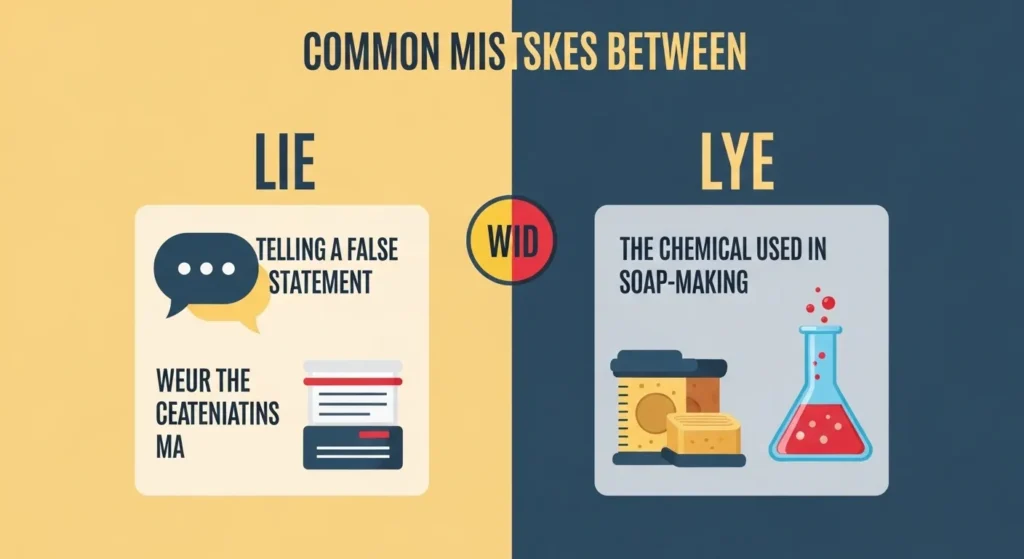
Many errors come from pronunciation similarity. Here are frequent problems:
1. Using lye instead of lie in daily sentences
Incorrect: “I want to lye down.”
Correct: “I want to lie down.”
2. Confusing lie with lay
Some writers mix lie with lay, which is a different grammar topic. Lie does not take a direct object in its resting form.
3. Using lie in chemical context
Incorrect: “Soap contains lie.”
Correct: “Soap contains lye.”
4. Thinking lye is a verb
Lye is only a noun. It never acts as an action word.
5. Mixing meanings in formal writing
Example mistake: describing a cleaning process but spelling the chemical as lie.
Simple tip: If you can replace the word with “rest,” choose lie. If you can replace it with “alkaline chemical,” choose lye.
Lie or Lye in Everyday Examples
Understanding real-life usage makes learning easier.
Emails
- “I need to lie down after the meeting.”
- “This soap uses lye during production.”
News Writing
- “The witness admitted the statement was a lie.”
- “Traditional soap makers still use lye.”
Social Media
- “Just want to lie on the beach all day.”
- “Homemade soap made with lye.”
Academic or Formal Writing
- “Patients should lie flat during recovery.”
- “Lye reacts strongly with fats during saponification.”
Casual Conversation
- “He told a lie.”
- “Be careful with lye; it is strong.”
Real examples show how context clearly separates these words.
Lie or Lye: Google Trends & Usage Data
Usage patterns vary based on meaning.
Lie appears far more frequently because it covers many topics like storytelling, behavior, grammar discussions, and daily actions. Searches often include phrases like “lie down,” “tell a lie,” or grammar questions.
Lye appears mainly in niche areas such as soap making, chemistry education, cleaning products, and historical crafting techniques. Interest increases in regions with strong DIY communities or traditional soap production.
Country trends often show:
- United States: High search volume for both words, especially grammar questions and soap crafting.
- United Kingdom: Similar patterns, with educational searches about homophones.
- Canada and Australia: Balanced interest tied to language learning and DIY topics.
- Global learners: High curiosity due to pronunciation confusion.
The data suggests people usually search when unsure about spelling differences between identical-sounding words.
Comparison Table: Lie vs Lye
| Feature | Lie | Lye |
| Part of speech | Verb and noun | Noun |
| Meaning | Resting or false statement | Strong alkaline chemical |
| Pronunciation | Same as lye | Same as lie |
| Usage frequency | Very common | Less common |
| Context | Everyday language | Chemical or soap making |
| Example sentence | “I will lie down.” | “Lye is used in soap.” |
FAQs About Lie or Lye
1. Are lie and lye pronounced the same?
Yes. They sound identical, which is why many people confuse them.
2. Can lye be used as a verb?
No. Lye is only a noun.
3. Is lie always related to dishonesty?
Not always. Lie can also mean resting or reclining.
4. Why does English have two words that sound the same?
English evolved from many languages, so similar sounds sometimes ended up with different meanings and spellings.
5. Is lye dangerous?
Yes. Lye is a strong alkaline substance and should be handled carefully.
6. How can I quickly remember the difference?
Lie relates to actions or truth, while lye relates to chemicals.
7. Do schools teach this difference?
Yes. It often appears in grammar lessons about homophones.
Conclusion
Lie and lye may sound identical, but their meanings are completely different. Lie has two main uses:
describing the act of resting and referring to something untrue. Lye refers only to a chemical substance used in cleaning or soap production.
The confusion happens because English includes many homophones, and pronunciation alone cannot guide spelling choices. Understanding context is the easiest way to avoid mistakes.
Ask yourself what you are describing. If the sentence involves physical position, truth, or storytelling, choose lie.
If the sentence involves chemistry or soap making, choose lye. Since spelling does not change between major English varieties, writers worldwide follow the same rule.
Practicing with real examples helps build confidence. Over time, recognizing the difference becomes automatic.
Clear writing depends on precise word choice, and mastering small distinctions like lie or lye strengthens both professional and casual communication skills.
Related More Posts !
Fridays or Friday’s: Which One Is Correct? With In 30 Seconds

My name is James Whitmore.I am a language research writer. I explore the history and evolution of English words. I write detailed comparisons explaining why spellings change over time and how British and American English diverged. My articles add depth and credibility to grammar comparison topics.