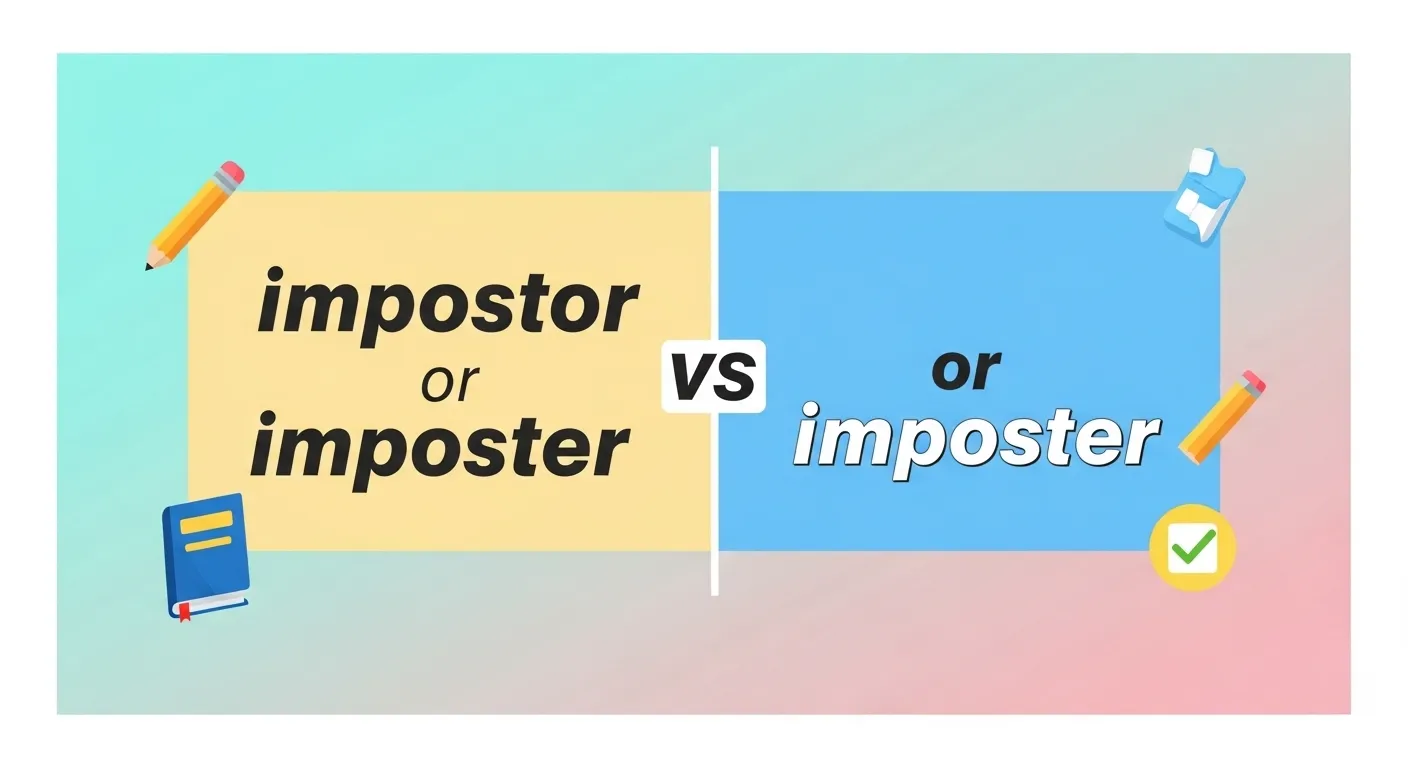
Impostor and imposter are both correct spellings, but their use depends mostly on region and style preference.
Many writers pause when typing this word because both versions look right. Students, and professionals often search this topic to avoid mistakes in articles, emails, or academic writing.
The confusion happens because English spelling changes between British and American forms, and dictionaries sometimes accept more than one variation.
Some people also know the word from psychology terms like “impostor syndrome,” which adds to the uncertainty.
This guide explains the difference in a simple way. You will learn the meaning, origin, usage, examples, common errors, and how to choose the right spelling confidently.
Impostor or Imposter: Quick Answer
Both impostor and imposter mean the same thing: a person who pretends to be someone else in order to deceive or gain advantage.
👉 Impostor : Often seen in formal writing and traditional spelling. Many dictionaries list this as the original form.
👉 Imposter : Common modern variant, especially in American English. Widely accepted and understood.
Simple Examples
- The police caught an impostor pretending to be a doctor.
- She felt like an imposter in her new job.
- The company warned customers about an online impostor scam.
- He worried others would see him as an imposter.
Quick tip: Both are correct, but consistency matters. Choose one spelling and use it throughout your text.
The Origin of Impostor or Imposter
The word comes from Latin and French roots. Understanding its history helps explain why two spellings exist.
Latin Roots
The Latin word imponere means “to impose” or “to place upon.” Over time, this idea linked to deception or trickery. A person who “imposes” on others through false identity became known as an impostor.
French Influence
The term passed into English through Old French words like imposteur. French spelling influenced early English forms, which is why impostor appeared first in historical texts.
Development in English
Early English writers used many spelling variations because spelling rules were not fixed. Over time:
- Impostor became the traditional spelling found in classic dictionaries.
- Imposter emerged later as a phonetic variation that matched common pronunciation patterns.
Language evolves. As pronunciation and regional habits change, alternate spellings appear. That is why both forms are now accepted.
Why Two Spellings Exist
- English absorbs words from many languages.
- Spelling standardization happened slowly.
- American English often simplifies or adapts spellings.
- Writers prefer forms that look natural to them.
Because of these factors, both versions remain valid today.
British English vs American English Spelling
Regional differences play a big role in spelling choices. British English often preserves older forms, while American English sometimes accepts simplified or alternate variants.
General Pattern
- British English: More likely to use traditional spellings.
- American English: Accepts both but often uses phonetic versions.
However, this is not a strict rule. Both forms appear worldwide.
Examples
- British publication: “The impostor posed as a royal advisor.”
- American blog: “She felt like an imposter among experts.”
Comparison Table
| Feature | Impostor | Imposter |
| Traditional form | Yes | No |
| Modern variant | Yes | Yes |
| Common in British usage | Often | Less common |
| Common in American usage | Yes | Very common |
| Academic writing | Frequently used | Also accepted |
| Meaning difference | None | None |
Important note: Dictionaries like Merriam-Webster and Oxford recognize both spellings.
Which Spelling Should You Use?
Choosing the right spelling depends on your audience and writing purpose.
If Your Audience Is American
Both spellings are acceptable. Many writers choose imposter because it feels natural and matches pronunciation.
If Your Audience Is British or Commonwealth
Many editors prefer impostor because it reflects traditional spelling patterns.
For Global Readers
Consistency is key. Select one form and use it throughout your content. Avoid switching between versions in the same article or document.
Academic or Formal Writing
Check style guides or institutional rules. Some organizations recommend one specific spelling for consistency.
Digital Content and Online Writing
Both spellings appear frequently online. Choose the version that aligns with your overall language style.
Common Mistakes with Impostor or Imposter
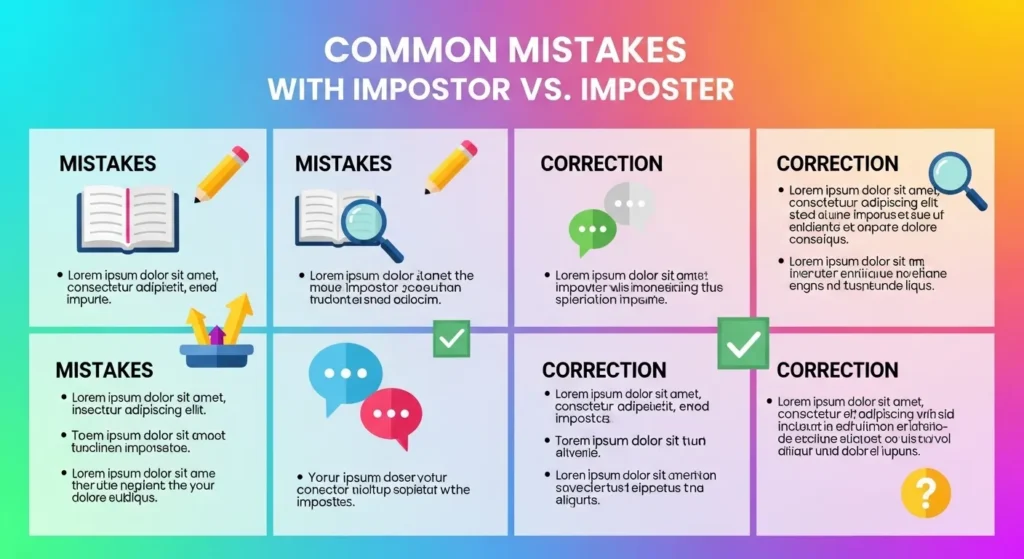
Many errors happen because people assume one version is wrong. Here are frequent mistakes and corrections.
Mistake 1: Thinking Only One Spelling Is Correct
❌ Wrong idea: Only “impostor” is correct.
✅ Truth: Both forms are correct.
Mistake 2: Mixing Spellings in One Document
❌ The impostor entered the room. Later, the imposter escaped.
✅ The impostor entered the room. Later, the impostor escaped.
Consistency improves clarity and professionalism.
Mistake 3: Confusing Meaning with “Imposter Syndrome”
Some believe spelling changes meaning. This is incorrect. Both spellings refer to the same concept, even in psychology phrases.
Mistake 4: Overthinking Pronunciation
The pronunciation stays almost identical regardless of spelling.
Mistake 5: Using Spell Check Without Checking Style
Automatic tools may switch spellings based on language settings. Always review final text.
Impostor or Imposter in Everyday Examples
Seeing real-life usage helps you understand when and how to use each form.
Emails
- “Please verify your identity to avoid dealing with an impostor.”
- “We detected an imposter using fake credentials.”
News Headlines
- “Online impostor scams increase this year.”
- “Police arrest imposter posing as government officer.”
Social Media
- “Feeling like an imposter at my new job today!”
- “Watch out for impostor accounts pretending to be celebrities.”
Formal Writing
- “The study explores impostor syndrome among professionals.”
- “Security measures aim to prevent impostor access.”
Workplace Communication
- “Report any suspected impostor immediately.”
- “Cybersecurity training helps identify imposter threats.”
These examples show that both forms work in many contexts.
Impostor or Imposter: Google Trends & Usage Data
Search behavior shows how language changes over time.
Popularity by Region
- United States: Both spellings appear frequently. “Imposter” sometimes shows slightly higher casual usage.
- United Kingdom: “Impostor” often appears in traditional or academic contexts.
- Canada and Australia: Both forms are used, depending on writer preference.
Influence of Psychology Topics
The phrase “impostor syndrome” gained popularity in psychology and career discussions. Because of this term, many writers lean toward the “impostor” spelling in professional articles.
Online Content Trends
- Blogs and social media show mixed usage.
- Academic publications often favor traditional spelling.
- Marketing content may choose whichever aligns with brand voice.
Language trends change constantly, so both forms remain active.
Comparison Table: Impostor vs Imposter
| Aspect | Impostor | Imposter |
| Meaning | Same | Same |
| Pronunciation | Same | Same |
| Origin | Older spelling | Later variation |
| Formal tone | Often preferred | Accepted |
| Casual tone | Accepted | Common |
| British style | Frequent | Less frequent |
| American style | Common | Very common |
| Dictionary acceptance | Yes | Yes |
FAQs
1. Is impostor or imposter correct?
Both are correct. They have identical meanings and pronunciation.
2. Which spelling is older?
Impostor is the older, traditional spelling derived from earlier language forms.
3. Do the spellings change meaning?
No. The meaning remains the same regardless of spelling.
4. Which spelling appears in psychology terms?
Many writers use “impostor syndrome,” but “imposter syndrome” also appears.
5. Should I use impostor in academic writing?
Many academic sources prefer impostor, but always follow your style guide.
6. Why does spell check change my spelling?
Language settings may favor regional spelling rules.
7. Can I switch between both spellings?
Avoid mixing them within one document. Choose one and stay consistent.
Conclusion
Understanding the difference between impostor or imposter becomes simple once you know that both spellings are correct and share the same meaning. The choice usually depends on tradition, region, and personal or organizational style.
Impostor reflects older linguistic roots and often appears in formal or traditional contexts. Imposter developed later and feels natural to many modern writers, especially in American usage.
Since language evolves through everyday communication, both forms continue to exist side by side without conflict.
When deciding which spelling to use, think about your audience first. Writers addressing British or international academic readers may lean toward impostor, while those writing for casual American audiences may prefer imposter.
The most important rule is consistency. Switching between spellings within one piece can confuse readers and reduce clarity.
Examples from emails, news articles, social platforms, and workplace communication show that both spellings work well in real situations.
By understanding the origin, regional patterns, and common mistakes, you can choose confidently and focus on clear communication rather than worrying about spelling differences.
With practice, selecting the right version becomes quick and natural, helping your writing look polished and professional.
Related More Posts!
Don’ts or Dont’s: Which One Is Correct and Why It Matters

My name is James Whitmore.I am a language research writer. I explore the history and evolution of English words. I write detailed comparisons explaining why spellings change over time and how British and American English diverged. My articles add depth and credibility to grammar comparison topics.