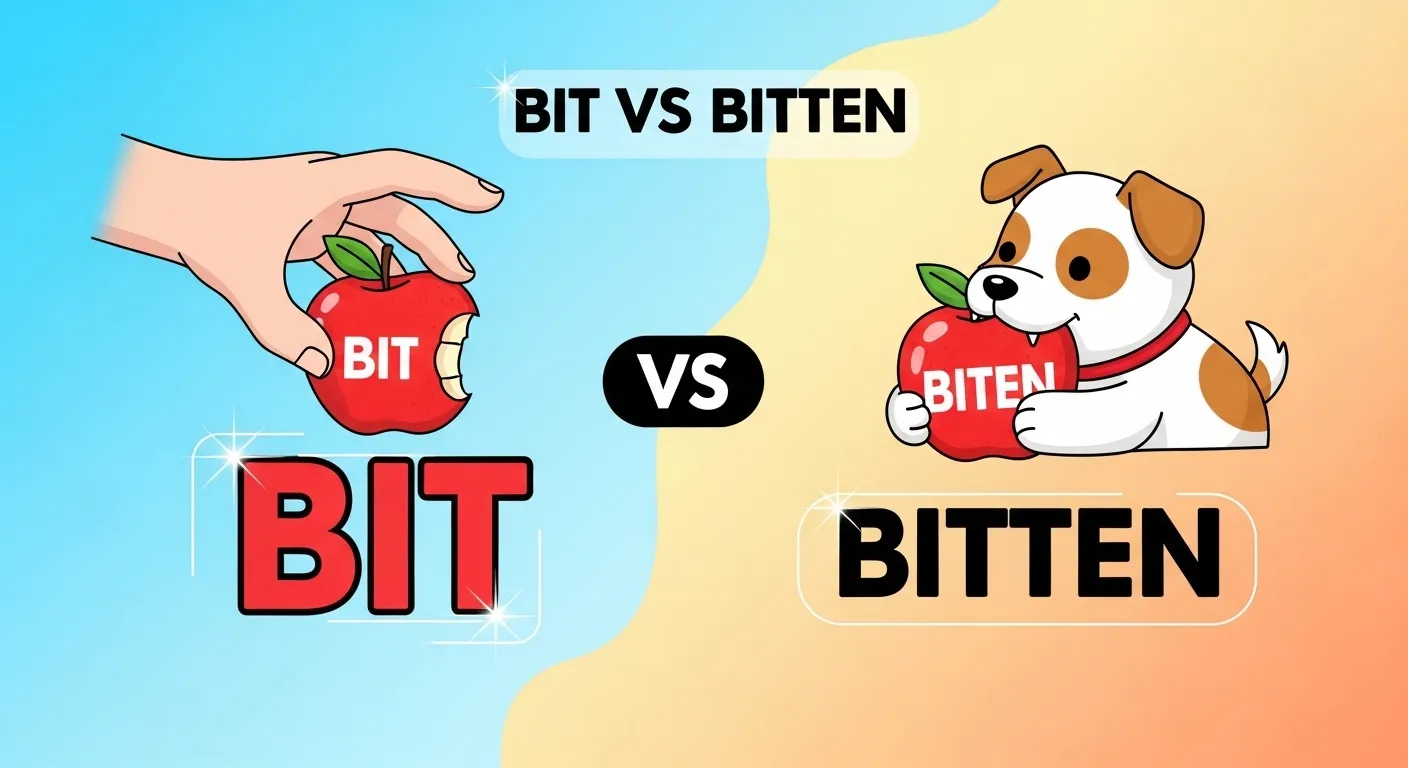
The correct word depends on context. “Bit” is the past simple form of “bite,” while “bitten” is the past participle.
Many learners confuse these two because they look similar. Knowing the difference helps you write accurately.
This guide explains everything about bit and bitten, from their origins to everyday usage. You will learn which form to use in sentences, emails, news, social media, or formal writing.
We will also look at common mistakes and give tips for UK and US English. By the end, you’ll use bit and bitten confidently.
Bit or Bitten: Quick Answer
- Bit → Past simple of bite.
- Example: “I bit the apple yesterday.”
- Example: “I bit the apple yesterday.”
- Bitten → Past participle of bite. Used with auxiliary verbs.
- Example: “I have bitten my tongue.”
- Example: “I have bitten my tongue.”
Tip: Use bit for actions that happened in the past. Use bitten with “have,” “has,” or “had.”
| Form | Usage | Example |
| Bit | Simple past | “He bit the sandwich.” |
| Bitten | Past participle | “She has bitten her lip.” |
The Origin of Bit and Bitten
Both words come from Old English “bītan”, meaning to cut or pierce with teeth.
- Bit developed as the simple past form.
- Bitten came from the past participle pattern in Old English, adding -en to verbs.
The difference exists because English verbs often have irregular past forms. “Bite → bit → bitten” is one of them.
Fun fact: Irregular verbs like bite are tricky because they don’t follow the simple “-ed” past tense rule.
British English vs American English Spelling
Both British and American English use the same forms: bit and bitten. There is no spelling difference here.
| Aspect | British English | American English | Example |
| Simple past | bit | bit | “He bit the sandwich.” |
| Past participle | bitten | bitten | “He has bitten his lip.” |
Note: Unlike words like “learned/learnt,” bit/bitten does not change across regions.
Which Spelling Should You Use?
- Use bit for past actions.
- Use bitten with “have/has/had.”
Audience-based advice:
- US English → bit / bitten (same as UK).
- UK / Commonwealth → bit / bitten (no change).
- Global writing → stick to standard forms.
The key is context, not location.
Common Mistakes with Bit or Bitten
Many learners confuse bit and bitten.
- ❌ “I have bit my tongue.”
✅ “I have bitten my tongue.” - ❌ “He has bit the cake.”
✅ “He has bitten the cake.” - ❌ “I bitten the apple yesterday.”
✅ “I bit the apple yesterday.” - ❌ “She bited the cookie.”
✅ “She bit the cookie.”
Rule:
- Past simple → bit
- Past participle → bitten
Bit or Bitten in Everyday Examples
Emails:
- “I accidentally bit my lip during the meeting.”
News headlines:
- “Man bit by dog recovers quickly.”
- “Snake has bitten five people this week.”
Social media:
- “I bit the donut before taking a picture 🤭”
- “Have you ever been bitten by a mosquito?”
Formal writing:
- “The patient has been bitten by a venomous snake.”
- “He bit into the apple carefully.”
Using the correct form shows professionalism and clarity.
Bit or Bitten: Google Trends & Usage Data
- Most searches come from US, UK, India, and Australia.
- “Bitten” is often searched with phrases like “have bitten” or “bitten by dog.”
- “Bit” is searched more when people write about past events, e.g., “I bit the cake.”
Context matters: People search when they are unsure which form fits grammatically.
| Keyword | Popularity | Example search |
| Bit | High | “I bit the sandwich or bitten?” |
| Bitten | Medium | “Have you been bitten by a dog?” |
Bit vs Bitten Comparison Table
| Form | Type | Auxiliary | Example |
| Bit | Past simple | None | “She bit the apple.” |
| Bitten | Past participle | Have / Has / Had | “I have bitten my tongue.” |
Tip: If you see “have/has/had,” always use bitten.
FAQs About Bit or Bitten
1. Can I say “I have bit it”?
❌ No. Correct: “I have bitten it.”
2. Is “bitten” only for humans?
No. Animals, humans, and objects can all “bite.”
3. Can “bit” be an adjective?
Yes. Example: “A bitten apple sat on the table.”
4. Do Americans use “bitten” less?
No. Both UK and US use it equally in past participle forms.
5. How do I know when to use “bitten”?
If there is have/has/had, use bitten. If not, use bit.
6. Can “bit” describe an object?
Yes. “The bitten cookie was delicious.”
7. Are there any idioms with “bit” or “bitten”?
Yes, e.g., “The bitten apple” or “bit the bullet.”
Conclusion
Choosing between bit and bitten is simple once you know the rules. Bit is past simple; bitten is past participle. Remember to check if there is an auxiliary verb: “have,” “has,” or “had.” This is the main clue.
Both UK and US English use the same forms. Using the wrong word can make your writing look unprofessional
In daily writing, emails, social media posts, or news, the correct usage shows clarity.
Many learners search for this topic because confusing these forms is common. Following the rules ensures accurate grammar.
Next time you describe a bite, you will know If to use bit or bitten instantly. Practice using both forms in small sentences. Soon, it will become automatic.
Related More Posts!
Focused vs Focussed: Easy Guide for English Learners 🌟
Feel or Feal: Which Spelling Is Correct?
Reinforce or Re-Enforce: Which One Is Correct?

I am Sophia Martinez.I am an ESL grammar coach. I specialize in teaching English to non native speakers. My content focuses on commonly confused words like affect vs effect, their vs there, and verb tense comparisons. Sophia writes in a friendly, supportive tone designed to build confidence in learners.