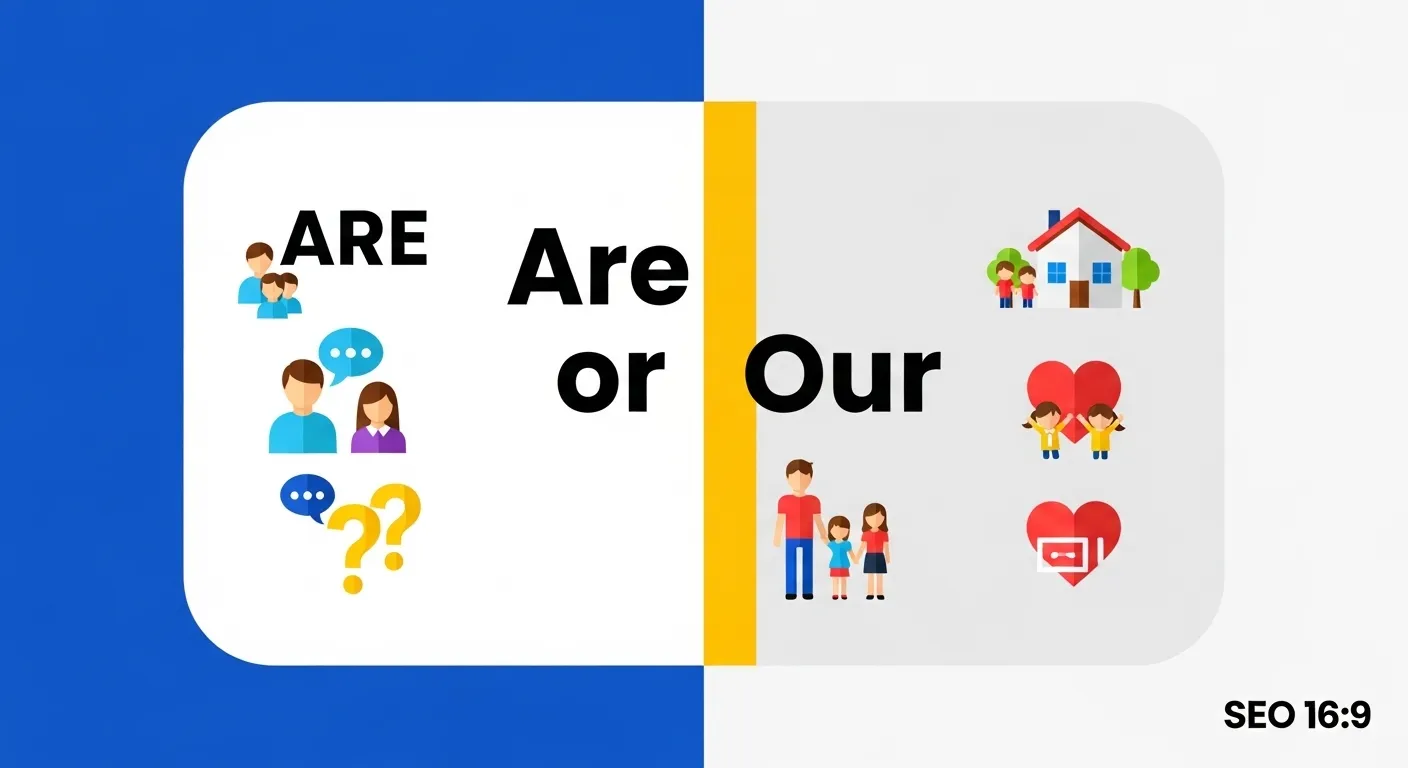
“Are” is a verb used with subjects, and “our” is a possessive word that shows ownership.
Many learners confuse these two because they sound similar when spoken fast. This confusion often causes grammar mistakes in social media posts, and professional communication.
People search for “are or our” because they want quick clarity and easy rules that help them avoid embarrassment. The spelling difference looks small, but the meaning changes completely.
Using the wrong word can make a sentence unclear or incorrect. This guide explains the difference in a simple way.
You will learn meanings, origins, examples, common mistakes, and practical tips so you can use both words with confidence.
Are or Our : Quick Answer
The main difference is simple:
- Are → A form of the verb “to be.” It describes a state, action, or condition.
- Our → A possessive determiner. It shows something belongs to “us.”
Examples:
✅ They are ready.
✅ We are learning English.
✅ This is our house.
✅ Our team won the match.
If you can replace the word with “belonging to us,” then use our. If you need a verb that connects the subject to information, use are.
Quick test:
- Try replacing with “we are.” If it fits, choose are.
- Try replacing with “belonging to us.” If it makes sense, choose our.
The Origin of Are or Our
Understanding word history helps you remember the difference.
Origin of “Are”
The word “are” comes from Old English and Germanic language roots. It is a form of the verb “to be,” which is one of the oldest verbs in English. Over time, English kept many forms of this verb, such as am, is, are, was, and were.
These forms changed based on subject and tense. “Are” became the plural present form used with “you,” “we,” and “they.”
Historical development made English grammar flexible. That is why “are” works with different subjects today.
Origin of “Our”
“Our” comes from Old English possessive forms related to “us.” It developed to show shared ownership or belonging.
Early speakers needed a way to show that something belonged to a group rather than a single person. Over centuries, spelling became standardized as “our.”
Because “are” and “our” evolved from different roots but later sounded similar in speech, confusion increased, especially for learners.
British English vs American English Spelling
Unlike many other words, “are” and “our” do not change spelling between British and American English. The meaning and usage stay the same in both language varieties.
Still, pronunciation may vary slightly depending on accent. Some accents pronounce “our” more like “ow-er,” while others sound closer to “ar.” This sound similarity sometimes causes spelling errors.
Examples:
- British English: We are ready for our meeting.
- American English: We are ready for our meeting.
Same spelling. Same grammar rule.
Comparison Table
| Feature | Are | Our |
| Word type | Verb | Possessive determiner |
| Function | Shows state or condition | Shows ownership |
| Example | They are happy | Our car is new |
| US spelling | Are | Our |
| UK spelling | Are | Our |
| Pronunciation differences | Minor accent changes | Minor accent changes |
Which Spelling Should You Use?
Choosing between “are” and “our” depends only on grammar, not location or audience.
For US readers
Use standard grammar rules. No spelling variation exists. Focus on sentence structure.
For UK and Commonwealth readers
Same rule applies. Grammar determines choice, not regional style.
For global audiences
Keep sentences simple. Many international readers confuse similar sounds. Clear structure helps avoid mistakes.
Quick advice:
- If the word connects the subject to information → choose are.
- If the word shows something belongs to your group → choose our.
Example:
❌ Our going to the park.
✅ We are going to the park.
❌ Are house is big.
✅ Our house is big.
Common Mistakes with Are or Our
Many writers mix these words because they sound alike.
1. Using “our” instead of “are”
❌ We our ready.
✅ We are ready.
Reason: A verb is needed, not ownership.
2. Using “are” instead of “our”
❌ Are team won the game.
✅ Our team won the game.
Reason: The sentence needs a possessive word.
3. Confusing spoken sound
Fast speech makes both words sound similar. Writers then spell based on sound instead of grammar.
4. Missing subject clarity
❌ Are planning a trip.
✅ We are planning a trip.
5. Overthinking spelling
Remember: spelling does not change by country.
Are or Our in Everyday Examples
Seeing real-life examples helps learning.
Emails
- We are pleased to inform you about our new service.
- Our team members are available for support.
News Writing
- Officials are discussing our national policy.
- Experts are studying the impact on our environment.
Social Media
- We are excited about our new project.
- Our followers are amazing.
Formal Writing
- Researchers are analyzing our data carefully.
- Our organization values teamwork.
Casual Conversations
- Are you coming with our group?
- We are meeting at our favorite cafe.
Are or Our: Google Trends & Usage Data
Search interest shows that many people look for help with similar-sounding words. Language learners and students are the main audience. Countries with high English-learning populations often show strong search activity.
Popular regions:
- India
- Pakistan
- Philippines
- United States
- United Kingdom
Contexts where confusion appears:
- School assignments
- Online messaging
- Content writing
- ESL learning
People often search quick comparisons because they want immediate clarity. Short explanations and examples work best.
Comparison Table (Keyword Variations Side by Side)
| Sentence Type | Correct Word | Example |
| Verb form | Are | They are ready |
| Ownership | Our | Our plan works |
| Question form | Are | Are you coming? |
| Group possession | Our | Our family travels |
| Present tense plural | Are | We are learning |
| Shared item | Our | Our project started |
FAQs About Are or Our
1. Why do people confuse “are” and “our”?
They sound similar when spoken quickly. New learners rely on sound instead of grammar rules.
2. Can “are” show ownership?
No. “Are” is only a verb. It never shows possession.
3. Can “our” act like a verb?
No. “Our” only describes ownership or belonging.
4. Is pronunciation the same everywhere?
Not exactly. Accents change sound slightly, but spelling stays the same.
5. How can I remember the difference fast?
Think: Are = action or state. Our = ownership.
6. Are these words interchangeable?
No. Switching them changes meaning and grammar.
7. Is one more formal than the other?
No. Both are standard English words used in all writing styles.
Conclusion
Understanding the difference between “are” and “our” is simple once you focus on grammar function instead of sound.
“Are” is a verb that connects a subject to information. It describes a condition, identity, or action in present tense.
“Our” shows ownership shared by a group. Even though the pronunciation may feel similar, their roles in a sentence are completely different.
Many learners struggle because spoken language moves quickly, but written English depends on structure and meaning.
The best strategy is to pause and check the role of the word. Ask yourself if the sentence needs a verb or a possessive determiner.
Practice using real examples from daily writing like emails, messages, or articles. Over time, your brain will recognize patterns automatically.
Remember that both British and American English follow the same spelling rules, so you only need to focus on grammar accuracy.
Clear usage improves communication and builds confidence in professional and casual writing.
Related More Posts!
Lie or Lye: Meaning, Differences and Complete Grammar Guide✨
Colum or Column: How Should You Use It?
Sympathy or Empathy: What’s the Difference?With In 30 Minutes

My name is James Whitmore.I am a language research writer. I explore the history and evolution of English words. I write detailed comparisons explaining why spellings change over time and how British and American English diverged. My articles add depth and credibility to grammar comparison topics.